One of two Ruffs seen this morning from Lady Ann's Drive.
I have not simply come up to North Norfolk to go birding 24/7 as one has to realise it is a joint holiday that both my wife and myself and therefore, I like to take my wife places that she wants to go to as well. Today, we planned a trip to Wells-next-to-Sea for a nice walk with Scruff and hopefully, a spot of lunch in one of the harbour side Cafe’s. However, the weather was going to be indifferent with strong winds and showers forecast throughout the day. Thankfully, it remained dry throughout our stay at Wells.
Brent Geese were abundant on the Salt marsh.
A Little Grebe swimming in the channel near the sea wall.
Becky and Scruff walking along the footpath leading to the Lifeboat Station.
Becky bought herself a warm hat to wear in one of the local gift shops and then we took a walk north along the harbour up till we got close to the Lifeboat Station. All the time we were walking, I was keeping an eye out on all the bird life which included good numbers of Brent Geese making the most of the fresh marsh within the harbour. The tide was up and almost immediately, I came across a lone Little Grebe on the water and along the shoreline, Curlew, Oystercatchers and Redshank could be seen in search of food.
A couple of Herring Gulls enjoying resting on one of the small boats.
East Hills in the distance. I wonder if anyone goes birding over that side of the harbour?
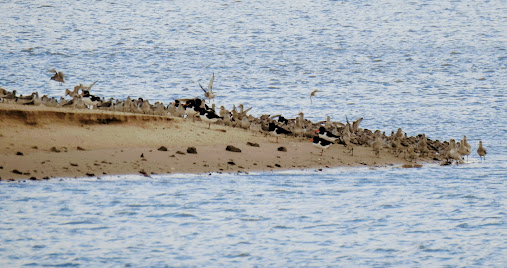
Waders flocking up over East Hills. One of the rotors of the Offshore Wind farm out in the North Sea can be seen behind them.
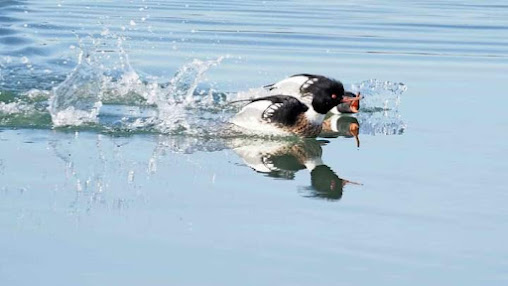
The footpath was a little flooded in places, but that did not put off many dog walkers out for a stroll, despite the freezing cold wind buffeting us. Both Skylark and Meadow Pipits flew over and I was pretty sure that a Goldcrest had flown over the Saltmarsh and landed in the Sueda bushes below us along the shoreline. I was checking out the Salt marsh all the time and I could see skeins of Brent Geese flying over and large flocks of waders also flying over in the distance. It wasn't till we neared the beach at the end of the path that I noticed a sizable group of both Bar-tailed Godwit and Knot resting on the beach with the Oystercatchers. Out on the water, I had to use my camera to identify a pair of distant ducks on the water. They turned out to be a pair of Red-breasted Mergansers bobbing on the now choppy water.
Knot, Bar-tailed Godwit and Oystercatchers coming into land on the beach near the Lifeboat Station.
Occasionally, the sun came out and lit up the Salt marsh and even the wind dropped a little. A wonderful place to be then as the waders and wildfowl were a lot more active. A distant raptor suddenly flew high over the Salt marsh, putting up all the bird life and scattering them everywhere. It was a Red Kite, judging by the wing shape and length of tail. I am really hoping for a Merlin hunting over the Salt marsh, but maybe later this coming week. We both agreed to have a hot drink and something to eat before we left here and so had lunch in Wells Deli, enjoying the views of the harbour in doing so.
The Fieldfare in the field from Lady Ann's Drive.
Wigeon and an Oystercatcher within the fields.
Another photo of my first Ruff of the year.
We planned to go to a Farm shop before heading back to the Cottage, but beforehand, I wanted to check out Lady Anne's Drive for wildfowl and waders. I could not be bothered in paying the parking fee as I was not going to be too long due to the huge rain cloud heading our way. I just parked up and got out of the car and looked firstly east into the fields where there were large flocks of Wigeon and smaller numbers of Teal and Shoveler among them. There were also a few skeins of Geese present, which included Pink-footed, Canada, Grey Lags and a pair of Egyptian Geese either flying or resting within the fields. A lone Fieldfare was showing well, hopping about among an Oystercatcher, Redshank and the Wigeon, which looked quite unusual. Then the rain came.
A Curlew looking rather proud of itself.
A Common Snipe feeding near a small stream in the field.
A Pink-footed Goose flying off over the fields.
Quickly jumping back into the car, I put the wipers on so I could see out of the windscreen and from here, I found my first Ruff of the year, searching for food in the field close by. A second bird, sporting a much whiter head and probably a male bird, was seen minutes later along with a small flock of Common Snipe flew over the same field. The rain eventually abated and I got out of the car and began photographing the birds, most being very co-operative. I could see a Common Buzzard drifting over the fields, again, a large raptor upsetting most of the birds below. Looking over to the west side of the Drive, there were plenty of Wigeon but not a great deal else so I made my way back to the car and off to the Farmhouse. Both Red Kite and Common Buzzard were seen along the way back, while Becky enjoyed looking at the many Piggies in the fields!
Though I was back at the Cottage around 2.30pm, it was still a very eventful day. Becky and I awoke to below freezing temperatures, -3 degrees to be exact and taking Scruff for a walk first thing this morning, I nearly froze with that strong south-westerly wind cutting right through you. Nevertheless, taking our Scruff for his walk, I managed to get up to the east end of the Village, just past St. Andrews & St. Mary’s Church, which was sporting a lovely carpet of Snowdrops, then checked out the countryside to the south where I saw a large flock of Lapwing flying over in the distance. A large flock of Partridge also flew up from the fields but too distant to get a proper ID.
Snowdrops growing outside the Church.
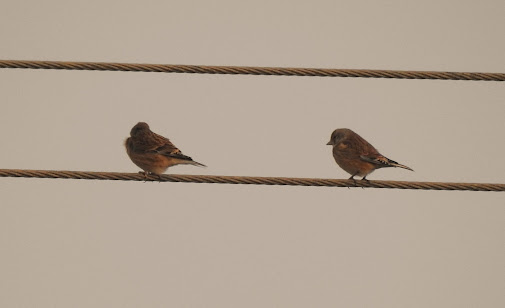
On the walk back, a fairly large flock of passerines was feeding within a dry bit of rough grassland beside the road and though I did not have my binoculars with me, looking through my camera, I could see they were Linnet, Chaffinch, Yellowhammer and a single male Reed Bunting! A Great Spotted Woodpecker was heard to call, but not seen and a male Chaffinch was in full song as we made our way back to the Cottage.
Above, the male Reed Bunting just on the outskirts of the village. Below, a pair of Linnets joined him.
Breakfast was on the agenda and so Becky and I took a drive into the small town of Holt. As we were getting into the car, a pair of female Blackbirds were fighting among themselves and it looked pretty serious too. They honestly looked as though they were fighting to the death, or so it looked, grappling each other's bills or claws, that was until the male birds jumped in to split it up, then they resumed again as we drove off!
Lapwing flying over the fields on the outskirts of the Village.
Not only did we have a nice cooked breakfast in Byfords, but a female Sparrowhawk flew high over the town, putting up all the local Rooks and Jackdaws. We then made our way back to the Cottage (Becky pointed out both a Kestrel and a Common Buzzard whilst driving!) and I got ready to do my first spot of serious birding for the day. My target bird was the adult Red-breasted Goose that was seen yesterday and so I made my way to the Quayside car park at Blakeney. On reaching there, I had to pay a parking fee, but after a lot of buggering around trying to get some change for the machine, it turned out that it was not working anyway! I started to make my way north along the main footpath and was a little disappointed to see so many people walking along it.
Black-tailed Godwit passing overhead by Blakeney Harbour.
The male Peregrine in the Eye Field at Cley Marshes.
Almost immediately, I came across a small flock of Brent Geese out in a nearby field along with some Curlew and a large flock of Brent had taken off from the saltmarsh and headed to the neightbouring fields, but I could not pick out the Red-breasted Goose among them. Earlier today, a female Hen Harrier had flown over the salt-marsh here, but no sign of the bird during my brief time here, though there were several Marsh Harriers over the Salt-marsh and fields and even a Red Kite flew over! I checked my Birdguides App on my mobile phone and it turned out the Goose in question was actually in the Eye Field on Cley Marshes. So, without hesitation, I made my way to the reserve.
Another photo of the obliging male Peregrine in the Eye Field.
Dark-bellied Brent Geese bathing in the only pool within the Eye Field at Cley Marshes.
I have to say, the road leading to the Eye Field was somewhat flooded in places and with all the money spent on these reserves, surely this road could be better constructed for better vehicle use? Driving carefully, I got to the big car park at the end and checked out the small Brent Goose flock present. The bird was nowhere to be seen. A fellow birder sitting in his car told me that the Goose had disappeared back towards Blakeney again and so I decided to wait it out for the bird to return. Meanwhile, I did see a cracking Peregrine hunting over the Eye Field, which eventually landed in the field, showing well. Several Marsh Harriers could be seen quartering the reedbeds over the Marshes to the south and a few Shelduck flew high overhead, heading to the pools.
Cley Beach, with the Halfway House in the background. Though one could walk to Blakeney Point from here, it is such an arduous journey walking miles on shingle. No thanks!
I decided to take a look at the sea, though balancing my scope against that strong, very cold wind, was proving a tad tricky. Mostly Cormorants were passing over the sea and to be honest, very little else, but I did find my first ‘year-tick’ of the day, a drake Common Scoter. The bird was sitting on the choppy sea some 100 yards out and all on its own. A sick bird, perhaps?
The Red-breasted Goose eventually came in to the Brent flock.
After about an hour or so, I made my way back to the car and then noticed that the Brent flock had certainly increased during my absence. A very kind couple of birders let me look through their scope as they excitedly showed me the location of the recently returned Red-breasted Goose and my second ‘year-tick’ of the day was assured.
Film footage of the adult Red-breasted Goose at Cley Marshes.
I got some long distance photos of the bird and after a while, I decided to join the small group of birders by the side of the road and photographed the bird from there, where it was some thirty feet away from the small road. Cracking views were obtained as the bird did not seem perturbed by our presence as it grazed among the Brent Geese. Looking slightly south, something small grabbed my attention and it was a lone Fieldfare hopping about in the grass; arguably the best one I have seen all winter. I did manage to grab some film footage of the bird before I left to make my way back to the Cottage.
The Red-breasted Goose was happy to graze close to the roadside. Surrounded by birders, as soon as the bird lifted its head, you could hear all the shutters of the cameras going off!
This lone Fieldfare was hopping just south of the Geese.
However, before heading back to the Cottage, I popped into Cley Spy, within the village of Glandford, to get some advice about my Swarovski telescope. It seems my 12 year old scope most certainly needs cleaning as the front lens is really worn. The kind shop assistant recommended that they send it back to Swarovski to replace the main front piece of glass and should only take about a fortnight to replace and clean the telescope throughout. It would be cheaper to do this than buy a new scope. I shall bring it back to them later next week.
Such a stunning bird among the Brent.
Checking Birdguides, it looks as though I had dipped on the Iceland Gull that was on Cley Beach today and one of the re-introduction scheme Isle of Wight White-tailed Eagles had been seen just south of Fakenham this afternoon. I wonder what delights this superb area has in store for us tomorrow?
At last, we have arrived at our cottage in Langham, North Norfolk. We are staying in the quaint, little Yew Tree Cottage set in the heart of the small village and thankfully, very close to the pub, The Bluebell Inn. We have a full week here to explore and chill out the delights of North Norfolk and already, there are some exciting birds to be seen here at this location. An adult Red-breasted Goose is nearby at Blakeney Freshmarsh and an Iceland Gull is on the beach at Cley Marshes. A Short-toed Lark will be hot on the menu as well, with a long staying but irregular bird at West Runton.
No.9 Yew Tree Cottage, Langham.
I managed to grab one ‘year-tick’ today when at least two Yellowhammers were flying over our Cottage shortly after our arrival at 4pm. Not a bad start to our trip, but all the Partridges seen in the countryside fields on the way through Norfolk were Red-legged Partridges with at least 5 coveys seen from the roadside. Becky saw a Red Kite flying over the countryside near Fakenham, but I had to make do with a few Common Buzzards and a Kestrel. I did see at least three Red Kites around the M25 along with several Common Buzzards, but no Parakeets this time.While passing RAF Lakenheath, I spotted a Muntjac deer grazing right by the side of the road, but Becky was looking the other way! We are all unpacked now and looking forward to our meal in the Bluebell Inn. Becky wants to go into Holt first thing tomorrow to stock up on supplies and hopefully, some serious birding will begin.
This Double-striped Pug was my first 'macro' moth of 2022 by my moth box this morning.
One of three Common Plume moths in my garden late this afternoon.
This week has been quite mild with daily temperatures just into double figures most days, though mostly overcast. The rest of the week looks to remain the same and with Norfolk knocking on my door tomorrow, I am just hoping that my wife and I get some good weather. We shall see.
Above, a female Goosander on Eyeworth Pond and below, a drake Mandarin posing nicely for the camera on the same pond. Photos by Christine Whiffen.
Yesterday, it was a glorious day with near unbroken sunshine and hardly a breath of wind. This weather brought out my first Hoverfly sighting of the year; though I did not get a great look at it as I was actually working, I was pretty sure it was a Marmalade Hoverfly. I was working in the Bosham area yesterday and while waiting outside the Holy Trinity CHurch at Bosham, a pair of Common Buzzards were circling high overhead in the sunshine. On the way there, I spotted a female Sparrowhawk making a dash between houses in Bedhampton, what looked like a hunting swoop on its potential prey. Also seen yesterday were at least three more Common Buzzards and a Kestrel over Portsdown Hill while driving.
A pair of displaying Red-breasted Mergansers at Hayling Oysterbeds. Photo by Christine Whiffen.
I have noticed a lot of Snowdrops coming out in bloom on my way around Portchester Crematorium and along some roadside verges in the area. Also at Portchester Crematorium, there were good numbers of Buff-tailed Bumblebees on the wing, enjoying the flowering heather near the North Chapel. In West Sussex yesterday, up to 6 Glossy Ibis have been seen around the Marsh Farm area of Pagham Harbour and are regularly roosting now within the Owl Copse along with at least 40 Cattle Egrets. Incredible, just a shame I have not caught up with them yet.
This superb photo of a White-tailed Eagle was taken yesterday near Christchurch, Dorset. Obviously, one of the re-introduction scheme birds from the Isle of Wight; they are certainly spreading out all over the place. The programme, Winter Watch, reported one in the North Norfolk area last week! I do hope it is still there. Photo by David John Faulkner. Many thanks David.
Today, me and my work colleagues did a road trip to Trent Park Cemetery, Barnet, in North London and it was a most enjoyable trip too. Always on the lookout for Ring-necked Parakeets over the M25, this time I was eventually in luck when I spotted a flock of 4 birds flying over the road, a species that was added to my year list. Other notable sightings included up to 6 Red Kites, 6 Common Buzzards and 5 Kestrels from the road, while in the Cemetery itself, a Green Woodpecker, a single Redwing and 2 Goldcrests were seen and another Ring-necked Parakeet was heard only in the nearby woodland.
Check this out. I have actually been recording birds since 1977 and looking back in one of my old Notebooks (way before Computers, etc), exactly 40 years ago yesterday, I was down Farlington Marshes with my birding pal, Geoff Farwell. Though the literature is somewhat brief, look at the birds we saw that day. Hen Harrier, Merlin and Scaup to say the least. It is probably why that Farlington Marshes is still my favourite location and can always throw in a nice surprise or two when down there.
I have actually put the moth box on within my garden tonight. Because of the mild overnight temperatures, I just might get lucky. Today, I have found 3 Common Plume moths near the moth box and earlier this week, there was a Beautiful Plume moth, so there is always a chance of something a bit scarcer?
My moth box is on tonight. Hopefully, I could get a few tomorrow morning?
A pair of Blue Tits came down to feed on my garden feeder.
According to the RSPB, we have lost 38 million birds in the UK over the past 20 years and over 900 million in Europe alone! Global Warming, pollution, intensive farming and shooting are some of the reasons why we have lost so much and all caused by HUMANS! We have been destroying our planet at an alarming rate in the past 100 years and if Coronavirus has taught us anything, we could be next on the destruction list?
House Sparrows, which have suffered a 30% decline over the past 40 years, are doing well around my garden.
The RSPB had over 1 million people putting in their time to record what was within their own gardens last year and so this year, I would not be surprised to see if that record is broken. I, personally, try to get involved every year and there was a surprise in store for me. Today’s temperature was up to 8 degrees between the hours of 11.45am to 12.45pm as I spent an hour in the back garden, enjoying the warm sunshine. I had cleaned the Sunflower heart feeder the night before and put the feeder out this morning, all set for today.
A pair of House Sparrows enjoying the sunflower hearts.
Though the birds were somewhat a bit quiet at time, probably due to one of my neighbours working in their garden or a cat passing by the back of my garden. Still, there were a few birds, notably the House Sparrows and Blue Tits that enjoyed my feeder.
The following birds were recorded in and over the garden this morning:
8 House Sparrow
1 Wood Pigeon
2 Blackbird
2 Blue Tit
1 Starling
1 Greenfinch
1 Goldfinch
1 Collared Dove
4 Herring Gull
1 Black-headed Gull
I saw my first butterfly of the year, a Red Admiral, that was seen flying firstly over my neighbours garden and perched on their guttering to rest in the sunshine. It was later seen flying over my garden and then off to the neighbouring gardens to the south. An Early Bumblebee put in a brief appearance in my garden for all of 10 seconds until flying off into neighbouring gardens. When I was a youngster, none of these insects would have been seen till around April, which goes to show how Global Warming has changed our climate.
The Red Admiral butterfly basking in the morning sunshine on my neighbours guttering.
Low and behold, the Yellow-browed Warbler at Hook-with-Warsash showed well this morning in the bright, near windless, sunshine! Fume! The windy conditions most certainly put the bird off yesterday. Off Church Norton this morning, a Red-necked Grebe, 2 Long-tailed Ducks, 2 Goosanders, 12 Slavonian Grebes were swimming on the calm sea and fly-by Red-throated Divers and Gannets! Birding pal, Geoff Farwell texted me to say that yesterday, he was birding at the Nether Wallop / Broughton area today in north Hampshire. He saw the following birds: Red Kite, Peregrine, 5 Buzzards, 80 Lapwing, 96 Stock Dove, 2,000+ Wood Pigeon, 2 Raven, 730 Black-headed Gulls, 160 Fieldfare, 30 Redwing, 300 Starling and 2 Stonechat.
I found this Beautiful Plume moth outside the kitchen window.
The Peregrine in front of the Tern Hide at Blashford Lakes this afternoon.
A Yellow-browed Warbler had been present for most of the week at a site near Hook-with-Warsash, but our luck wasn't in as there was no sign of the bird in windy conditions early first thing. Andy and I managed to get down to the site, close to the Warsash Maritime Academy, around 9.30am and we eventually found the area in which to search as we came across Graeme Loader yet again! He had already been here for an hour, but there was no sign of the bird as we decided to watch and wait by a sheltered area, some fifty yards from the sea.
The Chiffchaff at Hook-with-Warsash which was sporting a ring.
From here, we were lucky enough to see our first Firecrest of the year, skulking quietly among the Ivy growing on some of the trees. It was heard to call several times deep within cover. There were a few Blue, Great and Long-tailed Tits on show, the latter species is what the Yellow-browed Warbler was mostly being seen with, but, again, the bird did not appear. There was a brief chance when a ‘Phyllosc’ warbler species popped up, but it was a Chiffchaff of which it was also sporting a ring on its left leg. Graeme had earlier seen a pair of Bullfinch, but there was no sign of them for us either.
The sun did come out a few times, lighting up the Forest occasionally.
One of the Ravens flying over Bolderwood.
After a good hour or so, we decided to make tracks and head to the New Forest. My next target species was Hawfinch and Bolderwood was where we were heading. The car park at this site was unbelievably near full, but we managed to squeeze my car in and then slowly make our way to the Holly Clump opposite. The adjacent large green by the car park held a small flock of around 7 Meadow Pipits, with a few Chaffinch and Pied Wagtail along with them. I have seen Hawfinches on this stretch of grass in the past, but no sign of any today. We had no success in finding any Hawfinches among the Holly Trees, but we did see a pair of Ravens flying low overhead and a pair of Bullfinches in one of the trees.
Meadow Pipits, Chaffinch and Pied Wagtail on the green by the car park.
Meadow Pipit.
Marks Ash Wood wasn't too far away and so taking a drive through the woodland, we parked up and took a slow stroll within the woodland. As well as good numbers of Chaffinch within the woods, we did have a nice flock of Brambling in the treetops. They had just flown in and I managed to grab a few photos of the birds, including a nice male bird. A Marsh Tit was notable, seen feeding on a seed head and two Treecreepers were also seen. Despite taking a good walk, again, no Hawfinches were present.
A Marsh Tit within Marks Ash Wood.
A male Brambling in Mark Ash Wood.
After grabbing some lunch from the garage of Blashford, we made our way to the Tern Hide as Birdguides informed me that the adult Ring-billed Gull had turned up in front of the Lapwing Hide at Blashford Lakes. From the Tern Hide, Andy caught sight of his first Peregrine of the year and fortunate for me and the rest of those within the Hide, the male bird landed on a post in front of the Hide. A real cracking individual too. I was somewhat very busy going through the large Gull flocks (mostly Herring, Lesser Black-backed, Black-headed and Common Gulls), but the Ring-billed Gull proved difficult to find. Meanwhile, a female Goosander flew past the Hide and a few Goldeneye were seen on the choppy water. The wind was quite strong here too and the light was not all that great either. A Green Sandpiper flying past the Hide was a bonus and several Egyptian Geese were seen over the west side of Ibsley Water.
Mr Andrew Fisher checking out the woodland.
There were a couple of birders present to my left and one of them gave the shout that the female Red-crested Pochard that had been present a few weeks back, was now in flight and heading west over the lake. I did manage to get onto the bird, though to be honest, it was mostly a silhouette flying away from us and so I had to take the word of this chap. It got better as the same guy then picked up the adult Ring-billed Gull among a small group of Common Gulls and getting onto the bird, I could see the subtle differences between that species and the Common Gull, though viewing the dark ring on the bill proved difficult due to the light conditions. Nevertheless, this was my 3rd ‘year-tick’ of the day and a good one to have on my year list.
What a beauty. The Peregrine perched for a good ten minutes in front of the Tern Hide before flying off north.
Pleased with the Gull, I then decided to call it a day. It was now 3pm and so I said to Andy that it was time to go. Climbing back into the car, we had to head to Ringwood to rejoin the A31 due to the fact that the Ringwood to Fordingbridge was closed to northbound traffic. Why, not a clue, but driving through the Forest home was not an option, unfortunately. Another good day birding and this time next year, I should be hopefully enjoying the delights of North Norfolk.