Sunday, February 25, 2024

A superb day at both Pennington & Farlington Marshes.

Saturday 24th February 2024.


Hurst Point Lighthouse and Castle with the Isle of Wight in the background. It was raining when I took this photo, but when the sun eventually came out, the island reminded me of one of those in the Hebrides.

It was just Geoff Farwell and myself that went birding this morning as our Andy had car troubles and had to stay behind to sort that out. When I left my home this morning, it was clearly evident that there was a heavy frost overnight, so I didn't expect some heavy rain showers when we arrived at our destination this morning. Driving through the New Forest towards Lymington, the heavens really opened and judging by the heavy clouds overhead, it did not bode well for a dry morning's birding. We arrived at the small car park at Pennington Marshes around 9am and thankfully, the rain had stopped for a while.


 Above, Rock Pipits were abundant along the seawall at Pennington Marshes. Below, the drake Scaup on Fishtail Lagoon. The last time I was here, the pools had hardly any water on them and now, most were flooded!


Above and below, this male Marsh Harrier flew across the path leading to the seawall. A good start to the day.

I thought I would go to Pennington Marshes today to catch up with some of the birds I missed when I went up to Norfolk (which now seems like an age ago!).Though I knew the Red-breasted Goose had seemed to have left the area, it didn't stop me checking the many Brent Geese that were still present here, just in case. Today, I picked up 6 more Hampshire ‘year-ticks’ here this morning, with three of them new for the year on my overall total for the year. But it's not all about year ticks, for the birds here most certainly entertained and the variety was superb. As always, Geoff is great company as we made our way to the seawall, enjoying views of passing wildfowl and a few waders overhead.


Above, small numbers of Turnstone walked close to the footpath by the seawall and below, a pair of Mediterranean Gulls flew past overhead.


Above, a sleeping Ruff with a Redshank on Keyhaven pool. Below, a pair of Pied Wagtails, a male Reed Bunting and a Rock Pipit amazingly altogether in one area.

From the sea wall, we headed west first to the lagoons that held good numbers of both waders and wildfowl. A superb male Marsh Harrier drifted east in front of us and headed off over the marshes, scattering a few ducks on the way. The tide was up within the Solent and the sea was very still, which helped pick off any Grebes on the water. At least four Great Crested Grebes were seen and a distant Shag, but I was more than happy when I found our first Slavonian Grebe of the day (my first ‘year-tick’) ; a solitary bird near the fresh marsh. More were to follow later in the afternoon. Among the many Tufted Duck and Shovelers, the long staying male Scaup was present on Fishtail Lagoon and showed very well as it busied itself diving in the shallow water (see film footage). A good number of waders were mixed in with some of the resting wildfowl on the islands, for all the pools were virtually flooded due to high water levels. I found my first ‘Hampshire’ Ruff with Redshank and at least two more were picked out along with good numbers of both Dunlin and Bar-tailed Godwit. Even the main footpath along the sea wall held small numbers of Turnstone that were more than happy searching for food close to where we stood!


Above and below, this Cormorant on Fishtail lagoon caught, tackled and eventually consumed this large Plaice in the rainy weather.


Above, yet another Rock Pipit below the seawall and below, a male Pied Wagtail in the wet conditions.


The drake Scaup on Keyhaven Lagoon.

I checked the Solent thoroughly for anything of note, including the many Brent Geese dabbling around by the Saltmarsh and then I picked out a female Peregrine flying away from us heading west. Also looking west, a distant Great White Egret was sleeping on the edge of Keyhaven Lagoon along with a few Little Egrets. Annoyingly, another huge rain shower came in and so we slowly made our way along the seawall and headed east towards Oxey Marsh. By the edge of the seawall, there were a good few Rock Pipits around and a small flock of three birds also held a male Reed Bunting (several heard singing this morning too) and a pair of Pied Wagtails.


Above, this Curlew was on the seawall until flushed by a Cyclist. Below, the Spotted Redshank on Oxey Marshes showed very well.


Above, one of at least three Greenshank seen today and below, the lone Avocet was nearby on Oxey Marshes.

Nearing Oxey Marshes, something caught my eye out in the Solent and so setting up my scope, it turned out to be a pair of Red-breasted Mergansers. Scanning further east towards the small islands off Normandy Marshes, I found a flock of 15 resting Eiders; mostly drakes and a few females and quickly got Geoff onto the birds. These were my first ‘Hampshire’ birds after seeing one a few weeks ago in Holkham Bay, Norfolk. Sadly, too distant to get a decent photo of these smart birds. As we neared the point by Oxey Marshes, the long staying Spotted Redshank made an appearance (again, my first ‘Hampshire’ bird of the year). The bird was busy feeding and put on a wonderful performance just below us on the main pool (see film footage). There were plenty of Redshanks around the area and then Geoff found a Greenshank that also performed well in front of us along with a lone Avocet.


Above, another photo of the Avocet and below, the Spoonbill flock on Normandy Lagoon.


Above, one of the immature Spoonbills decided to take flight and we think it ended up on one of the islands out in the Solent. Below, a large contingent of Avocets joined the remaining Spoonbills.


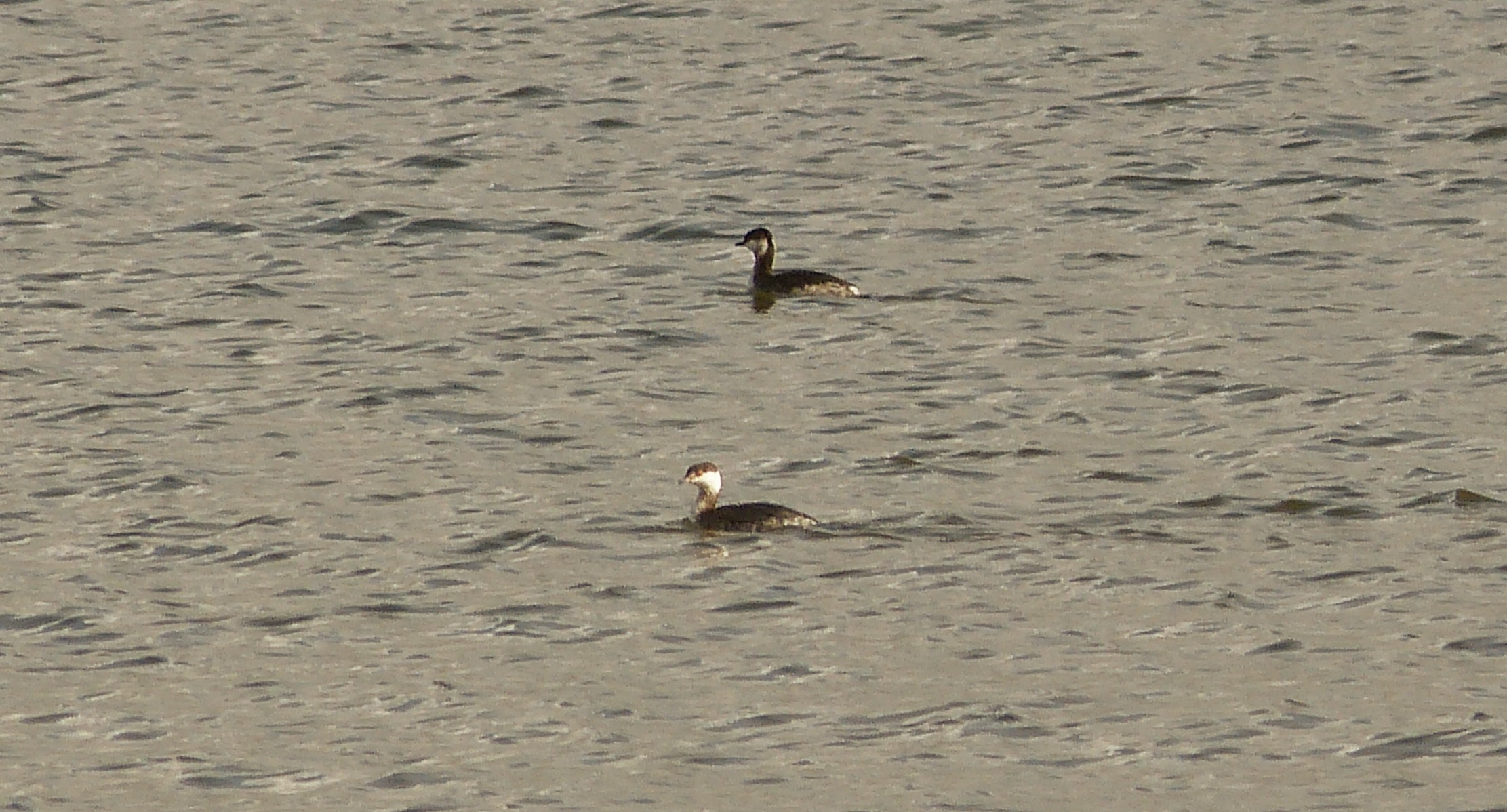
Above and below, the Slavonian Grebes off the seawall. Arguably, the best views of this species I have had in a very long time.

As we passed the creek by Oxey Marshes and followed the footpath to Normandy Marshes where the Spoonbills were seen earlier today, Geoff found an Egyptian Goose among the many Canada Geese on one of the pools (another first for Hampshire this year!). There were plenty of people walking dogs (a lot were unfortunately off their leads), ramblers and Cyclists along the seawall and believe it or not, several birders too! We eventually got to Normandy Marshes and as Geoff said, arguably the best pool we had come to this morning. The 11 Spoonbills showed very well, but remained in a resting flock on one of the islands along with at least 30+ Avocet and good numbers of Dunlin and Ringed Plover.There was a good variety of birds here as I enjoyed my flask of coffee and checked out the birds before us through my scope.


Above, a singing Song Thrush greeted us when we got to Farlington Marshes. Below, a rainbow over Hayling Island to the east as the rain departed in that direction, thank God!


Above, a Little Egret with a Black-headed Gull by the Sluice gate near the seawall at Farlington Marshes. Below, a flock of Shelduck flew into the harbour.

Wildfowl here included Pintail, Shoveler, Tufted Duck, Teal, Wigeon and Mallard, with smaller numbers of Pochard (they seem to be scarce away from Blashford Lakes this year), three Red-breasted Mergansers (a drake and two females) and a lone gorgeous drake Goldeneye. There were plenty of waders present as mentioned earlier, but no Little Stints among the many Dunlin present despite a good search. Several Great Crested Grebes also swam in the pool and a few Little Grebes too to add a bit more variety here. So, after around an hour here, we made our way back to the car. Walking around the seawall past Oxey Marshes, we came across at least two Slavonians Grebes close in on the Solent. These birds were a lot closer than our first sighting earlier this morning and showed very well with a few Great Crested Grebes present. 


Above, a Curlew was on the mudflats in the harbour and a Little Grebe swam towards us by the Viewing Platform on the reserve.


Sunset over Langstone Harbour and Farlington Marshes.

It was 2.30pm when we finally got back to the car park and I wanted to finish the day off with either South Boarhunt for the Little Owls or Farlington Marshes for a possible Bittern. There have been a few Bittern sightings at dusk at the latter site this week and so I made the decision to try my luck there, even though it was hammering down with rain on the way back. We sat in the car within the car park on arrival, waiting for the rain to stop and when it eventually did, it was then a glorious late afternoon right up to dusk. As we walked past the Bushes area, a Song Thrush was in full song on top of a bramble and I caught sight of a Green Woodpecker briefly flying away from us.


Above, the Spotted Redshank on Oxey Marshes searching for food.

We made our way to the viewpoint that looks west over the site and was a little dismayed at how high the water level was on the main lake. Was the Sluice here actually working properly for it certainly doesn't look like it! The tide was now out within the harbour, but the creek here held good numbers of waders and wildfowl, that included several Avocets in the distance. The light now was perfect as I scanned the fields for anything of note. A good scan through the hundreds of Brent Geese in the fields didn't reveal a Red-breasted Goose hiding among them, but I did find a Pale-bellied Brent Goose among them. Raptors were prominent on the reserve that included a pair of Marsh Harriers quartering the main reedbed, which occasionally tussled with the local Buzzards here. A pair of Sparrowhawks were also seen hunting over the reserve along with at least two Kestrels, but there was no sign of any Short-eared Owls during our stay here right up till dusk. A male Stonechat was on a fence post behind the main reedbed, with one of the Common Buzzards looking towards it. Supper? As mentioned before, the light was amazing as the sun slowly set behind us, but sadly, despite watching the main reedbed for any Bitterns, none appeared during our stay. Never mind, for it was really enjoyable being here watching the birds coming into roost. The light was so good that I could see Skylarks running about in the fields through my scope and even a perched Marsh Harrier on a post that was partially hidden by the reeds; things to look back on in the future. It’s little things like that which makes our hobby so fantastic.          


Friday, February 23, 2024

After all the rain, it's back to the Cemy.

Friday 23rd February 2024


One of the many footpaths within the Cemetery. You just never know what could be lurking in the bushes and trees here.

Finally I managed to grab a bit of birding done today when I took my dogs for a walk around my local patch, Highland Road Cemetery. The weather here on the south coast has been absolutely awful over the past few days, with heavy rain, strong winds and even a bit cold too. Typical wintry weather I hear you say, but it has been so mild of late, it was a bit of a shock. This morning, though a tad cold at 8 degrees, it was bright and fairly sunny with the occasional bit of heavy cloud. A breezy westerly wind blew down Pembroke Road this morning, that kept me a bit cooler than I would have liked as I notched up 16 species this morning on my first shift. Three Brent Geese were on Governor’s Green first thing, but they soon moved off; the first time I have seen them this week here. There was nothing out of the ordinary this morning, though there was a decent flock of 7 Pied Wagtails on the Bowling Green yesterday in the grotty weather.

Already, a few summer migrants have been reported nationally that have included a House Martin in Kent, a few Swallows (one seen this morning over Paulsgrove!) and even a Little Ringed Plover. A few Wheatears have also turned up; one in Dorset and another further inland. The big rarity in the UK currently is a Myrtle Warbler in a back garden at Kilwinning, Ayrshire. The bird has been favouring a particular garden and enjoying the nut feeders it seems. Incredible that this American warbler has made it through the winter there. The drake Baikal Teal is still at Greylake RSPB Reserve, Somerset and the drake Ferruginous Duck is still on Posbrook Floods, Titchfield!


Above, a male Blackbird in search for worms in the long grass. Below, Starlings had gathered on the chimney pots, keeping a sharp eye out for the local Sparrowhawk that eventually came their way. 


Above, these Collared Doves are joined by a few Wood Pigeons in their favourite tree; the old Yew tree over in the south-east corner. Below, the Lords & Ladies plants are now getting quite big.


Above, plenty of Robins were heard, but only this one was actually seen. Below, Blue Tits were abundant throughout the Cemetery this morning. 


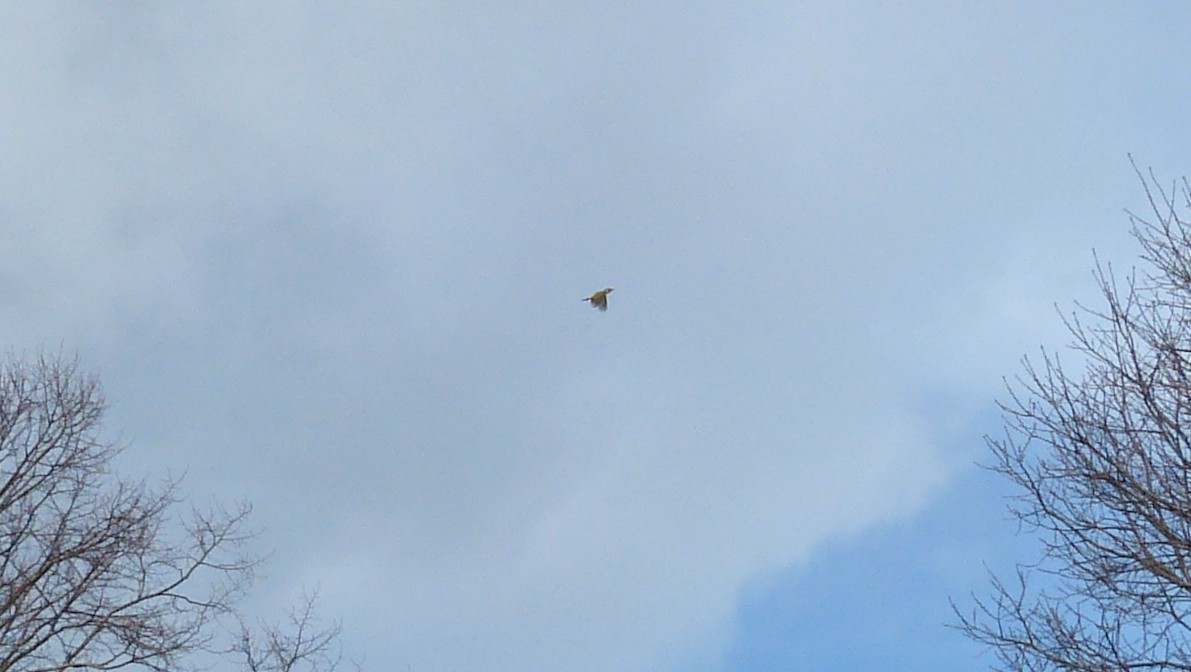
Above, a record shot of the Green Woodpecker flying over and below, I was lucky to get a quick distant photo of the female Sparrowhawk heading north over the houses.


Above, this male Greenfinch was giving its spring call and below, this Wren was seen singing over in the north-east corner.

Back to earth now with my hour long walk around where there were 18 species recorded this morning. The Green Woodpecker eventually put in an appearance when it was flushed by a passing female Sparrowhawk and calling loudly, it flew over the Cemetery and eventually landed in the tall Oak Tree in the north-east corner. The Sparrowhawk never settled and sailed off northbound over the rooftops, followed noisily by a posse of Herring Gulls! It was nice to hear the Greenfinches singing this morning and I wonder when the first Chiffchaff will start singing here?

  • Herring Gull
  • House Sparrow
  • Starling
  • Robin
  • Wren
  • Greenfinch
  • Goldfinch
  • Green Woodpecker
  • Sparrowhawk (female)
  • Carrion Crow
  • Jay
  • Magpie
  • Blackbird
  • Blue Tit
  • Great Tit
  • Wood Pigeon
  • Collared Dove
  • Feral Pigeon


Tuesday, February 20, 2024

Fox on the Rocks!

Tuesday 20th February 2024.


The dog Fox on the rocks by Southsea Castle.

It was a lot colder than I expected it to be this morning as I went about my first shift at Pembroke Road, Old Portsmouth. Thankfully, I had the cold weather gear in the car and this morning, I notched up 18 species in all, which included a flock of 12 Brent Geese plus a single bird; a Cormorant and a singing Dunnock! Nothing, I suppose, that would set the birding world alight, but the ‘day-ticks’ came thick and fast during the first 20 minutes there.


Above, a small flock of Brent Geese flew over the Castle area.


Above and below, a 'sinensis' race of Cormorant heading west low over the Solent. Unfortunately, very little else over the Solent.

Afterwards, before heading off home, I brought my camera and binoculars along with me this morning for I wanted to check out Southsea Castle for a possible Black Redstart and also to see the Purple Sandpipers again. Sadly, there were neither on show today and the weather got worse too with a drizzle in the air making visibility over the Solent very poor. For my efforts, a dog Fox was sat on the rocks staring at me in my high-viz gear, but at least he posed for the camera nicely. The only other birds around here were a couple of Cormorants, a few Black-headed Gulls loafing on the sea and good old Feral Pigeons sat on the Castle Wall. A few Brent Geese flew over, but apart from that, naff all (as Fletch from Porridge would say)!  


Sunday, February 18, 2024

Very Spring-like around the Cemy.

Sunday 18th February 2024.


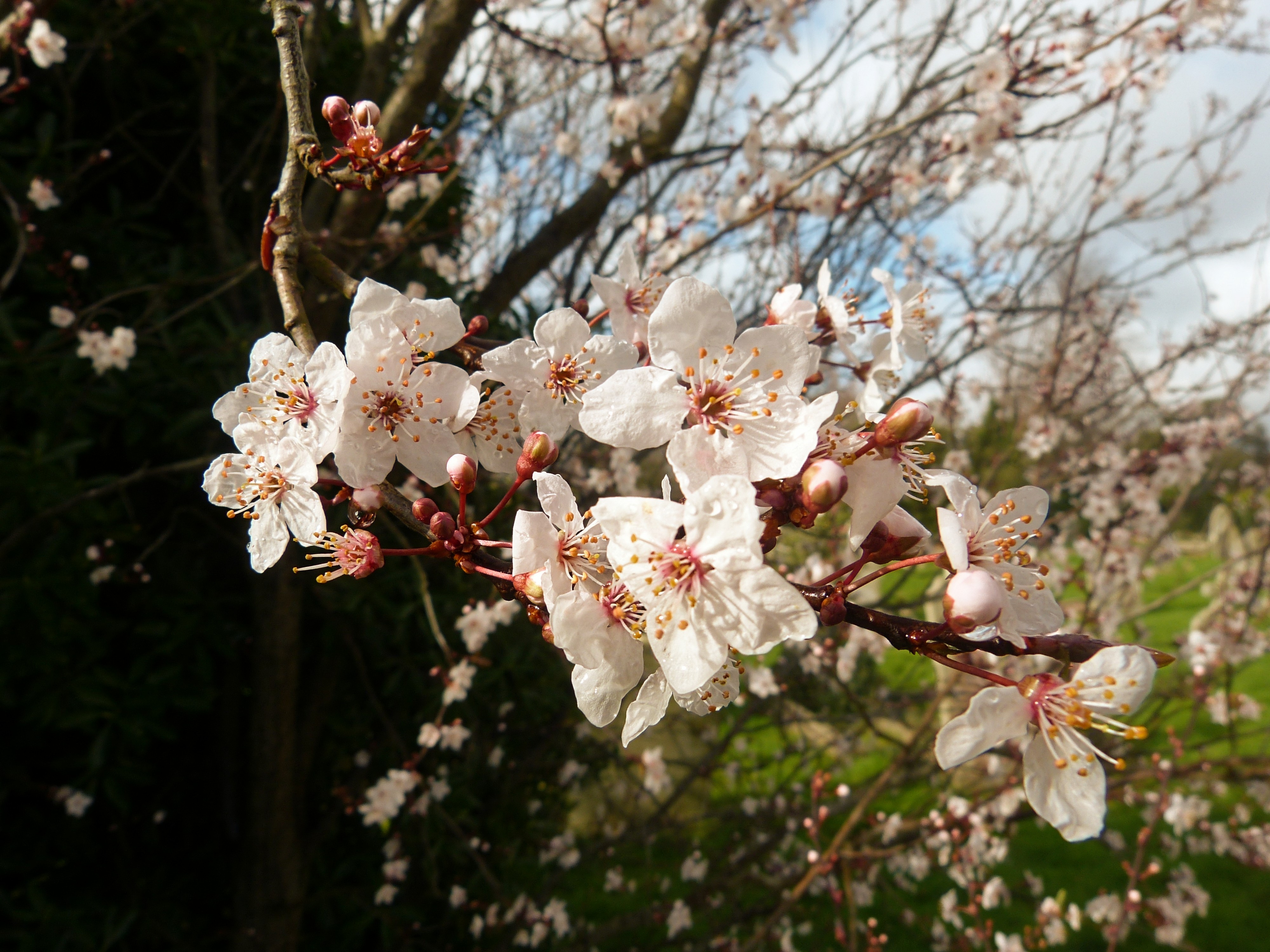
Blossom is now coming out on some of the fruit trees here in the Cemetery. That should soon attract the Bees and Hoverflies.

After a relaxing holiday in North Norfolk, it was back to the hustle and bustle of Portsmouth and once the rain had gone, I took the dogs for a walk around Highland Road Cemetery in the now bright sunshine. Spring is just around the corner and with the daytime temperature around 15 degrees, I was expecting to see some butterflies on the wing and possibly some different flowers in bloom. How right I was.


Above, a Ruby Tiger caterpillar on a gravestone and below, one of several singing Robins in the Cemy this morning.

A total of 18 species were recorded this morning that included the female Green Woodpecker and up to 3 Jays. Even a Mistle Thrush flew over and headed south-west low over the Cemetery; a rare bird here. The female Green Woodpecker was first heard and lucky for me, seen a little later flying up into a tree and showed well in the bright sunshine. Seconds later, a Jay flew past then followed by two more birds.


Above, Blossom adorned some of the Ornamental Cherry Trees and below, my first butterfly of the year, a gorgeous Red Admiral. A little while later, my first Brimstone butterfly of the year was also seen.

I was hoping for my first butterfly of the year and was duly rewarded when I spotted a Red Admiral fluttering low down around the graves and thankfully, it landed on one of them as I managed to grab some photos of this pretty insect. About ten minutes later, I saw my first Brimstone butterfly of the year flying around by the tall Silver Birch near the Holm Oak clump, but it didn't settle and flew off north through the trees. I did see a few Bumblebee’s on the wing today, which were most likely queen Buff-tailed Bumble bees, but none settled on the ground.  Regarding the plant life, my first Sweet Violet and Self-heal plants of the year were found while walking around the perimeter. With a lot of birds singing in the Cemetery today, it most certainly felt like Spring. 


Above, a Wren sunning itself and below, a Self-heal plant, my first of the year, growing in the Cemy. 


Above, me and the dogs stood still as we watched a male Blackbird bathed in one of the many puddles along the footpath. Below, the female Green Woodpecker was eventually spotted in one of the tall trees in the centre of the Cemy.

The following birds were seen or heard within the Cemetery today:

  • Herring Gull
  • Carrion Crow
  • Magpie
  • Jay (3)
  • Wood Pigeon
  • Feral Pigeon
  • Collared Doe
  • Blackbird
  • Mistle Thrush
  • Blue Tit
  • Great Tit
  • Green Woodpecker
  • House Sparrow
  • Starling
  • Robin 
  • Wren
  • Goldfinch
  • Greenfinch

Above, the Mistle Thrush flying south-west low over the Cemetery and below, Sweet Violets growing in the short grass. I think this is the first time I have ever seen them growing here in the Cemetery.


Above, another Ruby Tiger moth caterpillar found on a different gravestone. Below, this Bittern was seen from the Ivy North Hide, Blashford Lakes this morning. Photo by Andy Tew.


On a worrying note, a petition has gone viral regarding the future of Farlington Marshes Nature Reserve. I’m not sure why this happened but it was requesting people to write in to explain why they go to the reserve and what they get out of it by going there. I have been going there since I was about 12 when my Dad introduced me to the place. I even got to see my first Yellow Wagtail on that particular summer's day, a species that does not breed there now, sadly. I am wondering if the Council is wondering about the cost of replacing the sea wall that has to be maintained every other year. What with the sea levels rising, it is another cost to the Council (or should I say the taxpayer). Let's hope common sense prevails and may this wonderful reserve entertain for the rest of my lifetime at least.


PINION-STREAKED SNOUT moth added to my Life List.

Tuesday 15th September 2026. Dawn from my garden. A cooler morning today with some cloud cover and hardly any wind whatsoever. When I was ...