Saturday, February 19, 2022

Goshawk and other goodies at Woolmer Pond.

Saturday 19th February 2022.


Early walk through the woods by Woolmer Pond.

After Storm Eunice gave the south coast a battering yesterday, the aftermath was there for all to see! I, sensibly, remained indoors, though I did pop out once to the shops and nearly had a bin lid hit me in the head! So today nearly never happened, but thankfully, Andy (who was kind of celebrating his 59th birthday) and I made our way north to Woolmer Pond to spend a very good three hours there. The weather forecast did not look good from midday onwards and so made the best of the bright sunshine first thing.

A fluffed up Robin in full song beside the Pond. 


A male Chaffinch in full song north of the Cottage. 

Yes, the rain eventually did come in around 11am, but by then, we had seen some superb birds, mostly over the Woolmer Forest heathland area where we notched up 3 ‘year-ticks’ in a matter of minutes, plus another two more ‘year-ticks’ in the same area a little later! On arrival, we noticed how high the water level was on the Pond and there was a small flock of both Canada Geese and Tufted Duck taking full advantage of it. A little later, a pair of both Shoveler and Mallard also was seen on the water. 

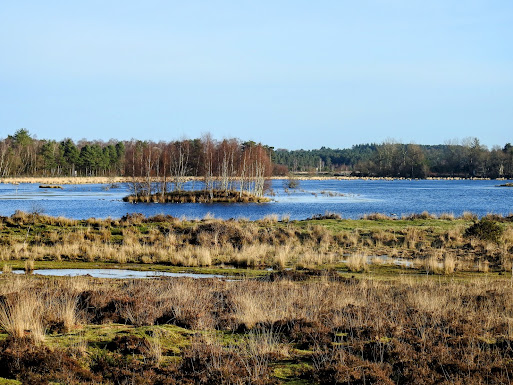
There was a high water level on Woolmer Pond this morning. 

Tufted Duck on the Pond. 

We took a short walk anti-clockwise around the pond, enjoying the sunshine, but there seemed to be very little bird-life, bar a few showy Robins and what I have mentioned already. Therefore, we turned back and made our way to the Cottage area. We had a nice cup of coffee to warm up with (the large puddles were covered in ice!) as I picked out a pair of Red Kites drifting over the Pine trees to the north. A flock of Goldfinch landed in a nearby Birch Tree and a pair of Mistle Thrushes took off from the field to the north. There wasn't too much within the garden which was disappointing, but we did find a skull of a mammal which we believe was a small deer, though I am awaiting a correct ID.

Some of the storm damage from yesterday here at Woolmer Pond. 


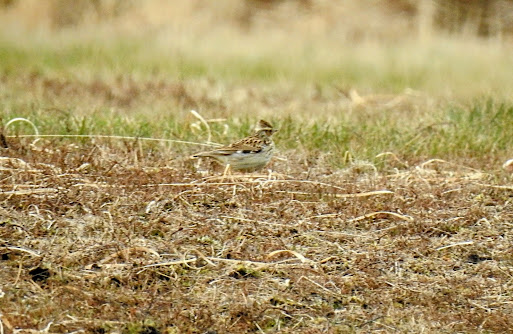
I wanted to check out the heath land to the east of Woolmer Forest and it most certainly paid off when we exited the Forest. Almost immediately, our first Common Crossbills of the year, flew high overhead calling loudly and heading to the Forest. Around half an hour later, probably the same pair flew out of the Forest and headed east. Within seconds, I heard a Woodlark singing but could not locate the bird and then I heard and saw our first singing male Dartford Warbler of the year, seen perched on a small Pine sprig. After grabbing a quick view of the bird it then plopped down out of view and so I went looking for the Woodlark. The bird soon flew up and landed some fifty feet away, with just enough time to grab a few photos before it flew off again.


Our first Woodlark of the year just east of the Forest. 


The male Dartford Warbler on the heath. It sang several times while we there. 

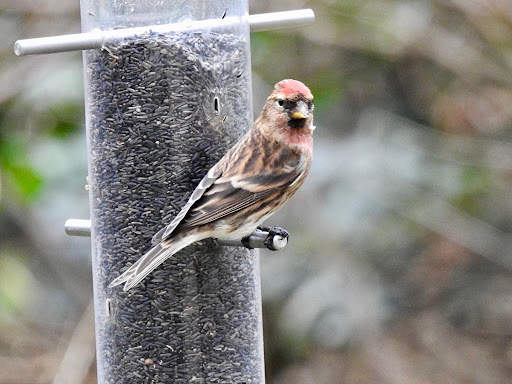
I next wanted to check the heath to the east, where both Hen-harrier and Great Grey Shrike were habiting the area last winter and although there were no sign of these birds, a superb female Goshawk flew in high over the heath and then circled only to fly off below our viewpoint. We got a better view of the heath, but failed to locate the Goshawk again, which was really frustrating, but I was in no doubt it was a Goshawk and our first of the year. We settled down for another cup of coffee and then a Lesser Redpoll, again, our first of the year, flew high over calling in doing so. That was our 5th ‘year-tick’ of the year and it was only 10am and so what did the rest of the morning have in store for us?


A Coal Tit foraging for food by the Forest.


One of several Red Kites seen in the area.

I knew that rain was coming in around midday and the sky was now getting a lot cloudier and so we made our way back to the car. We got to see another pair of Red Kites soaring over the field to the north along with a Common Buzzard that was soaring below them and though the Buzzard drifted north, the Kites made their way south, heading towards Greatham village. Passing the gate near the Cottage, a flock of passerines included Chaffinch, Goldfinch and at least one Reed Bunting among them until they all flew off towards the Cottage garden.Though we checked the Pond for anything new, the only notable sighting was of a Grey Heron flying high over heading west and a small flock of Long-tailed Tits among the Silver Birch trees.


The view of the heath looking east. Here is exactly where the Goshawk was soaring.


The skull we found by the Cottage. 


Alas poor Roe Deer, I knew him well!

Not done with the day, we took a risk in doing a ‘sea-watch’ down at Hayling Bay, but not before treating Andrew with a nice late breakfast from Greggs as a Birthday present! Sadly, the rain did come in and though we managed to watch from the car, looking through the windscreen with the wipers going, we only noticed a lot of both Herring and Black-headed Gulls and a small number of Turnstone flying by the beach. OK, a Gannet or Fulmar was a possibility, but the weather really closed in and so I made the decision to head home, reflecting on yet another good morning's birding. Earlier today, a Black-throated Diver, Great Northern Diver and 2 Slavonian Grebes were seen at the harbour entrance from Black Point.  

Wednesday, February 16, 2022

Midweek update.

Wednesday 16th February 2022.

A Common Plume moth at Portchester Crematorium today. 

Three species of raptor have been seen today while on my travels at work and as per usual, they were all seen over Portsdown Hill that included 2 Common Buzzards, 2 Kestrels and a Red Kite. Though I pointed them out to my work colleagues, I don't expect it will stay long in their memories! While driving over the Hill, I saw up to 6 Skylarks this morning, all hovering low over the roadside fields and another was heard singing high over the grounds of Portchester Crematorium, though I never saw this bird. Yesterday, while working over The Oaks Crematorium, a Grey Wagtail flew high over heading westbound.

A Firecrest in the New Forest. Photo by John Manley.

I had a good check around Portchester Crematorium for moths, but the only one I found was a Common Plume (see photo).  The wait for a Noctuid moth goes on it seems. The weather has been extremely mild this week and even this morning it got up to 14 degrees. However, the weather soon closed in as two big storms are on their way to the UK; Storm Dudley today and on Friday, Storm Eunice. I have got Friday off work and was hoping to do a spot of birding, but judging by what the meteorologists are saying, the winds could get up to 100mph!

A Lesser Redpoll at Blashford Lakes. Photo by John Manley.

The American Robin, Hume’s Leaf Warbler and the Hooded Crow are still in the Eastbourne area according to Birdguides and currently, there are two drake Baikal Teals in the UK! The very long staying Belted Kingfisher is still residing in Lancashire (please come further south!) and who knows what these winds will bring in? I have been keeping an eye on what North Norfolk has had to offer and I noticed that there are FIVE Shorelarks now at Holkham Gap and the Short-toed Lark is still at a place called West Runton. I never made the journey to see this bird when I was up there last week, but I did need more time to potentially get another potential 9 species on my year list.

One of the Shorelarks I saw at Holkham Gap last week.

Sad news came in over the weekend that two of the reintroduced Isle of Wight White-tailed Eagles had been found dead in suspicious circumstances in Dorset. Both were found around hunting estates. Surprise, surprise! Even the local Tory MP made a derisory comment about police should be spending more time catching criminals instead of worrying about wildlife; the sad f***!. I have had the pleasure of seeing one of these birds last year in West Sussex and even the birds on the Isle of Skye many years ago. They belong in our skies and in our lives for all to enjoy.      


Sunday, February 13, 2022

Saturday 12th February 2022.


The Hooded Crow at Polegate showing well by McDonald's.

Fresh from a good sleep overnight, Andy and myself made the trip down to the Eastbourne area for a trio of superb ‘year-ticks’. Over the past week, an American Robin was, it seemed, right at home on a stretch of grass and bushes near a housing estate, pulling in a steady stream of admirers and this morning was no exception. For a supporting cast, there was the Hooded Crow that had taken up residency at the Polegate Services and finally, a Hume’s Leaf Warbler (or Hume’s Yellow-browed Warbler), which was going to be the trickiest bird to see in windy conditions off Bolsover Road.


The Hooded Crow at Polegate Services. 


The American Robin at Eastbourne showing well. 

Our first port of call was for the Hooded Crow at Polegate Services and though the drive was relatively easy, some daft idiot nearly crashed into us when a stretch of the A27 went from two lanes into one. If I never swerved out of the way in time, she would have smashed right into my car, so you can imagine how angry I was. It just goes to show how dangerous the roads are, even when things seem so calm. The weather was looking good with bright sunshine and a little wind, but once that sun hid behind a cloud, it got a lot colder.


The American Robin blending in to the background.

Negotiating the roads to the Polegate Services was easy enough and on arrival, we spotted a group of birders looking at something up in a nearby tree. It was the Hooded Crow and so I pulled over, grabbed my camera and reeled off several photos of this smart bird. I know this sounds a little ‘twitchy’, but there is not a lot of excitement in watching Crows and so we spent all of 5 minutes here and then headed off into Eastbourne. Yes, Hooded Crows are very scarce this far south and thoughts are that it is a European bird that has flown over. There was a McDonalds close by and probably enjoying picking up all the scraps that people leave behind. 


A rear view of the American Robin.

We soon reached the west end of Hill Road and we were lucky enough to find a convenient parking spot in which to make our way to join the main throng of birders. Best behavior was called for in places like this and from what I could see, all the birders (probably about 60+ ) behaved themselves admirably. We did not have to wait too long when the shout went up that the American  Robin was showing again and though not easy at first, it was perched at the base of a dead tree at first, then it popped out and started feeding typically ‘thrush-like’ on the grass. I managed to grab quite a few half-decent photos of the bird before we made our way back to the car. This was a ‘lifer’ for Andy though this was my second in the UK, after the Cornwall bird I saw many years ago.


Another photo of the American Robin. 

Letting others enjoy the American Robin (and many thanks to the local residents for putting up with the deluge of birders present should be mentioned), Andy and I went for our third ‘year-tick’, the very elusive Hume’s Leaf Warbler. The ‘Sat Nav’ took us to Bolsover Road and carefully parking up, we followed some birders to where the bird was seen last. We made one of the ‘Lazee Birders’, James and his son, at the location from where it was last seen and he told me that he hardly got a sighting of it though the bird was frequently calling. It didn't take long for the 50+ birders to scramble over to where the bird was calling, but with the wind coming in off the sea and bright light, it was going to be very difficult to view the bird and so it turned out.


A Red Kite over countryside at The Burgh. 

The bird led everyone a merry dance by flying from one area to another, but with the trees and bushes swaying in the wind and the bird falling silent now and then, it was difficult to locate, but every time the bird started calling (the call was somewhat not as high as the Yellow-browed Warbler), everyone, including us, would rush over to try and view the bird, but even this proved difficult to try and view. I got around three views of the bird, the last of which was the best one when I spotted it coming out of cover in some vegetation. It was damn cold here too and so after 45 minutes or so, we made our way back to the car. I had a  quick check on Bird guides for anything else to go for, but it was quiet in the area and so I made a decision to go to Burpham in West Sussex for potentially more ‘year-ticks’.


Andy enjoying the view up at The Burgh.

Sadly, the Bewick Swans were not showing in the fields west of the Church, but a pair of Little Egrets were seen walking around the sheep. We did see a few Mute Swans in the area and a few distant Swans, but without my scope, there was really no telling what species they were. We parked up by the ‘triangle’ and took a slow  walk up Peppering Lane, enjoying the many raptors on show this afternoon. The main species seen were Red Kites, which seemed to be everywhere (one stretch of sky held 5 birds at one stage) along with the Common Buzzards, they all put on a good spectacle. We were hoping for Hen-Harrier or Merlin, but we were not to be lucky on those species. At least two female Sparrowhawks were also seen along with at least 4 Kestrels, but best of all was a male Peregrine that flew high south and even took a stoop at a Common Buzzard below it! I told Andy that young Buzzards get killed by Peregrines should the youngsters stray into a Peregrine's territory.


A Common Buzzard perched on a distant fence.

There was surprisingly not a great deal else to be seen, with very few passerines around; though we did see a few Reed Buntings, three Pied Wagtails in a sheep field, a flock of Starlings  and the occasional Chaffinch. The area was good for Grey Partridge but apart from a very distant bird, which I think was one judging by the colour, but it was too distant to be certain. Andy spotted a Red-legged Partridge from the car as we were leaving. Large Gull flocks drifted out of the valleys heading south and most likely were to make their way to the harbours to the south after feeding out in the countryside. Even the regular Corn Buntings did not show today either, which was disappointing, but I am sure another trip here later in the year will reveal one or two. It was 3pm by the time we left here and it was certainly getting colder and so made our way back home with three very good ‘year-ticks’ under my belt.


Another Red Kite drifting high overhead.

The trip back was not without incident either as one dangerous driving dickhead got far too close to my car on the A27. I am seriously considering putting cameras in both my cars as the level of dangerous driving on the roads now is getting ridiculous. Thankfully, Andy took the registration plate of the idiot on the A27 and so we shall see what the Police will do there. I will not hold my breath on this one. I really do not want to write about incidents like this, but it is getting more common on our roads and with the new Highway Code laws that have come in, I honestly think the world has gone mad.   

Thursday, February 10, 2022

Spoonbills over Titchwell RSPB Reserve.

Thursday 10th February 2022.


The pair of Spoonbills flying west over the reserve.

It's the penultimate day of our trip to North Norfolk and where else than to take a drive to Titchwell RSPB Reserve, the flagship of the RSPB, to virtually round off an excellent week's birding. I even rounded the trip off with another ‘year-tick’ when I spotted a pair of Spoonbills flying high over the reserve, heading west. I really didn't think it was about spotting as many ‘year- ticks’ today, but more of really enjoying being at a wonderful place enjoying the thing I love most in life. With a really bright day with lots of sunshine, I really made the most of  the following three hours there.


This male Goldcrest was just a few feet from where I stood in the small stretch of woodland.

Snowdrops brightening up the woodland floor.

Sometimes, when i spot something really good, I do like to show people what I have found and when I just happened to turn round to view the reserve from the Beach, I saw the two Spoonbills flying over and told the nearest birders to me that such a superb bird should be making their way across the reserve. They even gave me a thumbs up to say they saw the birds, which really made my day. Then I got chatting to a single lady, sitting on a bench out of the wind, overlooking the reserve. She said, though there were few birds currently showing, she just enjoyed waiting for birds to arrive, rather than go looking for them. She even offered me a seat next to her, but I told her that I was making my way back home, but we had a nice chat nonetheless. If I had the time, I most certainly would've spent some time on that bench. She was a bit of a novice, but I was willing to help identify the birds for her; but time was against me and so I said my goodbyes.


Grey Lag Geese flying over the Salt Marsh to the west of the reserve.  


I was again just a few feet away from this exploring Wren in the small woodland.

The reserve has changed a bit from the last time I was here a few years back. More Marsh management has taken place here for the benefit of the birds and even the front entrance of the reserve has had a bit of a face lift, with a reception area to show your membership card to access the reserve, instead of leaving your card on your dashboard within your car. Good PR? I'll let you decide that. The cafeteria is still there, offering some lovely hot food and drink at quite high prices, but the money goes towards looking after the reserve. Then it's worth it. Remember though, the RSPB, though doing some fantastic work, is a Business and businesses have to make money to survive.


The Island Hide in the foreground and the Parinder Hide in the background.


Bar-tailed Godwit and Oystercatchers on the Fresh Marsh.  


Looking south towards the Island Hide.

Back to the birds and my sightings. The bit of woodland through the car park towards the Shop held some very obliging Goldcrests and Wrens, showing down to just a few feet and with small numbers of Long-tailed Tits balancing on tiny twigs above me, there is always something to look at here. No Redpolls, a species I was hoping might be in the Alders above me, were seen, but plenty of Chaffinches, with some singing birds too.


Several Redshank showed well close to the main footpath.


A pair of Reed Buntings by the main footpath.

There were also plenty of Geese on the reserve, that included Brent, Grey Lag and a few Egyptian and wildfowl present included Gadwall, Teal, Mallard, Shoveler and a few Pintail. Large numbers of Wigeon were at the east end of the reserve with many more out in the fresh marsh to the west. Waders were roosting out on the fresh marsh that included large numbers of Bar-tailed Godwit, with smaller numbers of Redshank, Dunlin and Avocet and though I did not venture into the superb Hides today, I enjoyed taking a slow ramble along the main footpath to the beach. The reedbeds were patrolled by at least 5 different Marsh Harriers, with several more flying over the Salt marsh to the west, but I could not find any Hen-harriers today. A pair of Reed Buntings showed well by the footpath as did several Meadow Pipits, but little else of note there. 


Bar-tailed Godwit and Oystercatcher on the Fresh Marsh.

From the beach, the sea held at least 8 Eiders, including 7 drakes and a female; 4+ Great Crested Grebes and a pair of Goldeneye on the choppy water. Sadly, not a great deal else apart from Oystercatchers, Sanderling and a few Barwits flying through. The Spoonbills were a real bonus today, always great to see something unexpected, but though the reserve was fairly quiet, it was delightful to be here again.


The view from the beach. The Wind farm way out in the North Sea was clearly visible as was the 'Helter Skelter' at Skegness, Lincolnshire through my scope, which was just left of the Wind farm! 

I dropped into Cley Spy to drop off my telescope to be mended, which I am looking to be without for at least 8 weeks. I got back to the Cottage and then watched a beautiful Red Kite sail low over the houses to the east. Wow! The light was superb, lighting up all the birds colourful plumage as it twisted its wings and tail to guide itself south over the countryside. Then a pair of Yellowhammers flew over to round off my day's birding. Tonight, Becky and I went to dinner in Holt and on the way there, not only a Hare ran across the road and into a neigbouring field (thank God our car has good brakes!), but a Barn Owl was seen briefly hunting by the roadside.


Wednesday, February 9, 2022

Finally got the Shorelarks at Holkham Gap.

Wednesday 9th February 2022.


The Shorelarks put on a superb show this morning on the west side of Holkham Gap.

News materialised on my Bird Guide App that the Shorelarks had returned to Holkham Gap, this time on the west side, but finding the birds was not going to be easy. I did get some ideas from a couple of birders I passed by the reserve entrance, but the beach itself is a big area, but thankfully, there were many birders present this morning to give a helping hand. The drive there was looking miserable with a big bank of dark clouds coming in and by the time I got to Lady Anne's Drive, drizzle had begun to fall.


A Curlew feeding in the fields to the east of the Drive.


Spot the Meadow Pipit? This Grey Lag Goose and Lapwing are looking the wrong way!

The rain did not bode well, but it didn't last long as I quickly checked the fields of anything I could take photos of. There were some obliging Curlew, Oystercatchers, Lapwing and Wigeon to pose for me and good numbers of Meadow Pipits were also within the field. Good numbers of both Geese and wildfowl were within the fields again as well as large numbers of Lapwing, with a sprinkling of Redshank enjoying the small pools. A few Marsh Harriers and Common Buzzards were seen over the fields, but no Red Kites were seen this morning. On the east side, the Chinese Water Deer was grazing in the same place as yesterday and on the west side, at least one Hare was seen.


More photos of the delightful Shorelarks.


Walking along the footpath leading to the Hides, I took the boardwalk to the beach and was a little dismayed to see a couple of guys with three large dogs off their leads heading the same way. Thankfully, they branched off right as I made my way to the beach. Now, where were the Larks? A pair of Skylarks flew overhead and as I rounded one large Sand dune, I realised that I was looking in the wrong place. I needed to be walking further west along the beach and eventually, I picked up a couple of birders in the distance checking out something on the sand. Another birder walking his dog, kindly told me that the Shorelarks were just a little further to the west and so joining the other birders, I finally caught up with the four gorgeous Shorelarks. 


The Shorelarks on the beach on Holkham Gap this morning.

They soon flew off, but thankfully, they flew right past me and landed some 50 yards away behind me and so retracing my steps, I got as close as I dared and managed to grab quite a few reasonable photos of the birds. There was a young chap, armed with a long lens camera laying on his front in the sand earlier and now was soaking from the wet sand. Out of politeness, he asked me if he could get close to the birds again to take some awesome photos. How could I refuse? I am glad he moved carefully and slowly and got into position laying on his front and photographed the birds to his heart's content!


The two Grey Partridge with a Red-legged Partridge checking out the Wigeon. 


This Little Grebe was with two others on a small pool by the footpath through the woodland.

I decided to make my way back to the car, so I rounded the birds and took a few more photos. With that, I heard something calling close to my feet and it was a pair of Sanderling some five feet away from me! I know that they can be confiding, but this close? I was just about to take a photo, but they flew off. Grumble! When I reached the boardwalk, I heard  the distinctive call of a Snow Buntings and sure enough, a flock of at least 9 birds flew over the beach and down onto the Salt marsh. Well, that rounded off a good trip here to the beach.


I couldn't resist a photo of the shells on the beach at Holkham. Thousands of Razor Shells, Whelks, Cockles and Clams could be found on the sand.


The Boardwalk leading to the beach.

Back at the Centre and main entrance, the pair of Grey Partridge that were present yesterday, were now joined by a Red-legged Partridge, of which attracted an appreciative crowd of onlookers. A Great White Egret flapped ever so slowly across the fields and eventually landed well to the east. There was a report of 4 Spoonbills in front of the Joe Jordan Hide, but despite a good search over the fields to the east, there was no sign of the birds. The Shorelarks now put me on 140 species for the year and seeing it is still early February, could I be in for a bumper year? We shall see. The American Robin was showing well again this morning and I did see some film footage of the bird on WhatsApp this afternoon and it looks quite stunning. 


The beach at Holkham Gap looking east.

Later this afternoon, Becky and I took a drive into Holt again and on the way there, a Cattle Egret was seen flying high over the main road near Letheringsett.  


SULPHUR PEARL moth added to my Moth Life List.

 Monday 3 rd August 2026. This SULPHUR PEARL   moth was a 'lifer' for me, which was found on the Church window of St. Margaret'...