Looking west from the east side of the Cemy towards the Mausoleum.
Though I never put my Moth Box on last night, I wanted to have something to write about on my blog for the first day of September (officially the first day of Autumn!); so I took the dogs for a walk around Highland Road Cemetery. In fact, walking around the Cemy at 8am this morning, there was plenty to look at including a few surprises. The easterly wind was still blowing, though gently over the Cemetery, but this could spell a lot of migrants from northern Europe arriving in the UK. We shall see. The weather was nice too with warm, bright sunshine and a bit of high cloud coming in from the south-east.
Above and below, the Grey Heron flying over Southsea.
Above, one of the two Chiffchaffs showed well in the south-east corner and below, this tatty looking juvenile Blackbird showed well on a gravestone nearby.
It started to actually liven up with birds when I saw a Grey Heron about 20 minutes in, flying west high over Southsea. The bird eventually disappeared over the rooftops but not before grabbing a few photos. The large bushes area in the south-east corner held a showy calling Chiffchaff, withanother heard nearby, but little else apart from a Small White butterfly landing on the brambles here The Green Woodpecker was heard but not seen; but I assume it was the adult bird calling? I managed to get up to 16 species here this morning, with all the common birds seen along with a few uncommon birds here. A Grey Wagtail flew north low over the Cemetery, but too quick for a photo. I also got my first two moths of the month with a Vapourer Moth flying over the Cemetery and earlier today, a Vine’s Rustic moth was fluttering about on my garden patio.
In the centre of the Cemetery, there were at least four Robins hopping around close to one another.
The birds recorded in the Cemy included the following:
Great Tit
Blue Tit
Grey Heron
Green Woodpecker
Blackbird
Herring Gull
Wood Pigeon
Feral Pigeon
Collared Dove
Chiffchaff
Goldfinch
Grey Wagtail
Carrion Crow
Magpie
Starling
House Sparrow
In Hampshire, this morning, a Curlew Sandpiper and a Little Stint was on Fishtail Lagoon on Pennington Marshes and a Black Tern flew past Hill Head this morning. Probably more to follow.
Above and below, a juvenile White-winged Black Tern at Dungeness. Matt & Emma Parkes took a trip to Kent yesterday to see this 'lifer' for them. Photo by Emma Parkes.
Another cracking days birding with the lads (Geoff Farwell & Andy Fisher) where we kicked off the day with the Moths then onto Old Winchester Hill for possible migrants and then down south to the Paddocks at Northney for the Flycatchers. We even had a last gasp look at the islands within Langstone Harbour for the Osprey, but to Andy’s dismay, there was no sign. There were no new moths for the year at both Andy’s or my Moth Box, but we did have two new butterfly species for the year at Old Winchester Hill and over at the Paddocks on Northney, I finally caught up with a Pied Flycatcher. The weather was a bit indifferent throughout the day with a breezy north-easterly blowing and quite strong at times too, especially over Old Winchester Hill; but it remained dry throughout the day and so great sightings kept us thoroughly entertained throughout the day.
My first Dusky Thorn moth in my garden this year. I had seen one earlier in the month in Devon.
My Moth Box:
Though there were no new moths for the year this morning at my Moth Box, I still had my second Lesser Yellow Underwing, Dusky Thorn and Flounced Rustic for the year, which were nice looking moths. Up to 57 moths of 29 species were recorded today and it is nice to see the Autumn moths now coming through which, hopefully, might bring in some immigrant moths over the next few months. I have been looking closely at some of the exciting moths turning up in Southern England and fingers crossed, they just might pay a visit to my little garden in Southsea?
This was my second Flounced Rustic moth of the year.
The moths present this morning included the following:
MACRO MOTHS:
Brimstone Moth
Double-striped Pug
Canary-shouldered Thorn
Dusky Thorn
Small Dusty Wave 3
Marbled Beauty 2
Vine’s Rustic 5
Shuttle-shaped Dart
Small Ranunculus
Square-spot Rustic 5
Flounced Rustic
Lime-speck Pug 2
Angle Shades 2
Garden Carpet 2
Bright-line Brown-eye 2
Willow Beauty 3
Garden Tiger
Large Yellow Underwing
Lesser Yellow Underwing
Pale Mottled Willow 3
MACRO MOTHS:
Dark-spotted Moss-moth
Chevron Grass-moth
Rusty-dot Pearl 2
Common Plume 8
Garden Pebble
Ruddy Streak 2
Beautiful Plume
Apple Leaf Miner
Light Brown Apple Moth
While checking the Moth Box, I heard a Yellow Wagtail fly high overhead heading east, but I failed to see the bird in the early morning sky. I should be hearing these quite regularly now as the weeks go on. Over at Andy’s house, there were a total of 37 moths of 17 species. Among these, there was my second Snout moth of the year among a nice variety of moths.
The moths recorded in Andy’s garden this morning included the following:
MACRO MOTHS:
Brimstone Moth 4
Double-striped Pug
Willow Beauty 4
Square-spot Rustic 3
Garden Carpet 3
White-point
Light Emerald
Setaceous Hebrew Character 4
Vine’s Rustic 8
Snout
Lesser Broad-bordered Yellow Underwing
Large Yellow Underwing
MACRO MOTHS:
Rusty-dot Pearl
Common Plume
Narrow-winged Grey
Dark-strawberry Tortrix
Chevron Grass-moth
Such an amazing view you have over the countryside looking west from the Hill. How many migrant birds must be within this area of the countryside?
Old Winchester Hill
We arrived at the car park at Old Winchester Hill around 9am and on arrival, we were obviously one of the first ones here. The ‘Hill’ is a hotspot for migrant passerines at this time of year and hopefully for us, we could be in for a treat…….fingers crossed. In fact, it didn't take too long to get to grips with a lot of small birds flitting about near the slope overlooking the Fort and the beautiful countryside to the west as we set about identifying the birds here. A large group of Goldfinches, probably 60+, were flitting about around the small brambles and fence line, with many being juveniles. I picked out a Redstart perched on the Pines below, but it didn't linger enough for the guys to pick up as it flew off behind the Pines. Walking slowly along the footpath by the fence line, a Green Woodpecker was flying away from us, but would land briefly then take off again until flying off strongly south.
Above, a pair of juvenile Cormorants circling high overhead was most unexpected and another was subsequently seen on the way back to the car park. Below, several large flocks of Goldfinch congregated on top of the Hill.
Above, one of several Ravens passing by us from one of the benches overlooking the Fort. Below, this Dark Bush-cricket showed very well for us near the reserve entrance.
Sitting down on one of the ‘comfy’ benches (all benches are comfy according to Mr Fisher!), we had a quick drink and watched a mixed flock of both Swallows and House Martins going over. I caught a glimpse of a possible Grasshopper Warbler flying past usbut it was too quick and disappeared behind the bushes. More Goldfinch flocks flew over and a few Chiffchaffs darted about below over the slope as did a lone Common Whitethroat. A Bullfinch flew over our heads, heading north and more Hirundines poured through. Things were looking good. Looking towards the Fort area, the distinctive shape of a Red Kite gracefully flew low over the Hill and Geoff saw one much lower down over the Pines to kick off our raptor sightings.
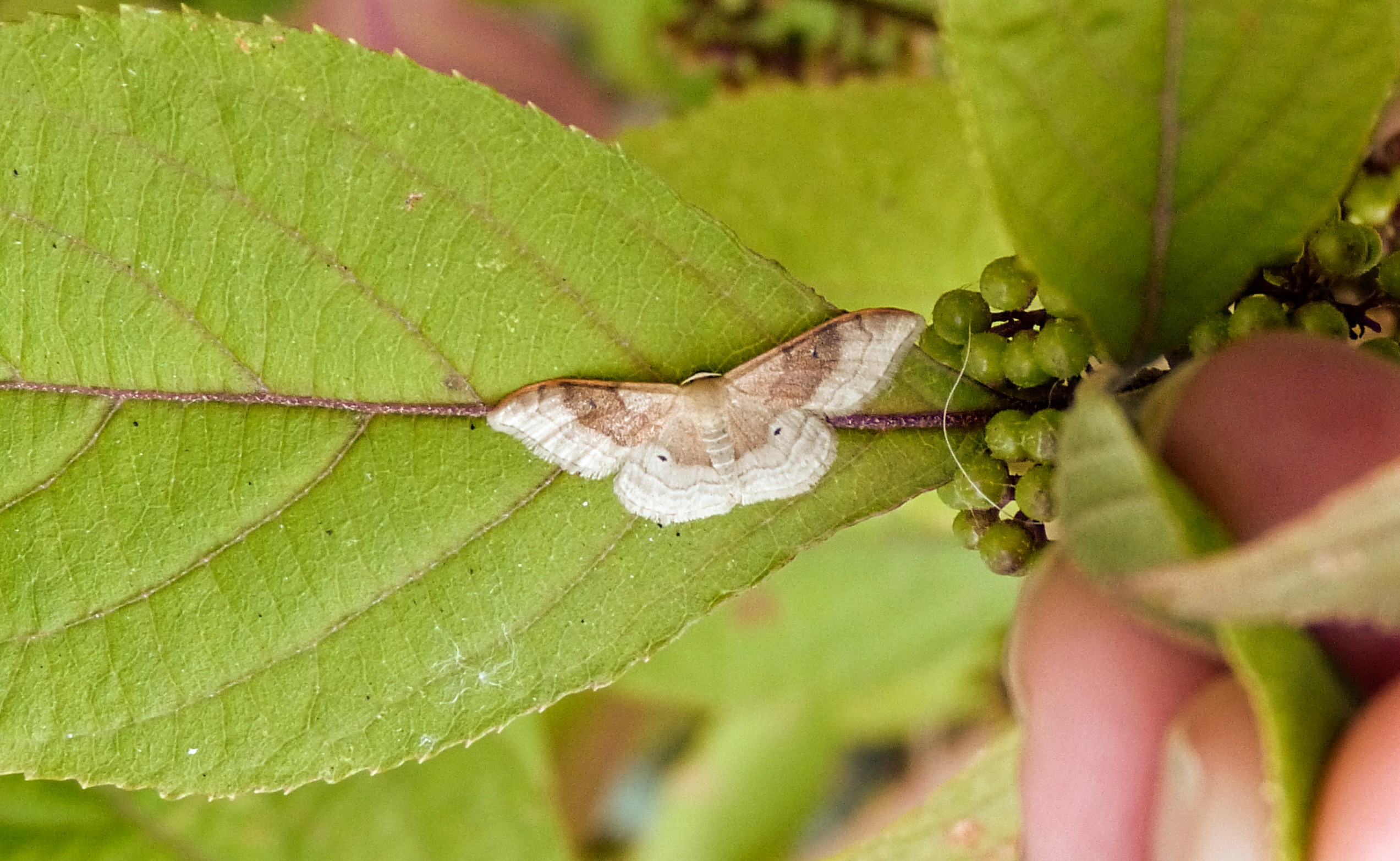
We found some interesting insects near the reserve entrance that included (above) this species of parasitic wasp called Amblyteles armortorius. Below, doing some research, I think this is a Pine Marbled moth.
Above, another Dark Bush-cricket that Geoff had found also showed well. Below, one of the Ravens flying over our heads.
Walking slowly to the next ‘comfy’ bench, a Common Buzzard was seen soaring high heading west and was joined by a female Sparrowhawk that flew off strongly south and then took a stoop onto some poor hapless bird somewhere in the trees below. From the bench, I picked up at least four distant Ravens north of the Hill, then suddenly more and more came through and all told, at least a ten or more birds were probably seen? A Marsh Tit was calling and then seen low in a nearby bush and a few Blackcaps were darting about around the bushes. A small flock of three Bullfinches flew north over our heads too. Geoff pointed out a rare plant growing by the bench, the Devil's-bit Scabious; my first sighting of this species this year. A Firecrest was heard nearby and seen briefly in one of the trees along the footpath as more Swallows and House Martins flew high overhead.
Above and below, two different Chalkhill Blue butterflies.
Above, a Common Blue butterfly and below, our first Silver-spotted Skipper of the year.
The footpath leading to the Fort was fairly quiet though a large party of elderly guys on a Wildlife Walk passed through; though I have to say, they were very noisy from where we stood; especially when me and the guys were down in the south slope of the Fort. I suggested going down the south slope to check out the bushes and trees below for migrants and during our time down there, we also got two Butterfly ‘ticks’ for the year: a Silver-spotted Skipper that was sat on an Ox-eye Daisy and at least two or more Chalkhill Blue’s. Other butterflies present included Common Blue, Small Heath, Small White and Meadow Browns.
Above, our first Autumn Lady Tresses that was found by Geoff. This tiny Orchid grows here abundantly, but this was the only one we found. Below, Andy and Geoff getting a closer inspection of this small plant that was growing on the south slope below the Fort.
Above, the Small Scabiousand below, the diminutive Carline Thistle also growing on the south slope.
Down at the bottom of the south slope, it was more protected from the wind and so we had a long rest while watching the many Blackcaps go about their business. Among them were a few Chiffchaffs,Greenfinches and a Common Whitethroat. A probable Flycatcher species flew north, but was lost in the bushes nearby as Geoff pointed out a variety of plants still flowering here including both Small and Field Scabious, Carline Thistle, Harebell, Ragwort, Knapweed, Greater Knapweed, Wild Marjoram,Wild Basil and Ox-eye Daisies that all attracted the many butterflies here. On the climb back up the slope, Geoff pointed out our first Autumn Ladies Tresses flower of the year. This is a species of Orchid and its latin name, Spiranthes spiralis, makes sense as the plant flowers in a spiral shape.
Above and below, a few Willow Warblers were seen among other passerines on the Hill as we made our way back to the car park.
Above, a Wheatear was flushed from the footpath and landed in this bush. Below, a Brown-banded Carder Bee took my eye and so I quickly got a photo of it to identify properly later.
On reaching the top of the slope, we climbed further still to the top of the Fort and walked around the circumference to the Fort entrance. On our way there, we flushed a Wheatear that must have flown off just in front of us and fortunately, it landed on a bush and so I quickly grabbed a photo. It was rather quiet on the way back to the car, but I got to see my fourth raptor of the day when a Kestrel flew low over the footpath and then south over the fields. There was a lot of small bird activity in the bushes on the way back to the car as we checked out the many Willow Warblers and Chiffchaffs flitting about within the nearby Wild Parsnip plants and bushes nearby. A few Blackcaps were seen too plus a few Goldcrests mixed in as well. Another Firecrest was heard calling, but remained hidden in the bushes as were the Long-tailed Tits. Surprisingly, there were no Tree Pipits heard or seen this morning and no Flycatchers either, though the wind was pretty strong at times and could be down in a more sheltered area. However, our next destination made up for the lack of Flycatchers here.
Northney Paddocks, Hayling Island.
One of at least five Spotted Flycatchers seen at the Paddocks this afternoon.
Parking up in the Applegreen Petrol Station car park, we met up with a friend of Geoffs who had earlier been checking out the Spotted Flycatchers here. Earlier today, a Pied Flycatcher was reported here, but he and his partner had not seen them; so we bid farewell and made our way to the well-known hedgerow that was a well known favourite area for the Flycatchers. When we arrived there, a fellow birder told us that he had seen a Pied Flycatcher just five minutes ago and so we quickly checked the hedgerow on the opposite side and came up with at least FIVE Spotted Flycatchers hawking for insects here. Most were a bit distant but one or two came quite close. We then tried our luck on the footpath leading to here and the chap we saw earlier gave us the nod that the Pied Flycatcher was showing again. I was lucky enough to pick it out near a Spotted Flycatcher, which was the first of the year and gave a quick hand pump of pleasure to the guys! After waiting for about ten minutes for the bird to reappear, we gave up and decided to watch from the opposite side of the hedge again and here, Geoff’s mate who we saw earlier, gave us the wave that signaled the Pied Flycatcher was showing well again, but from this side of the fence.
Above and below, the Pied Flycatcher always remained a bit distant but it showed well during our time there.
Above, one of the Spotted Flycatchers that showed a lot closer.
From here, by the field, we had several reasonable sightings of the Pied Flycatcher over a 30 minute period; though it never hung around long, I did get a few distant photos of this gorgeous bird. Along with the showy Spotted Flycatchers, we found a Common Whitethroat and a Willow Warbler sharing the same hedgerow. A male Kestrel was also seen earlier during our time here. As I said to the guys that it is amazing that year after year, this particular area of Northney attracts both Spotted and Pied Flycatchers virtually every year at this site.
Broadmarsh, Bedhampton.
To round off the day, we checked out the North Binness Islands for a possible Osprey, but to no avail. Despite a good look over the islands, there was no sign of the bird that was using these trees to rest recently. In front of us on the exposed mudflats below, there was a flock of at least 50 Black-tailed Godwits feeding and out on the water within the harbour, at least four Great Crested Grebes were seen. Needing to be home for my wife, we made our way home, with two butterfly ‘year-ticks’ under our belts and Geoff and I seeing our first ‘Pied Fly’ of the year (Andy had seen one at Catherington Downs earlier this month), but this was Geoff’s first one for many a year.
One of the five Spotted Flycatchers seen at Northney Paddocks this afternoon.
Another bright start to the day with a clear blue sky overhead and temperatures around 15 degrees with a very light north-easterly. It looks like it is going to be another pleasant, dry day today and hopefully, I might get some birding done today. I couldn't help by putting the Moth Box on again overnight as it was such a still evening and I was rewarded with at least 84+ moths of 31 species that included two more moths that were added to my year list.
My first Pallid Grey moth for a few years.
The new moths for the year included a smart and large Old Lady moth and the micro moth, Pallid Grey (Eudonia pallida). The Old Lady are annual to my garden and occasionally can be in large numbers for such a large moth. The Pallid Grey micro moth is not a regular to my Moth Box and I believe I have not seen one for a few years; therefore a good moth to pick up. Another Canary-shouldered Thorn graced the outside of my Moth Box and probably the same Portland Ribbon Wave and Small Ranunculus from yesterday were present too. Other migrant moths this morning included up to 7 Rusty-dot Pearls.
It's been a good year so far for Canary-shouldered Thorns in my garden.
The moths present this morning included the following:
MACRO MOTHS
Small Ranunculus
Portland Ribbon Wave
Square-spot Rustic 3
Lesser Broad-bordered Yellow Underwing
L-album Wainscot 3
Canary-shouldered Thorn
Brimstone Moth 2
Double-striped Pug 6
Lime-speck Pug 5
Large Yellow Underwing 5
Willow Beauty 10
Garden Carpet 4
Old Lady (New for Year)
Vine’s Rustic 4
Bright-line Brown-eye
Small Dusty Wave 4
Pale Mottled Willow
Marbled Beauty 3
MICRO MOTHS
Box-tree Moth
Chestnut Tortrix
Common Plume 7
Beautiful Plume 2
Chevron Grass-moth
Pallid Grey (NFY)
Bramble Shoot Moth
Light Brown Apple Moth
Rusty-dot Pearl 7
Light Brown Apple Moth
Dark Moss-moth
Apple Leaf Miner 3
Codling Moth
This Blue-headed type of Yellow Wagtail was seen by the 'Lazee's' today. Photo by Rob Porter.
Yesterday in Hampshire, A Wryneck was found at Oxey Marshes along the seawall late in the afternoon and a huge roost of at least 420 Yellow Wagtails were at Titchfield haven in the evening. An Osprey was seen early morning on North Binness Island, within Langstone Harbour and another Pied Flycatcher was seen at the Paddocks at Northney, Hayling Island.
ThisSmall Ranunculusmoth was my second of the year.
Another fine, but cool morning to start off with at 6am, but with the southerly airflow over the south coast over the past few days, I was hoping to get something exciting in my Moth Box. Thankfully, I did. A total of 65 moths of 33 species were counted this morning that included four more moths that were added to my year list. Top of the pile was a Portland Ribbon Wave; a species I only encountered for the first time last year and so to get one two years running is exceptional. This is a Red Data Book species and a rare immigrant for Europe and rarely encountered in Hampshire.
Above, thePortland Ribbon Wave and below, a Bloxworth Snout.
Other moths new for the year involved three micro moths; Clover Case-bearer, Mottled Oak Tortrix and the very small Firethorn Leaf Miner. My second Small Ranunculus moth for the year was found last night by the moth box and so I potted it for a photo the next day. Just the two Garden Tiger moths were also present this morning. I am starting to use my Bridge Camera more as it is much sharper than my mobile phone and the results are far better.
Mint Moth.
The moths recorded this morning included the following:
The Starlings are now starting to get their spotty Autumn plumage. A few were in and around the Cemetery this morning.
I took an early walk around Highland Road Cemetery this morning, arriving at my local patch at 8am to take a slow amble around this little oasis in the middle of Southsea. Earlier this morning, I sat outside in my garden enjoying a cup of coffee on such a fine morning, when a Tree Pipit flew high overhead heading south. That was a good start to the day and my second of this species this Autumn over my garden. This more than encouraged me to check out the Cemy and so once a few chores were done, I headed off with the dogs to my favourite part of Southsea.
Above, a flock of around 6 Blue Tits were around the Monkey tree and nearby bushes in the southern half of the Cemy and among them was a lone Willowchiff. Below, a clump of large trees and bushes that sometimes holds something exciting in the southern half of the Cemy.
There was a Pied Flycatcher over Northney yesterday and though I would love to see one this Autumn, I was hoping for one here in Highland Road Cemetery. Fat chance, as the only migrant I found today was a Willowchiff that was among several Blue Tits and even that bird only showed briefly a few times. I checked the bushes over in the south-east corner and the only bird of note was a Great Spotted Woodpecker that flew out and flew off eastbound over the houses. The only other birds here were several Blackbirds and a House Sparrow; just like the last time I was here. A Swallow flew very high overhead, but I failed to locate the bird as it must have headed off west.
A pair of Collared Doves were walking on the main path.
Sadly, apart from the usual birds, it was very quiet and being so early, I didn't expect any insects around, but apart from a Holly Blue butterfly settling briefly on the grass and a few Bumble Bees buzzing through, it was all quiet. Never mind, it was still a pleasant walk nonetheless and kicked off the day nicely. If you are reading my blog, even though the sightings and photos on here are a lot of common birds, please remember, in 20 years time, a lot of these birds might have disappeared for good and so it is nice to look back on what was here at this time. Yellow Wagtails, Tree Sparrows and a few other birds were once common here on the south coast and now gone. Our common birds are disappearing due to many reasons, including Global Warming; but our green spaces are disappearing fast. Now I hear that the Lake on Farlington Marshes has been flooded due to the very poor management of the Sluice Gates there. Whatever is next!!
An adult and juvenile Goldfinch sharing a TV aerial with a Wood Pigeon.
In Hampshire today, Pennington Marshes still held the Wood Sandpiper on Jetty Lagoon and a Curlew Sandpiper was now on Fishtail Lagoon! Bugger! Will I actually get to see one this Autumn? Another Curlew Sandpiper was seen on the Hook-with-Warsash reserve. Later on this morning, I found my first Rush Veneer moth of the year while I was in Reginald Road, Southsea, around midday. These are immigrant moths from the Continent and can turn up in very good numbers most years at this time of year. Annoyingly, the moth was flighty and my photos using my mobile phone were awful!
A very early Feathered Ranunculus moth this morning was unexpected.
Back up early this morning to check on the Moth Box and this time, there was something new for the year. It was bright and cool at 6am this morning and I could see there were a few moths around the Moth Box first thing. Still no visible migration going on overhead while I checked the Moth Box, but I am sure it is on its way.
Up to two Garden Tiger moths were present.
Pick of the moths goes to my first Feathered Ranunculus of the year, which was a whole month earlier than last year! Still, it had me scratching my head for a moment and then it clicked on what it was. Not much else to get too excited about, but a reasonable selection again. Common Plume’s dominated again in numbers with at least 11 counted, though there probably were a lot more around the plants.
Just the one Yellow-barred Brindle moth today.
The moths present this morning included the following: