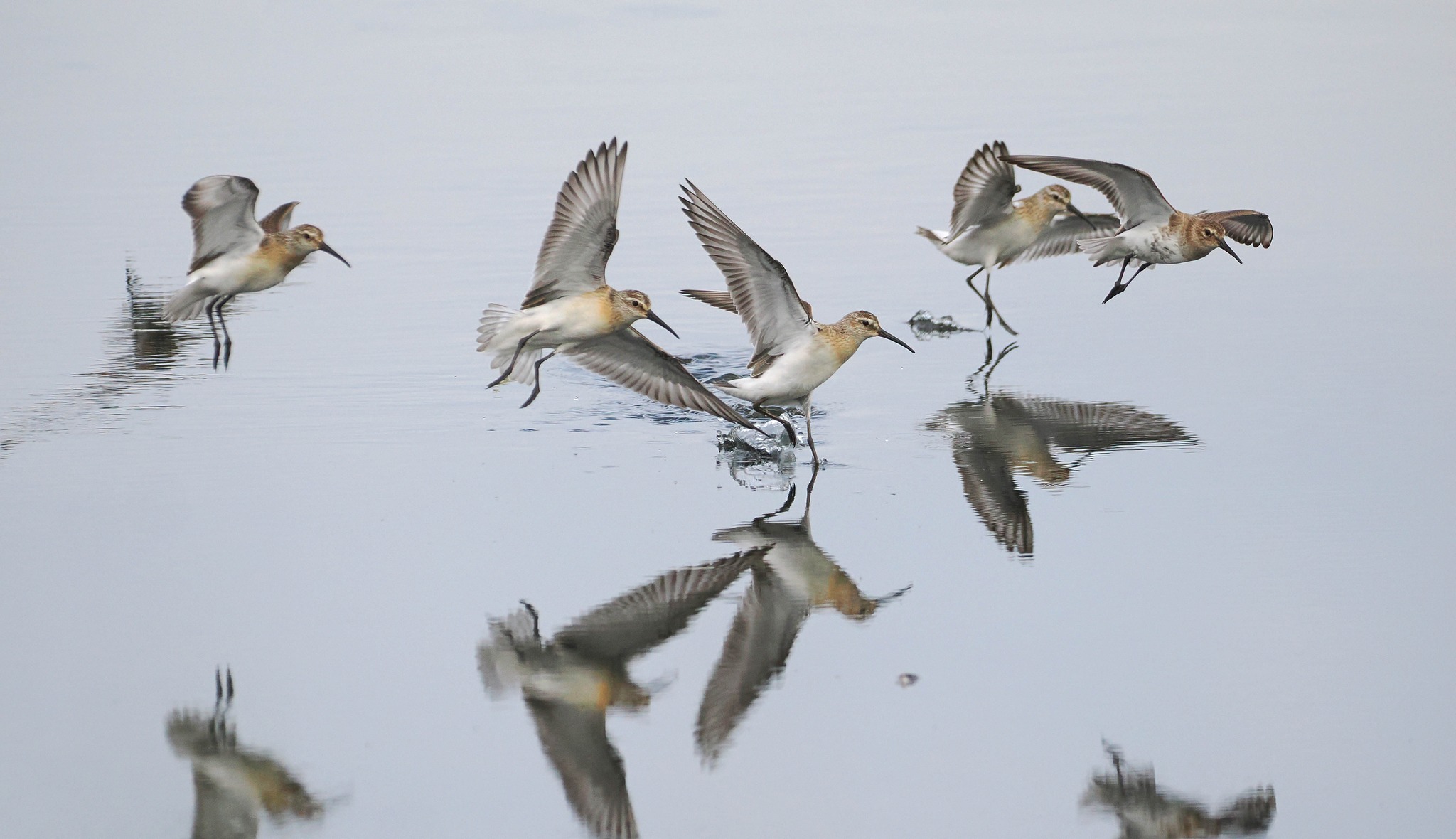
Sunday, September 24, 2023

What a day!!!

Saturday 23rd September 2023.


A selection of some of the moths in my moth box this morning which included an L-album Wainscot,  4 Lunar Underwing, Square-spot Rustic and a Lesser Yellow Underwing.

Another incredible days birding with two superb Phalarope species added to my year list, another two moth species added to my year list and to round off a fantastic day, we got to see the Long-tailed Blue butterfly this afternoon on Portsdown Hill; a species that was new for me in the UK. The only thing that marred a superb day was the fact I had left the memory card for my camera at home and so, I had to borrow the photos of some of the ‘Lazee’s’ and other birders for my blog entry today. Yet, another senior moment!


Above, my first Delicate moth of the year and below, the micro moth London Dowd (Blastobasis lacticolella).

Though it was a cold start to the day, there were two new moths added to my year list: a superb Delicate and at least four Lunar Underwings. The former is an uncommon immigrant moth, while the latter is a common Autumn moth, but most welcome addition to my year list. The moths present this morning included the following:

  • 1 Large Yellow Underwing
  • 1 Delicate (NFY)
  • 1 Lesser Yellow Underwing
  • 4 Lunar Underwing (NFY)
  • 1 Bloxworth Snout
  • 1 Pale Mottled Willow
  • 1 Square-spot Rustic
  • 1 L-album Wainscot
  • 2 London Dowd
  • 4 Light Brown Apple Moth
  • 2 Beautiful Plume 

Andy had his moth box on overnight and there was a nice selection there too, which included the following moths:

  • 1 Clancy’s Rustic
  • 4 Common Marbled Carpet
  • 1 L-album Wainscot
  • 1 Garden Carpet
  • 2 Square-spot Rustic
  • 2 Lunar Underwing
  • 1 Large Yellow Underwing
  • 1 Light Brown Apple Moth
  • 1 Common Plume
  • 1 Beautiful Plume


A nice selection of moths at Andy's moth trap this morning including 4 Common Marbled Carpets.

The ‘Lazee’s’ were up and about very early this morning and it didn't take long for the rest of us to get a notification that both the Hill Head Grey Phalarope and the Keyhaven Marshes Red-necked Phalarope were both present this morning, that our day was then mapped. So, after picking up Geoff, it was off to Hill Head first. The light was excellent when we arrived with a clear blue sky overhead and a light breeze across the beach. We picked out where the birders were and quickly parked up. It didn't take long for us to get onto the Grey Phalarope, which was feeding on the shoreline fairly close to where we stood, however, the bird was very flighty and didn't hang around long. I quickly grabbed some photos of the bird and then it dawned on me that I had not packed the memory card to my camera. After several very strong expletives, I took it on the chin and carried on watching this beautiful little bird with the guys. I could see some of the regular birders present nearby and said Hello, while enjoying a flock of 5 Yellow Wagtails flying over heading south along with many Meadow Pipits.


This cracking photo of the Grey Phalarope was taken by Andy Friend.

Behind us, a flock of 6 Bearded Tits rose from the reedbeds near the roadside and showed well as they climbed the sky and then dropped again into the reeds. They repeated this a few times, something this species does around this time of year. Well pleased with the Grey Phalarope sighting, we made our way back to the car to get some ‘nosh’ for our lunch and then off to Keyhaven Marshes for the Red-necked Phalarope. Earlier today, a Manx Shearwater was reported off Inchmary and heading in the direction of Hill Head, but there were no further reports.


Another excellent photo of the Grey Phalarope off Hill Head. Photo by Pete Appleton.

On arrival, we only just managed to get a parking spot at the awful car park at Keyhaven Marshes, which is at the bottom of Lower Pennington Lane. The weather was good and a passing birder told us that the ‘RN Phal’ was still present, although we had a long walk ahead of us. Walking south to the sea wall, a pair of Ravens flew low overhead and good numbers of both House Martin and Swallow were flying low over our heads.

The tide was out within the Solent and I found a small flock of 5 Knot feeding on one of the mud flats. A few Redshank were also present along with singles of both Curlew and Grey Plover. As we neared the main throng of birders present, I realised that it was Andy Friend and several of the ‘Lazee’s’, therefore we joined these guys for a good chat, while waiting for the RN Phalarope to reappear from the grass on the west side of Keyhaven Lagoon. During our time there waiting for the bird to reappear, a Cattle Egret flew in and landed on the small island out in the middle of the pool; my first for several months. Waders already present here included at least 80+ Lapwing, 20 Black-tailed Godwit, 4 Redshank, 2 Avocets and a flock of 12 Dunlin briefly flew in, but flew back out onto the mudflats. We knew a Curlew Sandpiper was also present, but there was no sign of the bird at the time.

A fine male Marsh Harrier was seen quartering the fields behind the Lagoon in the distance and several Common Buzzards were noted soaring high in the distance. A Kestrel was hovering over the mudflats in the distance before flying north and earlier today, an Osprey was reported flying over the Solent. Andy Friend and the rest of the ‘Lazee’s’ had their fill of the Phalarope and decided to make their way to nearby Oxey Marshes where the Grey Phalarope was said to still be present.


The Red-necked Phalarope on Keyhaven Marshes. The bird was always distant when we were there, but though I had left my memory card for my camera at home, at least I can rely on some mates to save the day. Photo by Andy Dickety.

The Red-necked Phalarope finally gave itself up as it reappeared out of the grass and popped out nicely for everyone to connect with the bird. It was closely followed by the Curlew Sandpiper and the two birds seemed inseparable. The Phalarope flew out onto the water once and showed well, although distant all the time we were there, but it was a good species to get on our year list of which mine now stands at 205 species for the year (198 in Hampshire). A male Dartford Warbler suddenly flew past us and landed in a nearby bramble. It disappeared for a while then was seen again right out in the open until disappearing again. That was a nice bonus. We noticed Red Admiral butterflies were streaming through the reserve, all heading in a westerly direction and behind us, Lesser Marsh Grasshoppers were heard stridulating.


Video footage of the Red-necked Phalarope and its companion, the Curlew Sandpiper at Keyhaven Marshes. The birds always remained distant. Video taken by Andy Friend.  

Happy with the Red-necked Phalarope (and it really looked good through the scope), we made our way to where the ‘Lazee’s’ were viewing from Butts Lagoon where we had sightings of a Greenshank, at least 100+ Teal, up to 5 Common Buzzards and a male Marsh Harrier, plus a good chat with the guys again. On the way back to the car, a male Stonechat was seen perched on one of the brambles while more Hirundines passed overhead. All in all, a superb trip to this area of Hampshire.


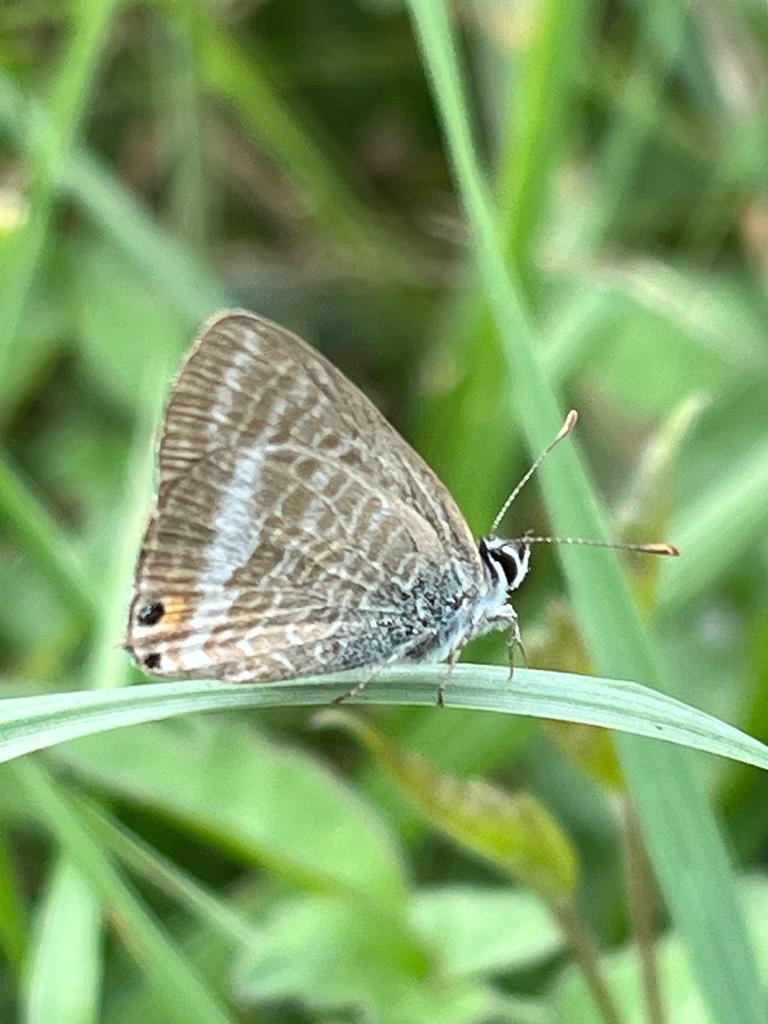
This male Long-tailed Blue butterfly happily climbed onboard my UK Butterfly life list. Having missed it last week, I was pleased it was still fluttering about in the same spot seen earlier this week. Photo by Andy Fisher.

I was told by my wife to be home earlier than last week, but I had to try for the Long-tailed Blue butterflies that were on top of Portsdown Hill. We should have seen them last Saturday because we were in the area at the time, but after getting the exact location, we successfully found a superb male Long-tailed Blue fluttering around near a bench, resting on some grass in the bright sunshine. I thought the spare memory card I had in the car would work with my camera - it didn't! Aaaaaagh! To make matters worse, I left my mobile phone in the car and so I had to rely on Andy’s mobile phone camera to grab a few photos of my first of this species in the UK. I have seen many abroad, but to get one in the UK is exceptional.


Andy managed to get a photo of the Long-tailed Blue butterfly with its wings spread. Well done that man. Photo by Andy Fisher.

On the way back to drop Geoff back home, I spotted a large raptor over the fields to the north and Geoff agreed it could have been a possible Hen-harrier or a Honey Buzzard, but I was driving at the time and so getting a good view of the bird went begging. Sob! Geoff went back later that afternoon, but failed to locate the bird, but did pick up a Wheatear.  

That crazy weather earlier this week produced some amazing Yank passerines to west Wales and not only was the Magnolia Warbler still present at St. Govans Head, Pembrokeshire, but someone found a Canada Warbler there!!!!!! Further north, at Cilan Head, Gwynedd, an Empidonax species of North-American Flycatcher was found, but to tie it to an actual species has not been established yet. We shall see. 


Thursday, September 21, 2023

Rarities pouring into the UK.

Thursday 21st September 2023.


Sadly, no American passerines in the Cemy this morning, so I had to make do with some obliging Chiffchaffs instead. At least 6 were either heard or seen this morning.

It seems like a long time since I have put anything on my blog and that was due to the extreme bad weather we have had over the past few days. The UK took a battering from Hurricane Lee that was slowly crossing the Atlantic and there was another following it according to the weather forecast this morning. However, despite the grim weather (very strong winds and heavy rain which produced a ‘Yellow’ weather warning), the winds have most certainly produced some amazing sightings, not only on the south coast, but Wales in particular. More later.


Above, there were still a few Smooth Sow-thistle plants along with Purple Toadflax growing around the graves within the Cemetery. Below, a Meadow Pipit flying high overhead.


Above, as me and the dogs were sheltering under the large Oak Tree in the north-east corner of the Cemy, this Carrion Crow was getting somewhat damp in the heavy rain shower. Below, Ivy Bees and Common Wasps enjoy the flowering Ivy.

The poor weather even resulted in me not putting my moth box on overnight for fear of it blowing over in the strong winds, but it was a lot better today as the winds have abated, but there was still the threat of heavy showers today. I managed to take the dogs for a walk around Highland Road Cemetery this morning and was rewarded with at least 6 Chiffchaffs, though only two showed well. Overhead, there was a small trickle of Meadow Pipits flying over and the total species seen this morning was 17; the highest for some time, that included a Jay, Greenfinch and a Goldcrest plus all your usual suspects. The Goldcrest was the first one this month here in the Cemetery and although I never got a sighting of it, it was most likely a migrant bird. Surprisingly, no Wren or Collared Dove to add to that total. The following birds were either heard or seen this morning:

  • Jay
  • Magpie
  • Carrion Crow
  • Herring Gull
  • Wood Pigeon
  • Feral Pigeon
  • Goldfinch
  • Greenfinch
  • Blue Tit
  • Great Tit
  • Goldcrest
  • Chiffchaff
  • Blackbird
  • Robin
  • Starling
  • House Sparrow
  • Meadow Pipit

There were plenty of insects again within the Cemetery, notably the Common Wasps, Drone Flies and Batman Hoverflies enjoying the flowering Ivy Plants (they really give off a strong scent when you walk past them) and also upon them were good numbers of Ivy Bees. At least four Red Admiral butterflies were seen, including two nectaring on the flowering Buddleia near the entrance and also a few Large Whites on the wing over the Cemetery. However, best of all was a Painted Lady that briefly stopped on some Ivy before flying off.


Above and below, another couple of photos of one of the Chiffchaffs in the centre of the Cemetery.


Above, a Drone Fly on an Ivy plant and below, I came across at least 10 Batman Hoverflies resting either on this Conifer or on my hat!


Above, this Red Admiral butterfly was sunning itself on a Buddleia plant near the main entrance.

As mentioned earlier, the very strong winds brought in some interesting birds to the south coast and sure enough, Grey Phalaropes began to arrive. These diminutive waders are normally storm driven into the UK and two birds turned up yesterday; one off Hill Head and another on Blashford Lakes. Today, there were two at Keyhaven Marshes that showed very well to all that went to view the birds. However, to eclipse these lovely birds (I do hope one hangs around this weekend), the west coast is awash with very rare American passerines! Today, in Wales alone, there are the following birds: Magnolia Warbler, Black-and-white Warbler, Bay-breasted Warbler, Alder Flycatcher, Red-eyed Vireo and a Bobolink! I think this September could be going down as one of the best for North-american passerines?


Above, this Grey Phalarope graced Hill Head just offshore, though you had to be quick to see it at times. These superb photos were taken by Mark Francis.


Monday, September 18, 2023

Storms over Portsmouth.

Monday 18th September 2023.


It was a bit dark and overcast just before the rain came in when I took Ted & Buddy for their morning walk around the Cemetery.


Last night's storm was very impressive, although it was quite distant and rather over to the east where there was a superb lightning display over the rooftops of Southsea. This morning's weather forecast didn't look too good either and I got a bit of a soaking on my first shift this morning in Old Portsmouth. Though the rain had stopped when I got home, I still had the dogs to take out and so I took a risk and walked them around Highland Road Cemetery. Yep, another good soaking!!!


Above, the rain came in as we quickly took shelter under a tree. Below, a Lusitanian Slug was more than happy with the wet weather until one of the dogs trod on it and it shrivelled up! 


On my first shift this morning, I did see a Chiffchaff flitting about the trees by the roadside and a Siskin was heard only somewhere high up and heading west by the sound of it. Highland Road Cemetery was rather quiet too, though not unexpected really, but at this time of year, anything could turn up, but it was just the usual birds on show today in the heavy rain. I took the camera anyway and snapped a few photos of the soaked birds along the way. A few Chiffchaff were heard only within the Bushes and Trees, but no other migrants on show today.


Above, this Carrion Crow managed to grab breakfast from somewhere and below, a Wood Pigeon in the rain. One of many here this morning. 


Above, I was walking the dogs around the Mausoleum when I came across two Magpies, two Carrion Crows (one flew off) and a juvenile Herring Gull all getting along fine in the rain! Below, then there were just two Carrion Crows and two Magpies.


Yesterday, birding pal Geoff Farwell braved the weather in the morning and got a thorough soaking for his efforts down Farlington Marshes where he saw the following birds: Marsh Harrier, Peregrine, 3 Common Buzzard, 2 Avocet, 8 Curlew Sandpiper, 2 Ruff, Common Sandpiper, 14 Brent Geese and 10 Yellow Wagtails. There was an interesting report of a flock of White Storks flying over Cowplain yesterday and someone put some video footage on Facebook of the sighting. No doubt on what they were. 


Above, a small flock of Curlew Sandpipers on Keyhaven Marshes. This superb photo made the title photo on the Hampshire Birding page on Facebook. Photo by Christine Whiffen. Below, another friend of mine, Paula Slape, took this photo from her mobile of Fulmars from a Whale-watching trip off Iceland yesterday. I wish my mobile phone camera was this good!


It was a much sunnier afternoon today, though a strong westerly wind blew which kept the temperature down to around 16 degrees. The only sighting of note during my second shift was a female Peregrine flying high over Old Portsmouth and then seen again seconds later heading east towards Southsea. A good total of 16 Cattle Egrets were noted on the Hayfield at Farlington Marshes today by fellow ‘Lazee’, Andy Friend. 


Sunday, September 17, 2023

Another great busy Saturday with the guys.

Saturday 16th September 2023.


Redshank off Northney, Hayling Island in the early afternoon.

Another busy day with both the moths and the birds today, with both Andy Fisher and Geoff Farwell joining me as we explored three areas around the south coast. The weather was glorious again, but very humid at times and even hot in places! Two new species of moth for my year list were found at Andy’s moth trap and although we never saw any new bird species for our respective year lists, there was a reasonable variety of birds to look at. However, I have to say, we struggled to find many migrant birds despite some very good likely areas.


My second Double-barred Tabby of the year after the one I had in June.

Kicking off with my moth box, my second Double-barred Tabby moth was arguably the best moth to be found and I would not of seen it until I was packing my stuff away in the back garden as I found it perched on the seat cover and thankfully, remained there so I could take a photo of it. There were 68 moths of 18 species this morning that included 4 Clancy’s Rustics, a species that was a real rarity in my moth box. Box Tree Moths were abundant yet again, but at least I don't get hundreds of them like some poor 'Moth-ers' do in various places in the UK.

The moths recorded in and around my moth box this morning included the following:

  • 2 Old Lady
  • 4 Lesser Yellow Underwing
  • 4 Pale Mottled Willow
  • 4 Willow Beauty
  • 3 Garden Carpet
  • 4 Clancy’s Rustic
  • 1 Vine’s Rustic
  • 9 Large Yellow Underwing
  • 7 L-album Wainscot
  • 2 Silver Y
  • 1 Square-spot Rustic
  • 1 Rusty-dot Pearl
  • 1 Double-barred Tabby
  • 5 Ruddy Streak
  • 1 London Dowd
  • 2 Light Brown Apple Moth
  • 16 Box Tree Moth
  • 1 Common Plume

I arrived at Andy’s house around 7.45am and was welcomed by a singing Chiffchaff in his back garden. I got a fleeting glimpse of it flitting about in his back garden as I made my way to his front door. WHile Andy made me a cup of coffee, I got stuck into the moths. Both Centre-barred Sallow and Frosted Orange were new for the year, two beautiful Autumn moths of which I was so pleased to see. 27 moths of 11 species were recorded, though a few flew off before I could identify them when I walked into the back garden. 


Frosted Orange.

The moths present this morning included the following:

  • 2 Brimstone Moth
  • 8 Willow Beauty
  • 4 Large Yellow Underwing
  • 2 Garden Carpet
  • 1 Frosted Orange (NFY)
  • 1 Center-barred Sallow (NFY)
  • 2 L-album Wainscot
  • 2 Pale Mottled Willow
  • 3 Square-spot Rustic
  • 1 Narrow-winged Grey
  • 1 Light Brown Apple Moth


Centre-barred Sallow.

This week has seen some serious accidents on the roads around Portsmouth and this morning was no exception, as there was a car on its roof on the A3M opposite Farlington Marshes when I made my way to Geoff's house, in Drayton. Huge roadworks along the Havant Road in Drayton didn't help either as we eventually all made our way down to Sandy Point, on Hayling Island, for our first destination.

The birds seen around this Nature Reserve included at least five Sandwich Terns fishing within the harbour entrance and gave good views most of the time. There was a good movement of both Swallows and House Martins overhead, of which some flew just a few feet away from us and low down too. Meadow Pipits were also going through in good numbers and both Grey Wagtail and Yellow Wagtail flew overhead. Geoff was pointing out the plants on the shingle that included the gorgeous yellow Evening Primrose and the not so attractive Sea Spurge and Sea Holly. Today's date is synonymous with the arrival of Brent Geese and we saw a flock of 16 birds flying distantly heading west over Chichester Harbour. New arrivals?


From top to bottom: A flock of 16 Brent Geese flying distantly over Chichester Harbour, Sandwich Tern flying through the harbour entrance off Sandy Point and a Common Carder Bee on an Evening Primrose plant on the beach.

From nearby Sparkes Marina, the tide was slowly coming up at 11am and out in the creek, a pair of Redshank were seen well as was a Little Egret. Sadly, the sandbank on Black Point suffers terribly from disturbance, so resting waders are regularly flushed here as was a mixed flock of Ringed Plover and Dunlin that flew over the area a couple of times.


A pair of Redshank in the creek off Sparkes Marina and a fishing Little Egret.

Next stop was to be Northney and so parking up in the small car park, we walked north to view the small harbour by the Marina and also to check out the brambles and fields along the walk up to the houses near Spinnaker Grange. We searched hard for any migrants present and the best we could muster were a few Chiffchaffs and a Blackcap and Whitethroat that was heard only. The potential for a Wryneck or Shrike here seemed overwhelming, but no diamonds. On a positive side, there was a nice selection of waders near the small Marina that included a couple of Greenshank, three Whimbrel and around 60+ Redshank, of which the latter were jostling for space on the rising tide.

Both Kestrel and a Common Buzzard were seen and a Kingfisher was seen briefly flashing past below the footpath near the Marina. A Grey Wagtail flew down and landed briefly before flying off north. But it was the Swallows and House Martins pouring through that grabbed our attention. Literally hundreds were seen heading east low over the harbour and over our heads; an endless stream of Hirundines it seemed and though I tried my hardest to find a rarer Hirundine among them, they all were our regular birds. Truly an amazing Autumn spectacle. A few Migrant Hawker and Common Darter dragonflies were seen along our walk around Northney along with the micro moth, a Rush Veneer, which was only my second of the year.


Photos from Northney. From top to bottom: A pair of Greenshank with a Redshank, Whimbrel with a Black-headed Gull, Small Copper butterfly, Sandwich Tern, small unidentified Bumblebee, 3 Whimbrel with a Curlew and finally, a Swallow flying over the Whimbrel and Curlew.

After a bite to eat back in the car park, we then finished the day off around the countryside of Pigeon House Lane on top of Portsdown Hill. Geoff had a good list of sightings here Saturday and so parking up, we crossed the road and made our way down through the fields. A large number of Red-legged Partridges, easily 100+, were in the fields opposite the road along with huge numbers of both Feral and Wood Pigeons. However, despite a long walk across the fields, the only migrants we saw were a couple of Chiffchaffs, a single Wheatear and up to 30 Yellow Wagtails (a flock of 26, 3 and a single bird). A couple of Common Buzzards were seen and a distant Kestrel to round up our sightings here, but despite the lack of migrants, the view here made up for that. We are so lucky to have such spectacular countryside.


Photos from the fields by Pigeon House Lane, Portsdown Hill: Red-legged Partridges among Carrion Crows, a lone Red-legged Partridge, Roe Deer, a large gathering of Red-legged Partridge, the only Wheatear we could find and Storksbill flowers.

While getting back into the car, there was a report of a Long-tailed Blue butterfly nearby. However, I did not realise how close the insect was and I should have given the info more attention, but time was against me as I had to not only get the lads home, but also the long drive home back in Southsea. Tomorrow, thunderstorms are supposed to be rolling into the south coast, although I really do not trust the weather guys and their awful predictions.   


The Long-tailed Blue butterfly on Portsdown Hill. Photo by Andy Friend.


A possible 'Lifer' among the Moths.

 Tuesday 4 th August 2026. A regular to my garden around this time of year, the Dark-bordered Pearl. The Moth Box was active again last n...