Sunday, July 30, 2023

Some great moths & Fishlake Meadows.

Saturday 29 July 2023.


My first July Highflyer moth of the year.

It was a wet drive up to Andy’s house this morning which resulted in a good thing and a bad thing. Before driving up the A3, I popped to the petrol station first of all and while filling up, a  female Peregrine was seen with prey in its talons, heading south over Fratton Park. A good start to the day. However, on my way up the A3, with rain coming down, I saw a Blackbird try to cross the dual carriageway, but was hit by the car in front of me. To see its poor wing flapping loosely in the road was not what I wanted to see first thing in the morning.


Another new moth for the year, a gorgeous Rosy Footman.

Andy had his moth box on again last night, though I didn’t. I don’t normally trap two nights running and so kept mine off overnight. Fortunately for me, Andy had a very good selection that included three more new for the year: July Highflyer, Scalloped Oak and Rosy Footman. There were 45 moths of 27 species recorded this morning and as well as the above mentioned, there were also some nice moths along with it including 2 Maidens Blush, Garden Pebble, Blair’s Mocha, Tree-lichen Beauty and a three species of Grass-veneer. 


One of three Scalloped Oak moths this morning.

Moths present in and around Andy’s moth box included the following:

  • 2 Riband Wave
  • 1 Rosy Footman (NFY)
  • 3 Willow Beauty
  • 1 July Highflyer (NFY)
  • 3 Uncertain
  • 1 Double-striped Pug
  • 3 Scalloped Oak (NFY)
  • 1 Single-dotted Wave
  • 2 Maiden’s Blush
  • 1 Blair’s Mocha
  • 1 Tree-lichen Beauty
  • 1 Common Pug
  • 1 Common Rustic
  • 2 Shuttle-shaped Dart
  • 1 Silver Y
  • 1 Garden Pebble
  • 2 Bird-cherry Ermine
  • 1 Bud Moth
  • 1 Codling Moth
  • 2 Common Plume
  • 1 Marbled Piercer
  • 5 Rosy Tabby
  • 1 Light Brown Apple Moth 
  • 2 Common Grass-veneer
  • 3 Inlaid Grass-veneer
  • 2 Garden Grass-veneer
  • 1 Small Grey


These dead trees on Fishlake Meadows provide excellent posts for birds to perch on including today's Osprey.

Our destination today was going to be Fishlake Meadows, Romsey, where, after picking up birding pal, Geoff Farwell, we done the 30 miles in a reasonable time (though Andy had to get some food from a nearby shop first!) and once in the car park, we made our way northbound along the Canal Path. Some of the ‘Lazee Birders’ had already reported that they had seen an Osprey over the reserve on the Whatsapp site and it didn't take long to see my first one of the year, perched up in one of the dead trees, eating a fish!


Sadly, the Osprey was over on the other side of the Meadows and from where we viewed the bird from the Canal walk, it always remained distant. But still a great sighting. Another bird was found today in Langstone Harbour.

I knew it was going to be a showery day today, but apart from the occasional shower, it was mostly dry and sunny and quite warm; excellent conditions for both Butterflies and Dragonflies. This is only the second time both Andy and myself had been to this reserve, but it was a first for Geoff and he told me later that he was really impressed with the place. I shall kick off with the bird sightings first of all and of course, the Osprey took the honours. Geoff picked the bird up first of all, perched on top of one of the dead trees, tucking into his breakfast. I quickly put a fellow birder onto the bird as all four of us enjoyed prolonged views of the raptor.


Above, a Carder Bee on Greater Burdock. Below, the poisonous Fools Watercress.


Above, Whirlygig Beetles and below, a Yellow-legged Mining Bee.


It wasn't a bad day for raptors and along with the Peregrine and Osprey, we had sightings of a couple of Red Kites, a Common Buzzard and a female Sparrowhawk. Sadly, no Hobbies were  seen today, despite ideal conditions. Water Rails were heard several times calling in the reedbeds and though we were so close in seeing our second ‘year-tick’ of the day, there were no sightings at all of this elusive species. I think we have a better chance when Autumn arrives when they are much more showy.


Above, one of the six Common Terns flying over the reserve in front of the screen. Below, one of the Sphaerophoria species of Hoverfly on Fleabane.

While watching the Osprey, there were at least two Great White Egrets near the bird; one perched on one of the dead trees and another wading on the marsh below. Later in the day, up to four birds were seen on the reserve from one of the viewpoints looking west. A few Grey Herons and several Cormorants were also perched on the dead trees. Overhead, there was a good number of Hirundines hawking for insects that included mostly House Martins. There were sightings of a few Swallows, Sand Martins and the occasional Swift too. A family flock of Nuthatches flew past us in the trees by the Canal Path and warblers present seen today on the reserve included Reed and Sedge Warblers, Cetti’s Warblers, Chiffchaffs and a female Blackcap. 


Above, some of the Gadwall seen swimming in front of the main Screen. Below, a rather early male Migrant Hawker dragonfly perched up near the footpath.


From the Viewing Screen (which was the first time we had been here due to the footpath being flooded earlier in the year), we encountered at least 6 Common Terns flying around the lake. We believe one was probably a male bird which was carrying a fish, courting a female bird and excitedly calling to her. Could they be late breeders? A Kingfisher flashed past twice over the lake and at least a dozen Gadwall were on the water swimming near the reeds and occasionally taking flight. One of the Water Rails was literally around 10 feet away from us ‘squealing’ loudly deep within the reedbeds. How frustrating was that!


Above, the tranquil and most beautiful River Test viewed from the west side of the reserve.


Above, a gorgeous female Beautiful Demoiselle damselfly gracing the River Test and below, a male Southern Hawker dragonfly nearby.

There was a good haul of butterflies around the reserve that included up to 10+ Brimstones in just one particular area, nectaring on Greater Burdock. Geoff, who is a very good botanist, told me that these plants are not very common and was pleased that so many were on the reserve. Other butterflies included Peacock, Large & Small White, Holly Blue, Red Admiral, Speckled Wood and Comma. Regarding Dragonflies and Damselflies, there were sightings of Southern Hawkers, a male Black-tailed Skimmer, a male Common Darter, a female Demoiselle Damselfly, Blue-tailed Damselfly and several Blue species of Damselfly. A lot of these insects were seen along the River Test that borders the western side of the reserve. The slow, chalk stream water attracted a lot of fish that included some very large Perch, probably Gudgeon and a lot of smaller fish.


Above, a female Brimstone butterfly on Greater Burdock. This was one of at least 10 individuals around these plants in just one area. Below, a male Common Darter dragonfly resting by the Canal Path.


Geoff posed the question to one of the reserve wardens about why the Willow Tree leaves were all brown and it turned out that there was a Beetle, a Willow Leaf Beetle was the actual cause of this. On closer inspection, Geoff picked one of the infected leaves and sure enough, out popped one of the Beetles! Apparently, the Willow Tree does recover from the infection after a while. Interesting stuff!
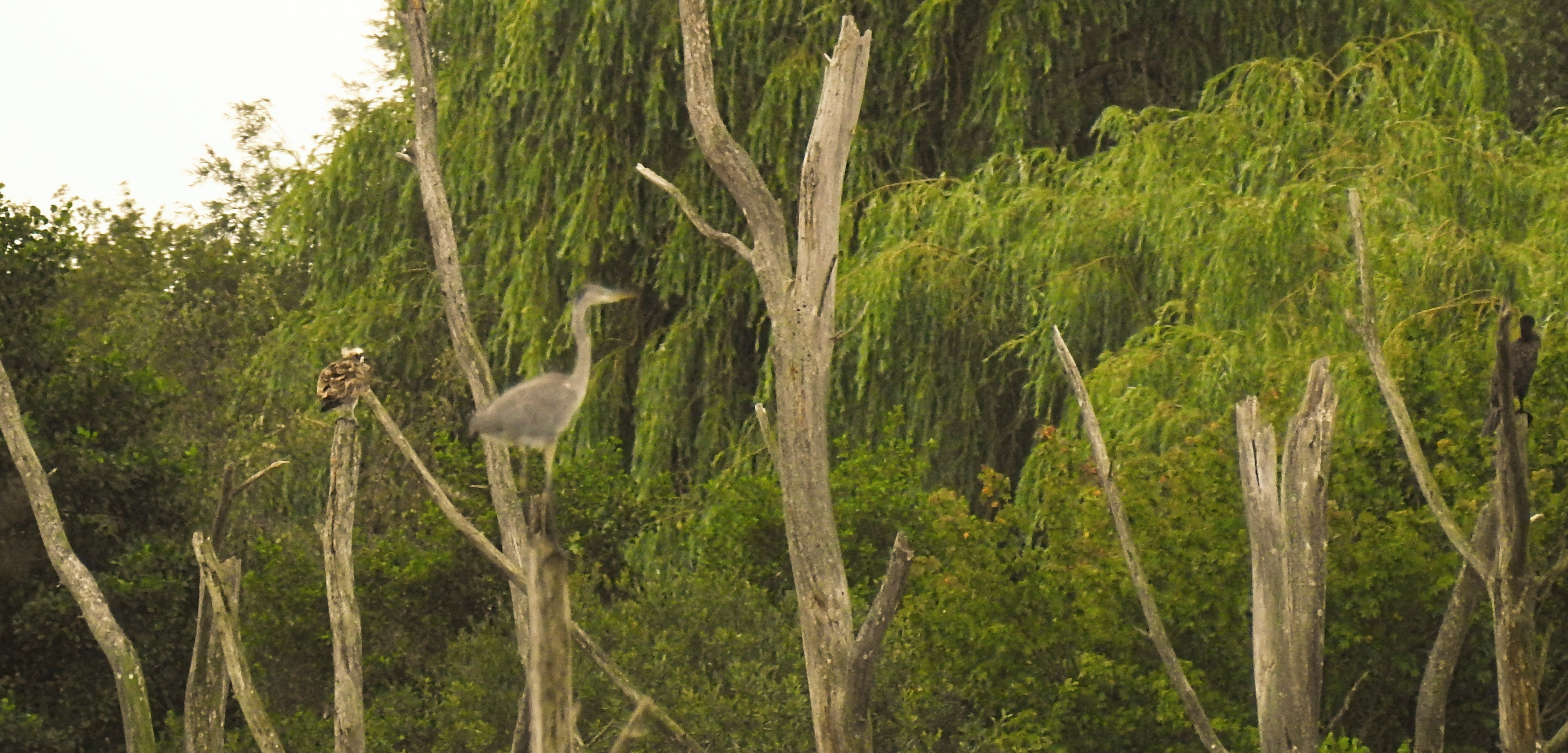

Above, from left to right, the Osprey, Grey Heron and Cormorant making the most of the tall dead trees on the reserve. Below, the water plant, Arrowhead with their distinctive shaped leaves. Also, Water Forget-me-not present there too.

Along the footpaths, Geoff was pointing out to both of us the fascinating plants along the way that included Water Speedwell, Water Forget-me-not, Greater Plantain, Enchanters Nightshade, Fools Watercress (which is a very poisonous plant!), the colourful pink  Amphibious Bistort and the attractive Arrowhead plants. The likes of Ragwort, Spear Thistle, Purple Loosestrife and Great Willowherb, all of which dominated the footpaths.


Above, probably the UK's laziest birder and below, another view of the male Common Darter dragonfly.

We spent a good seven hours on the reserve, which was well spent on this excellent area. We will most certainly return again, most likely in the Autumn where there could be a wealth of migrant birds arriving here. Judging by the recent sightings board, there were some decent sightings including a Bittern heard here.     


Whirlygig Beetles and Pondskaters at Fishlake Meadows.


Thursday, July 27, 2023

An excellent variety of moths despite the weather.

Friday 28th July 2023.


Only my second ever Gold Spot moth.

A horrible, drizzly wet start to the morning while I was checking the moth box at 5.10am. However, despite the wet conditions, there were some superb moths to keep me entertained. This wet weather at this time of year does throw up some nice surprises and this morning was no exception. A quick check on the white sheet, which had many moths on it today, then around the box before I turned the light off, produced all the usual moth and then I heard the familiar ‘whirr’ of wings as I watched an Elephant Hawk-moth rise out of the moth box and then shoot off over the garden. This was my third individual of this species for the year.


Dewick's Plusea. Again, only my second ever.

Among the 102 moths of 35 species, I found a Dewick's Plusea and a Gold Spot moth, two species that I have only encountered once before. The former is a rare immigrant to the UK, although there has been confirmed breeding in Middlesex and probably elsewhere according to Hants Moths. The latter is an uncommon resident, again, a beautiful species that I have only seen once before in my garden, Two cracking moths to kick off the day. My first Garden Tiger of the year (our Isabelle will be pleased as it's her favourite moth) was present within the moth box and hopefully, the start of many more to come. Another micro moth was added to my year list, a rather smart Dotted Oak Knot-horn (Phycita rubella), that I found resting on top of the moth box. I did have my rain guard on top of the box and underneath this, a Blair’s Mocha was present. Nearly a third of the moths present today were the familiar Light Brown Apple Moths, with at least 32 counted in and around the moth box.


My first Garden Tiger of the year, at last! This species is annual to my garden and can get up to double figures in August.

Thankfully, the drizzle abated a little, but it was a bit touch and go with the weather so I had to hurry to carry out checking the moths otherwise it would have been a good soaking first thing in the morning! With migration starting to happen in the birdworld, I did hear a ‘Willow-chiff’ calling somewhere in the gardens behind me and overhead, both Greenfinch and Goldfinch flew over. 


My first Dotted Oak Knot-horn micro moth of the year.

The moths present this morning included the following:

  • 1 Elephant Hawk-moth
  • 1 Gold Spot (NFY)
  • 4 Common Rustic
  • 1 Pale Mottled Willow
  • 1 Cabbage Moth
  • 6 Silver Y
  • 1 Tree-lichen Beauty
  • 1 Least Carpet
  • 1 Garden Tiger (NFY)
  • 1 Dark Sword-grass
  • 1 Shuttle-shaped Dart
  • 6 Brimstone Moth
  • 1 Common Emerald
  • 1 Garden Carpet
  • 1 Cloaked Miner
  • 1 Marbled Green
  • 1 Blair’s Mocha
  • 4 Lime-speck Pug
  • 1 Double-striped Pug
  • 2 Small Dusty Wave
  • 2 Willow Beauty
  • 1 Marbled Beauty
  • 1 Dewick’s Plusea (NFY)
  • 1 Box Tree Moth
  • 32 Light Brown Apple Moth
  • 4 Apple Leaf Miner
  • 2 Ruddy Streak
  • 7 Common Plume
  • 1 Beautiful Plume
  • 1 Dotted Oak Knot-horn (NFY)
  • 5 Dingy Dowd
  • 2 Marsh Dowd
  • 1 Garden Grass-veneer
  • 3 Privet Tortrix
  • 1 Olive Pyralid Moth


A pair of Ospreys were at Fishlake Meadows yesterday around midday. Photo by Andy Tew.


This juvenile Avocet was feeding on Farlington Marshes this afternoon. Film footage by James Cutting.
 

This Dun-bar moth was a bit of a surprise tonight while I was washing up! I found it sat near the kitchen window.


Monday, July 24, 2023

Less moths, but some quality.

Tuesday 25th July 2023.

Two Jersey Tiger moths graced my moth box this morning.

The moth box was on again last night and even though I knew there were going to be a few overnight showers, this did not deter me in trying for some more interesting moths. At 5.10am, it was dry with a few passing dark clouds overhead, but overall, it looked good enough to stay outside and check the moth box and the surrounding garden. Moth numbers were most certainly a lot less than Saturday morning, but still a nice variety again including two stonking Jersey Tigers. I am just wondering where the Garden Tigers are or are they simply late this year?


An early Square-spot Rustic was a surprise.

There were 40 moths of 19 species present this morning that included two more new for the year: an early Square-spot Rustic and the micro moth Chestnut Tortrix. I should have potted the latter as my photo of it was rather poor. Another good haul of Silver Y moths again with at least 13 counted, though I am sure there were more around hiding within the plants.

The moths present this morning included the following:

  • 2 Jersey Tiger
  • 1 Lime-speck Pug
  • 1 Double-striped Pug
  • 13 Silver Y
  • 2 Lackey
  • 1 Vines Rustic
  • 1 Garden Carpet
  • 2 Bright-line Brown-eye
  • 1 Square-spot Rustic (NFY)
  • 1 Shuttle-shaped Dart
  • 2 Common Rustic
  • 3 Fulvous Pearl
  • 1 Four-spotted Obscure
  • 2 Apple Leaf Miner
  • 1 Pellitory Cosmet
  • 6 Light Brown Apple Moth
  • 1 Chestnut Tortrix (NFY)
  • 1 Common Plume 
  • 1 Elder Pearl


Heavy cloud at times gave way to a few rays of sunshine in the Cemy.

This evening, I took a walk around Highland Road Cemetery for an hour, seeing it was still quite sunny outside at 5.30pm. I passed my neighbour, who was walking his dog along Albert Road and told him I was going to photograph butterflies over the Cemy. This time, I wasn't actually checking out the birds, but I did come across the Green Woodpecker and I think, even though it was the briefest of views, it was a juvenile and quite a vocal one at that.


Above, this path held a lot of Buddleia plants and attracted many Butterflies and Bees. One of many Red Admirals present along this pathway.


There was a lot of heavy cloud overhead and a bit breezy at times, occasionally the sun broke through and encouraged the Butterflies to take flight. The good news is that most of the Buddleia bushes in the Cemy were in full bloom, therefore attracting many Butterflies and Bumblebees. I made my way to most of the Buddleia bushes around the area and most had at least one Butterfly on it, which were mostly Red Admirals. Though I did find a few Painted Lady and a Large White. Maybe, if I was here around a couple of hours earlier, I expect to have seen a lot more butterflies, but I was happy with what I saw today.


Above, a Red Admiral on Bramble and below, a Painted Lady butterfly.


I did come across a small moth flying around near the Buddleia bush by the Mausoleum, but it would not settle and it most certainly did fly fast too. On the views I did get, it looked good for a Small Yellow Underwing, a species I have not ever seen before, but that's the nearest I could get for an identification. I spent most of my time around the middle of the Cemy, just north of the Holm Oak Clump where there were many Buddleia bushes, for this particular area seems to attract a lot of insects.


Above, a Large White Butterfly and below, a Queen Buff-tailed Bumblebee.


I did take a walk around the Cemy, but cut my walk a bit shorter than usual. I was really surprised when I found my first Dark Mullein plant within the Cemy. I have never seen this species of plant here and so kept a sharp eye out for any other new plants. All the usual plants were present including Ox-eye Daisy, Knapweed, Birds-foot Trefoil, Yarrow, Mallow, Lady Bedstraw, Nipplewort, Spear Thistle and Smooth Sow-thistle. All these plants produce the goods for all the insects. Excellent.


Above, a pair of Red Admirals and below, my first Dark Mullein plant on my local patch.


In Hampshire today, three Black Terns and an Arctic Tern were off Hill Head today, while nearby Titchfield Haven held the Spotted Redshank and three Common Sandpipers. Fishlake Meadows had a ringed Osprey this morning. Fellow ‘Lazee’ Andy Dickety had a Great Green Bush Cricket by Lakeside, Cosham this morning.  


Spear Thistle growing in the Cemetery. Thanks to Geoff Farwell for the ID.


This Great Green Bush Cricket was seen at Lakeside, Cosham. Seen and photographed by Andy Dickety.


Sunday update.

Monday 24th July 2023.


The Barn Owl at Bedhampton. Photo by Ollie Crabbe.

No birding was done yesterday apart from what was in my back garden that included the usual House Sparrows, Starling, Swifts and Goldfinches. A few butterflies went through the garden including Red Admiral, Small White and Holly Blue’s and annoyingly, I never had the moth box on overnight either due to incorrect forecast of rain overnight. In fact, I am getting a little fed up with the inaccuracies these so-called weather Apps come up with. As the comedian Robin Williams said, ‘If you want to know the weather forecast, stick your head out of the window!!!’


This juvenile Spotted Flycatcher was one of several broods in the New Forest. Photo by Pete Appleton. 

It was more of a family day yesterday as I took our Isabelle on top of Portsdown Hill to fly our kites. There is nothing wrong with her hearing either as she heard several Grasshoppers calling, when I couldn’t!! However, other birders I know were out doing their thing, including Emma and Matt Parkes, who went to one of the best butterfly haunts in Dorset, Alner Gorse Butterfly Reserve, near Sturminster Newton. There, they saw three species of Hairstreak: White-letter, Brown and Purple Hairstreak as well as the ‘Valenzina’ form of Silver-washed Fritillary. They were even rewarded with a superb Magpie Moth.


Magpie Moth at Alner Gorse Butterfly Reserve. Photo by Emma Parkes.

Geoff Farwell took a trip down to Farlington Marshes where he recorded the following: 20 Avocets, 11 Greenshank, 2 Green Sandpipers (not seen one this year yet!), Common Sandpiper, Marsh Harrier and 2 Ravens. A Great Green Bush-cricket was heard near the seawall too.


Also at Alner Gorse, this superb Brown Hairstreak. Photo by Emma Parkes.

An adult Roseate Tern, which going into winter plumage spent some time on the South Scrape at Titchfield Haven yesterday, seen and filmed by some of the ‘Lazee Birders’ and Oliver Crabbe found the Bedhampton Barn Owl in its roosting hole yesterday also. There was no further sign of the Black-winged Kite yesterday, so it will be interesting on where it gets located next?


Sunday, July 23, 2023

Ruddy Shelduck in the rain.

Saturday 22nd July 2023.


My first Black Arches moth of the year near Andy's moth trap.

I knew rain was coming in from the west and so I had to make a decision on birding somewhere where it was going to be fairly dry. Blashford Lakes seemed the most logical answer as watching from the Hides there could produce some nice sightings, despite the weather. As it turned out, I actually got a ‘year-tick’ with a Ruddy Shelduck present on Ibsley Water and showed well at both the Tern Hide and later that morning, the Goosander Hide.


Above, this Privet Hawk-moth was in the moth box and below, my first White-spotted Pug of the year.


Also, my first Common Carpet of the year was present.

Beforehand, it was a check of Andy Fisher's  moth box at Cowplain Marsh (his back garden!) where I picked up FIVE more excellent moths added to my year list. Pick of the bunch was a stunning Black Arches that was perched on the outside of the Conservatory window, where I had to use a ladder to grab some decent photos of the moth. A Privet Hawk-moth came very close to being the best moth as I found it sitting within the moth box as I quickly got a few nice photos of it perched on my hand. I then placed it carefully in one of the nearby Rose Bushes where it settled down and rested. Two more macros that were new for the year were a Common Carpet and a White-spotted Pug. The final moth was a micro, a Long-horned Flat Body (Carcina quercana) of which was nearly on the ceiling within the Conservatory therefore I could not get a decent photo.

Moths present this morning in Andy’s garden included the following:

  • 1 Privet Hawk-moth (NFY)
  • 1 Common Carpet (NFY)
  • 1 Black Arches (NFY)
  • 1 White-spotted Pug (NFY)
  • 2 Double-striped Pug
  • 1 Vines Rustic
  • 3 Nut-tree Tussock
  • 1 Single-dotted Wave
  • 2 Uncertain
  • 1 Common Rustic
  • 6 Willow Beauty
  • 1 Knot grass
  • 1 Tree-lichen Beauty
  • 6 Riband Wave
  • 1 Common Plume
  • 1 Long-horned Flat Body (NFY)
  • 1 Olive Pyralid moth
  • 1 Marsh Dowd
  • 6 Rosy Tabby


The Ruddy Shelduck on Ibsley Water with an Egyptian Goose and a Coot for company.

After picking up Geoff Farwell, we made our way westbound along the M27 and then through the New Forest to Blashford Lakes. We encountered a few showers along the way and then it didn't take that long for the rain to set in for the day. We were going to spend the day watching from the superb hides here at Blashford and the birdlife did not disappoint either. From the car park by the Tern Hide, Sand Martins were flying low over our heads, a kind of prelude for things to come as the whole lake was alive with these beautiful little birds. Even a few Swifts and Swallows joined them, but it wasn't till we got to the Lapwing Hide that we saw a small flock of House Martins joining in with the other Hirundines. Geoff had never been on these Hides and he was most impressed with the set up here (a big pat on the back for the Management here).


One of the Common Sandpipers present today. I think there might have been up to 5 birds present on the reserve today.

From the Tern Hide, up to three Common Sandpipers gave superb views in front of the Hide, occasionally walking along the shoreline in front of us and were also joined by a family group of three Pied Wagtails, which included a juvenile bird. There were not many other passerines seen, though the Sand Martins entertained us throughout the morning.


Above, the juvenile and below, the adult male Pied Wagtails in front of the Tern Hide. 

I had brought my scope with me and quickly got about checking and counting the birds around Ibsley Water that included a big count of at least 121+ Egyptian Geese, though from the other Hides, you could easily add another 30 birds to that number. Both Canada and Grey Lag Geese were present on the open water, though in much smaller numbers whereas other wildfowl included Tufted Duck, Mallard, Gadwall and hundreds of Coot. A sweep across Ibsley Water with my scope and I counted at least 43+ Great Crested Grebes from the Tern Hide, though I am sure there were many more around by the other Hides.


Above, one of many Egyptian Geese and a female Mallard in front of the Tern Hide. Below, a Sand Martin zooming past the Hide.

There were a few Common Terns present with at least three birds hunting over the water. One bird decided to perch right in front of the Hide and showed very well to us admirers as it had a quick preen and then off in search of small fish again. Geoff picked up the Ruddy Shelduck swimming west across the water near the ‘big stick’, but eventually disappeared behind the islands. It looked as though the rain had abated a little and so we decided to make our way to the Goosander Hide to see what was hiding around there.


Above, a Common Tern perched in front of the Tern Hide and below, another Sand Martin passing close by.

From the Goosander Hide, on opening one of the Hide windows, Andy had a confrontation with a Hornet, but though impressive, it soon flew off. I, however, had several Harvestman insects right in front of me when I opened up my window! We spent a good hour in the Hide where below us, the Sand Martin artificial nesting bank was still being used, with birds flying in and out of the nest holes. There are a few plants jutting out of the water for the birds to rest on, but the weather wasn't allowing them to do that.


Above, yet another Sand Martin and below, the Hornet on the Goosander Hide.

A female Grey Wagtail was searching for food near the Sand Martin area and a pair of Chiffchaffs were seen flitting about within the vegetation further along. Out on the water, Geoff picked out a drake Pochard swimming close to the edge of the island and further along, I found another three birds swimming near the point of the island among the many Tufted Duck and Egyptian Geese. Earlier this week, a female Goldeneye was reported back on Ibsley Water and I then found the bird near where Geoff found the first Pochard. A very early returning bird indeed.


Above, one of several Harvestmen on the Goosander Hide. Below, the Egyptian Goose was seen again from the same Hide.

Andy gave the shout that he had a raptor flying towards us and sure enough, it was our first Hobby sighting of the day and this bird looked as though it was on a mission too! It had obviously spotted something to attack and when the Sand Martins suddenly rose higher in the sky and gave off their alarm call, I think the Hobbies' attention was on them. A little later, another sighting of one heading south low over the area was had, though it really didn't hang around to linger. Earlier today, I did see from the Tern Hide, through the scope, a distant Lapwing on one of the islands to the north; so to see our next wader, an Oystercatcher flying low over the water, I quickly put the boys onto the bird to add to our day list of bird sightings. They bred successfully earlier in the year here, but there were no sightings of any Little Ringed Plovers today. I did pick up the Ruddy Shelduck again and this time showing a little better compared to our first sighting. It even popped out of the water briefly and rested on the edge of the island.


Above, the female Grey Wagtail with prey by the Sand Martin nesting holes. Below, the female Goldeneye was also in front of the Goosander Hide.

Our next stop was the Lapwing Hide and so we took the long way round along the footpaths despite the rain falling a little harder than before. On our way there, we had sightings of at least two juvenile Reed Warblers within the vegetation, both giving off their distinctive ‘churrs’. One of the screens overlooking a large lake that was nearly covered in weeds, held a large number of Mallard in eclipse plumage and also a Gadwall, but very little else. 


The Pondskater, Aquarius paludum, where several were seen. These are the larger form of Pondskater in the UK. This individual, I assume a female, was breeding with this male on top in front of the Goosander Hide.

On reaching the Lapwing Hide, apart from the Egyptian Geese, Coots and Mallard; the only other bird of note here was a Common Sandpiper that eventually flew off south. More Hirundines came in to hawk for insects low over the water including a flock of House Martins, but it was relatively quiet here. So after about 30 minutes, I checked my watch and said to the guys it's time to make tracks for home.


Above, Fleabane was growing abundantly by the footpaths. Below, Egyptian Geese, Mallard and Coot in front of the Lapwing Hide.

Though the weather was poor, we had a good selection of birds to look at and for me to pick up a most unexpected ‘year-tick’, that was a bonus. But most of all, I kept good company today, which makes all the difference.       


Another nice selection of Moths.

 Friday 7 th August 2026. My first Yellow-barred Brindle for some time. Sunny but cool this morning in my Southsea garden as I went abou...