Sunday, March 12, 2023

Lesser Redpoll at Blashford Lakes.

Saturday 11th March 2023


The female Marsh Harrier hunting near the Goosander Hide at Blashford Lakes.

Blashford Lakes was on the itinerary today for we had an outside chance of an early Sand Martin or Little Ringed Plover on the reserve, plus a host of other possible birds to add to our year list. The weather was going to play a big part because it did not look all that great around the Fordingbridge area according to the Weather App on my mobile. Nevertheless, we took a gamble and I think it rather paid off.


Above, Snowdrops showing well by the car park at the Reserve Centre. Below, a few Primroses were in bloom as well.

I had my moth box on overnight and caught absolutely bugger all again and even Andy’s moth trap drew a blank also. What a total waste of expensive electricity that was; but if you don't try, then the outcome is gunge anyway! Overnight temperatures didn't help either, with it being just above freezing. However, it wasn't all that miserable in Andy’s garden (‘Cowplain Marsh’), as a male Blackcap put in an appearance and several very showy Dunnocks sang their hearts out in both his front and back garden.    


Above, Scarlet Elf Cap fungus was growing abundantly within the woodland at Blashford Lakes. Below, the rare Wild Daffodils near the Reserve Centre.

Taking the long trip west along the M27, a male Sparrowhawk was seen flying low over the motorway before we took the Lyndhurst turn off to head across the New Forest towards Fordingbridge. We kicked off by checking the Woodland Hide for Lesser Redpoll, a species yet to be added to our year list and after around 20 minutes or so, Andy spotted a superb male bird on one of the feeders. There was no-one in the Hide on our arrival, so I had the luxury of the only window you can open in here to photograph the birds coming in.


Above and below, male and female Siskins were abundant throughout the woodland.

There was a good variety using the feeders that included 30+ Siskins coming in to feed and I even filmed a male bird singing right in front of me. Superb. The Siskins were joined by Chaffinches, Greenfinch and Goldfinches plus also Blue, Great and Long-tailed Tits in relatively good numbers. Even a male Reed Bunting came in to feed, but mostly picked off the spilt seed on the ground along with at least 5 Dunnocks. This time last year, Bramblings were in good numbers here in front of the Hide, but it has been a poor Winter for this species for some unknown reason. Fellow ‘Lazee Birder’ Pete Appleton joined us within the Hide and after a good 30 minutes or so, Andy decided to make our way to the Ivy North Hide for a possible Water Rail lurking around.


Above, at least three Nuthatches came down to feed including a 'ringed' bird. Below, also Long-tailed Tits showed very well in front of both the Woodland and Goosander Hide. On the subject of 'rings', I photographed at least three different birds sporting leg rings. Apparently, they do a lot of 'ringing' here at this site. 

The walk there produced sightings of more Siskins, Treecreeper and Redwing, but spending just 15 minutes in the Ivy North Hide produced nothing within the reedbeds, which was disappointing. So, after Pete had told us earlier that he had a couple of Water Pipits from the Tern Hide earlier this morning, we headed off there. While walking back through the woodland, a Common Buzzard flew through the woods, but too quick for a decent photo. Again, there was no-one in the Tern Hide and so we got about searching for anything of note. Wildfowl numbers have greatly reduced, but there were at least 6 Goldeneye present, including a drake bird, but they always remained distant. Other wildfowl included Mallard, Teal, Tufted Duck, Pochard, Wigeon and a few Gadwall. 


Above, this male Reed Bunting came down to feed below the feeder in front of the Woodland Hide. Below, Siskins were also feeding below the feeder including a 'ringed' male bird.

A small flock of Lapwing were on one of the islands and other waders present included a single Oystercatcher and Redwing on the islands. Always keeping an eye out for the Water Pipits, we noticed a large flock of both Pied Wagtails and Meadow Pipits out of one of the windows to our right, mostly feeding on the scrubby area upon the spits and among them, there was also a good sprinkling of Reed Buntings. Pete Appleton eventually joined us and while chatting to him, I spotted one of the Water Pipits searching for food on the shoreline on one of the spits. Right in front of us, a pair of Grey Wagtails dropped in and showed very well in front of the Hide as did a few Pied Wagtails. Way in the distance to the north, I saw a Red Kite sailing high over the treeline, but no other raptors during our stay in the Tern Hide. Some more birders arrived in the Hide and one young lady found some Goosanders in front of the Goosander Hide! I quickly got  onto the birds, three ‘redheads’, though her father (I assume?), found a drake, though I never saw that bird. They eventually flew off heading south-west. 


Above, the female Grey Wagtail in front of the Tern Hide and below, a male Pied Wagtail also popped in.

Our next stop was to go to the Goosander Hide and on the way there, I noticed a lot of plants sprouting up which turned out to be Lords & Ladies plants (thanks to the Facebook Wild flowers site). Earlier, we had seen the Wild Daffodils, Primrose and the Snowdrops all in bloom near the Woodland Hide and even the fungus Scarlet Elf Cap was showing well along the main footpath.


Above, the Chiffchaff that was flitting about the brambles by the Goosander Hide. Below, Andy spotted the paler of the two Water Pipits perched in the brambles. 

From the Goosander Hide, a female Marsh Harrier made several passes in front of us and the Pied Wagtail / Meadow Pipit flock showed very well to the left of the Hide. When the Harrier flew low over, you could see how many birds were actually on the ground when flushed by the raptor. While Andy popped out the Hide for a cigarette, I found a Chiffchaff flitting about in the brambles above the Sand Martin nest holes, which Andy eventually saw too. He then found something interesting that turned out to be the much brighter paler second Water Pipit that was perched on a bramble. Excellent. Andy was on a roll as he also found a pair of male Stonechats on the grassy embankment behind the Pipit!

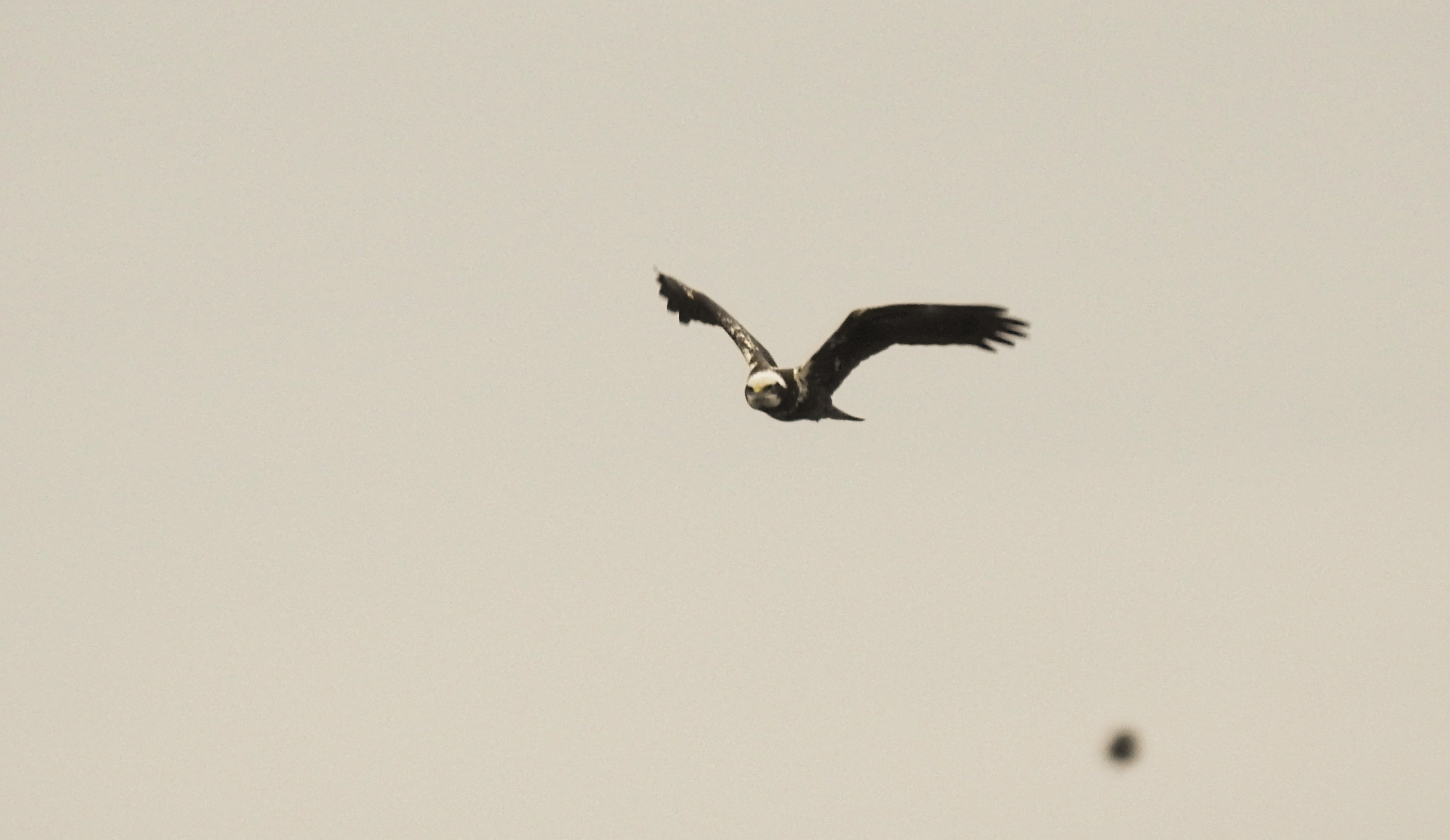
Above and below, the female Marsh Harrier flying over the Goosander Hide.

We gave Ibsley Water a good scan for any Hirundines but drew a blank and as it was nearing 2pm, I decided to call it a day and make our way back to the car. A couple of Redwing flew out of cover and one landed high up in a tree. A pair of Roe Deer were also flushed close to the footpath and looked at us totally bemused as we walked on. A good variety of birds today and another ‘year-tick’ in the bag too. 


A singing male Siskin in front of the Woodland Hide.


Thursday, March 9, 2023

Fairly quiet around Eastney and Southsea beach.

Thursday 9th March 2023.


This Lesser Black-backed Gull thankfully landed back on the Common.

Despite the rain, I had to go out today and see if I could come up with a good sighting along the both Southsea seafront and the harbour entrance at Eastney. Yes, I may have done it from the comfort of my car, but there was no chance of getting a soaking from the car and so looking through the window, I first pulled up at Eastney car park to check the high tide. There was quite a heavy swell within the harbour entrance, but there was absolutely nothing sitting on the water around midday.


Opening the car windows up a little, there were Starlings perched on the lone bush to my left (above) and Black-headed Gulls on the beach near the car to my right (below).

The car park was quite full when I arrived, but I was lucky enough to grab the last space. A small group of Black-headed Gulls were on the beach close by and a small flock of 10 Starlings were sat on the only small bush here and a pair of Dunnocks were feeding on probably bird feed on the concrete below. Sadly, nothing else to report here and so I took a drive down to the spit to check the northern end of Langstone Harbour.


Above, these two Brent Geese were close in by the spit while below, two flocks of Brent Geese flew in opposite directions from one another.

From here, which was also very busy with cars parking here, a pair of Brent Geese were bobbing on the high water close to the shoreline, while a large flock in the distance flew high over the houses, splitting into two groups with one heading east and the other flying west. I scanned the harbour thoroughly for any wildfowl on the water, but the only bird I found was a drake Red-breasted Merganser that was some distance out. The rain had eased up a bit and so I got out of the car to take a few photos of the said birds.


Above, this lone drake Red-breasted Merganser was the only duck I saw on the harbour. Below, the Lesser Black-backed Gull along with a nearby Carrion Crow, were on Southsea Common. 

After ten minutes or so, I then headed along the seafront, hoping to catch sight of my first Wheatear of the year (wishful thinking!) and also to check the small Gull flocks on the beach for any Med Gulls. I didn't come across any and so took a drive down to Southsea Common. From here, I pulled up in the lay by near the Hovercraft Terminal and scanned the sea first for anything of note. Naff all! So I checked Southsea  Common and among the many Black-headed and Herring Gulls present, I found a single Lesser Black-backed Gull on the field but it was soon flushed by a dog-walker and lucky for me, settled briefly nearby on the Common. There were plenty more Brent Geese again down here, but again, flushed by the dog-walkers. Ho hum!


Above, the Lesser Black-backed Gull settling back down on the Common. Below, this lucky photo of a Brent Geese passing the window of the Naval Memorial Building!

Apart from another largish flock of Brent by the old Royal Marine Museum flying over, not a lot else was seen and so I made my way back home. In Hampshire today, the four Glossy Ibis were once again seen early this morning at Bridge Street Floods as well as a Siberian Chiffchaff.        


Above, this Waxwing was seen and photographed by 'Lazee Birder' John Manley this morning at a place called Cranfield, Milton Keynes. Hampshire has not been blessed with this species for a few years now; but you never know what could turn up with this wintry weather around.


Wednesday, March 8, 2023

A blast from the past!

Wednesday 8th March 2023


Ten years ago today, 11 Purple Sandpipers were seen feeding by Southsea Castle and have been ever since during the Winter and early Spring period.

Today was a bit of a washout with near non-stop rain all day and so I did not venture out today apart from looking after our grandchild Isabelle for around an hour early this morning. In fact, the only bird I saw today was a Blackbird feeding on the Apple halves in my garden and a few House Sparrows also in the garden enjoying the Sunflower hearts within the feeder.

The weather was still very cold and although we had rain all day, further north in the County, snow had laid overnight and a few snow showers still lingered. It even settled as far south as Clanfield and the news services were warning drivers to not go out in the icy conditions. More snow is forecast overnight in the north of the County and hopefully, it will stay there. It just might push something interesting down further south. Fingers crossed.


From top to bottom, Geoff Farwell, myself and Geoff again birding at St. Catherine's Point, Isle of Wight way back in 1984! Both of us had lots of hair then! Cracking trip though.

So, though I have not been birding since Sunday, I thought I would do a ‘blast from the past’ by going back 10, 20, 30 and even 40 years ago! Bloody hell, I feel terribly old! I have been logging my bird sightings since 1977 and so I had the opportunity to go through my old log books. So I shall kick off March 8th 2013. I was actually birding in horrible conditions again (deja vu!) at Southsea Castle where I saw up to 11 Purple Sandpipers. That was the good news, or the bad news was that my DSL camera at the time got water damaged and with a trip to Cyprus coming up a few weeks later, that's how I got into Bridge Cameras. Meanwhile, Farlington Marshes was hosting on this date, a Red-breasted Goose and a Spoonbill.


Me sea-watching off St. Catherine's Point, Isle of Wight nearly 40 years ago

Twenty years ago today, I was at Portland Bill with my sons Nathan and Daniel. Yes, I used to take them a lot on my birding trips and although they were not really into birds, they always kept themselves entertained. Christ, I miss them, but that's another story. Portland Bill hosted the usual Gannets, Guillemots, Razorbill, Fulmar and a Great Northern Diver plus two Purple Sandpipers on the rocks below. While the boys were playing on the skateboard, I checked out Portland Harbour from Sandsfoot Castle where I saw both Slavonian and Black-necked Grebes plus a good number of Mergansers in blustery cold conditions.   


Summary of our sightings on 21st April 1984 at St. Catherine's Point.

Thirty years ago on March 5th (no birding on the 8th), I took a trip down to Farlington Marshes and although all the usual waders and wildfowl were present, I also saw a superb male Merlin flying over the seawall and out into the harbour and also a singing male Reed Bunting.

Forty years ago on this date, sadly I have no bird news at all as it seems I took a 8 month break from writing up my bird reports. However, I have provided a photo of both Geoff Farwell and myself on a big seawatch at St. Catherines Point on the Isle of Wight. This took place well before I was driving and also mobile phones; but in April 1984, we caught the Ferry across and then got the bus all the way to spend the weekend at this good seawatching area. If I remember rightly, we did notch up some good birds including Velvet Scoter, Arctic Skua, Manx Shearwater, Little Gull, Black-throated Diver, Hobby and Pomarine Skua on the 21st April.


This photo was taken at Church Norton, West Sussex in 1983! Oh to be able to wear a size 33 pair of Jeans again!!!

Will I be reporting what was seen 50 years ago we shall see, but the birds that are being seen regularly in the UK now for example: Little Egret, Great White Egret and Glossy Ibis are near common whereas Tree Sparrow, Willow Tit and Yellow Wagtail that we saw regularly all those years ago are so rare now on the south coast.


Sunday, March 5, 2023

Ravens over the Cemetery.

Sunday 5th March 2023.


A view of one of the footpaths looking east. Could there be a migrant bird lurking among the gravestones. I am surely due a Hoopoe soon?

It was back over Highland Road Cemetery this afternoon for a slow meander around my local patch. A trickle of migrants were seen yesterday, with both Sand Martin and an Osprey seen in Dorset; so would there be a possible Blackcap or Chiffchaff lurking about within the Cemy? It was still quite cold (snow is predicted in Scotland and Northern England tomorrow!), but there was hardly any wind and when I first arrived at 12.30pm, it was quite sunny.


One of three Jays seen this morning on my walk round.

A total of 18 species of birds were either heard or seen during my visit here today and that included a pair of Ravens that were seen flying high up and heading east. I have had them over the Cemetery before in the past, but it still is a rare sight still to see them here. Yes, probably the highlight of my visit here, though I did see my first Tapered Drone Fly of the year. The Jays showed well today and I think there might have been at least three of them today. The only relatively uncommon bird I noted this morning I didn't exactly see. A Mediterranean Gull was heard to call overhead, but checking the sky, I then came across the Ravens and so I gave them my total attention! Unbelievably, not one Starling was seen this morning.


Above, one of the two Ravens that flew high east over the Cemetery and below, my first Tapered Drone Fly of the year.

The birds seen or heard this morning included the following:

  • Raven
  • Carrion Crow
  • Jay 
  • Magpie
  • Herring Gull
  • Black-headed Gull
  • Mediterranean Gull
  • Wood Pigeon 
  • Feral Pigeon
  • Collared Dove
  • Blue Tit
  • Great Tit
  • Greenfinch
  • Goldfinch
  • Wren
  • Blackbird
  • Robin
  • House Sparrow


Above and below, a large swathe of Red Dead-nettle was now in bloom.

As mentioned before, my first Tapered Drone Fly of the year was seen this morning perched on one of the graves, warming itself up in the sunshine. Several Buff-tailed Bumble bees were again in the grave with all the Heather within it, but no other Bees or Hoverflies on the wing. On the subject of plants, a huge swathe of Red Dead-nettle was now out in bloom by the path leading towards the Holm Oak Clump; while other plants present and in flower included the Winter Heliotrope, Smooth Sow-thistle and the all too common, Common Groundsel. Yes, some of the graves held flowering Daffodils and Grape Hyacinths which were very pretty; but not quite as good as our native plants though.


Above, good numbers of Blackbirds were still in the Cemetery including this male bird. Below, this was the only Collared Dove seen this morning; perched high up in one of the Chestnut trees that are budding now.

In Hampshire this morning, a pair of Spoonbills were on Farlington Marshes, however, at least 9 birds were seen at Normandy Marshes! The long staying Iceland Gull is still at Redbridge Wharf and showing well still.


From top to bottom: One of many Goldfinches in the Cemetery today; several Buff-tailed Bumble Bees on the Heather grave and finally, the Winter Heliotrope still in flower near the Holm Oaks.


Saturday, March 4, 2023

Brambling & a superb Merlin out in the 'sticks'!

Saturday 4th March 2023.


It looked far better in the scope! This female Brambling was seen just north of Warnford among the many passerines present.

I was at a bit of a loss on where to go this morning with Andy Fisher and eventually, with Blashford Lakes, Farlington Marshes and a few other areas to think about, I decided to take a drive north-east to Warnham for possible Bramblings. The weather did not look particularly clever, especially for bird photography, what with heavy cloud overhead and the north-easterly still blowing. Even the temperature was colder than yesterday and not rising above 5 degrees centigrade.


This area north of Wheely Farm held a lot of stubble in the field that obviously attracted a lot of finches and Reed Buntings. However, we did not expect so many different birds at just one spot, which made our time here superb. The Brambling was photographed in the trees at the back of this field.


One of the many Reed Buntings present here.

Brambling have been very scarce in Hampshire this Winter and even Blashford Lakes and the New Forest have been parched for this species so far; so when I read earlier this week that a road just north of Wheely Farm near Warnham, had a few birds among the Chaffinches, I decided to take a gamble. Good news, it most certainly paid off, not only for the Brambling, but a very good selection of birds there.


A Red Kite spooked a lot of the passerines, but they did return, thankfully.

As we were both just about to get in the car, I heard a Raven overhead and sure enough, three birds were seen flying eastbound high over the houses. ‘A good omen’ I said to Andy. Then we drove north up the A3 to the village of Warnford. Taking Wheely Down Road from the village of Warnford, we got to the end and then turned right, drove past the Farm and kept an eye out for any finches flying around by the roadside. Some quarter of a mile from the end of the road, we saw a lot of passerines flying around the fields and so I pulled over on the side of the road and began searching through the many birds present. At first, we came across several Reed Buntings, with at least a dozen present and then a large number of Chaffinches flew over our heads, landing in nearby bushes. It was then I heard the familiar call of a Brambling and then caught sight of one landing in a bush on the opposite side of the field from where we stood. My Swarovski scope came to the rescue and there was no doubt we were looking at our first Brambling of the year. Andy punched the air in delight.


Above, a Reed Bunting sharing a bush with a female Chaffinch. Below, a female Reed Bunting landed in a tree close to where we stood.

Question was, how many were there? I think there were at least two birds among the 30+ Chaffinches, but the birds were quite flighty and did not hang around in the same place long. Earlier, as I was driving up to where I parked, Andy spotted a couple of finches perched by the roadside, which turned out to be a pair of Bullfinches. A good start. We then spent the next hour going through the many passerines present here. Both Red Kites and Common Buzzards flew over and even a Mediterranean Gull was heard to call as we watched a high flying bird heading north. Andy still needed a Yellowhammer for his year list and I soon picked out a calling bird in the hedge opposite from where we stood, then it flew over our heads and off over the fields.


This male Yellowhammer was one of three that were seen at Cheesefoot Head.

Andy was now on two new species for the year as we enjoyed several views of the Bramblings, but they were all distant views in my book and so we waited a little longer for a much closer view that never came. During our wait, we heard a Woodlark singing somewhere behind the trees and bushes in front of us, but sadly failed to locate the bird, which was frustrating. Lovely song, nonetheless. A Firecrest suddenly appeared, seen flitting about the Ivy clad trees by the roadside, though it didn't hang around for long. Happy with what we had seen in this one area, I said we would give Cheesefoot Head a try for Corn Buntings. As we drove down to the bottom of the road, the fields to our left held a large number of both Fieldfare and Redwing searching for food on the ground.


Above, good numbers of Red Kite were on the wing today including this individual over Cheesefoot Head. Below, the track we followed by the Scrubby area that held plenty of birds.

The car park at Cheesefoot Head was quite full, but we were lucky enough to grab one of the few parking areas as we soon grabbed our gear to make our way up to the footpath leading to the scrubby area to the south. There was a Tea stall in the car park that was tempting, especially with the delicious looking cakes on sale; but I resisted the temptation (my waistline is bad enough as it is!) and headed off down the track where we came across a couple of Meadow Pipits, at least 3 Yellowhammers and a dozen or so Chaffinches! To ‘cut to the chase’, there was absolutely no sign of any Corn Buntings during our hours walk here, but we did see a fantastic male Merlin come belting in low from over the fields to ambush a large flock of Chaffinches, of which it looked as though it grabbed one, settled on the ground briefly and then headed off south. Another punch in the air from Andy!


Above, one of at least four Brown Hare's we saw today and below, a Roe Deer ran across the field behind the Scrubby area.

There was an awful lot of activity here, which cheered us up no end as the cold temperatures here were really noticeable. Not just birds here were keeping us entertained, but I got onto my first Brown Hares of the year with at least four individuals seen in the fields. Even a Roe Deer ran out of the scrubby area to our right and ran across the field to the north. This in turn flushed up a few Red-legged Partridges while back in the scrubby area, large numbers of both Chaffinch and Linnet were seen. It was most certainly a good day for raptors as good numbers of both Red Kite and Common Buzzard were on the wing here and all over the countryside.


Most of my Red Kite photos came out either poor or blurred, but this distant individual showed very well in front of us at Cheesefoot Head.

While checking the fields on the horizon, there were huge numbers of passerines flying over the fields, though too far to be certain on what they were, but most likely finch flocks along with several thrush flocks too. It was nice to hear Skylark's singing overhead and a few were seen quite well as we made our way back to the car. Crossing the main A272, we took the footpath heading north and tried our luck there for the Corn Buntings; but although I have seen them there in the past, again there was no sign of any. Instead, as well as superb views of the Kites (plus a few Common Buzzards and a male Kestrel), there was a huge mixed flock of both Redwing and Fieldfare on the ground adjacent to the footpath. I also found a few Blackbirds, at least two Song Thrushes and a solitary Mistle Thrush that was perched on a fence post!


The battery in my camera was dying on me, but I managed to grab one photo of the many Fieldfare present at Cheesefoot Head! 

Back at the car park, I fancied trying Alresford Pond in New Alresford; however, on reaching the village, we could not find a suitable parking place and eventually took the Bighton Lane route where we came across some Cress Beds. There was a possible chance of a Green Sandpiper here and so we pulled over and took a look. No sign of any Green Sandpipers, but we did have both Grey and Pied Wagtail plus a Firecrest was flitting about in trees by the roadside. Apparently, viewing the Pond itself is not as easy as it looks and so we aborted that idea and headed off to Petersfield Lake (Heath Pond) for the dodgy Ruddy Shelduck that everyone seems to be ‘ticking off’! Andy had already seen the bird earlier this year, but when I looked today, no sign of the damn thing! Not the ending I was hoping for, but you cannot win them all, as they say. Still, some cracking birds today and a few surprises too.        


Peregrine and Ravens over Old Portsmouth.

Thursday 22nd October 2026. Another stunning dawn over Highland Road Cemetery while walking the dogs early this morning. A very strong wes...