Saturday, June 8, 2024

Off to Normandy Marshes for Roseates.

Saturday 8th June 2024.

The Roseate Tern on Normandy Marshes.


The three new moths for the year this morning in my Moth Box. From top to bottom: Clouded Border, Sycamore and the micro moth, Bramble Shoot Moth.

The Moth Box:

Another fair selection this morning, despite being cooler of late and a bit of overhead cloud. There were 47 moths of 21 moth species this morning that included three that were new for the year. I was up at ‘Whatstupidtimeisthis’ o’clock this morning (4.30am!) and it was still only just getting light. A quick check of the white sheet behind the moth box revealed a few moths, but not many, but better things were to be discovered when I found my first Sycamore moth of the year (an uncommon moth in my garden) as well as a superb Clouded Border, that was at the bottom of the moth box alongside a Garden Carpet. Of the micro moths, the best was my first Bramble Shoot Moth of the year; a common moth which I regularly see in the moth box throughout the summer, but always nice to get the first one. Other interesting moths included a White-point, which was probably an immigrant moth from the Continent; two Setaceous Hebrew Characters and two different forms of Marbled Minor.

The moths present this morning included the following:

  • White Ermine 3
  • Clouded Border (NEW FOR YEAR)
  • Lime-speck Pug 3
  • Common Pug
  • Bright-line Brown-eye 3
  • Common Marbled Carpet
  • Marbled Minor 2
  • Heart & Dart 4
  • Dark Arches
  • Garden Carpet 4
  • Willow Beauty 4
  • Sycamore (NFY)
  • Vine’s Rustic 4
  • Pale Mottled Beauty 4
  • Setaceous Hebrew Character 2
  • L-album Wainscot
  • White-point
  • Riband Wave
  • Barred Marble 4
  • Ruddy Streak
  • Bramble Shoot Moth (NFY)

On reaching Andy’s house, we quickly got stuck into the moths there and this morning, there was a good number and variety to go through. Three more moths were added to my year list including a superb Scorched Wing that was perched on the back door frame. There were two colourful micro moths present that were new for the year: Garden Straw (Agapeta hamana) and also a Yellow-spotted Tortrix with the near unpronounceable latin name of Pseudargyrotoza conwagana. With the new moths for the year seen earlier this morning and the ones in Andy’s garden, I can now confirm that I have officially seen 102 species this year so far.


Another three more moths that were new for the year were the above. From top to bottom: Scorched Wing and the micro moths, Garden Straw and Yellow-spotted Tortrix.

The moths present here included the following:

  • Willow Beauty 8
  • Heart & Dart 3
  • Dark Arches
  • Freyer’s Pug
  • Garden Carpet
  • Scorched Wing (NEW FOR YEAR)
  • Common Marbled Carpet 5
  • Green Pug 2
  • Freyer’s Pug
  • Common Pug
  • Brimstone Moth
  • Treble Lines
  • Vines Rustic
  • Blair’s Mocha
  • Garden Straw (New for Year)
  • Bee Moth 2
  • Narrow-winged Grey
  • Blushed Knot-horn 2
  • Brown House Moth 2
  • Yellow-spotted Tortrix (NFY)

We had a three-way choice. Go for the Ruddy Shelduck on Petersfield Pond (a pretty poor year-tick, but it's still a year-tick) and also the Lizard Orchid of which I will not disclose the location of this very rare plant or the American Golden Plover in Pagham Harbour (yep, still there) or the Roseate Terns on Normandy Marshes. I put this to Mr Andy Fisher and it was a resounding Roseates please!!


Above, on arrival to Normandy Marshes, the first area on the west side, there were many family parties of Avocets wading in the shallow waters including their gorgeous fluffy chicks. Below, Little Terns were most entertaining by hovering right in front of us.


Above, one of the hovering Little Terns and below, a small group of Avocets together.


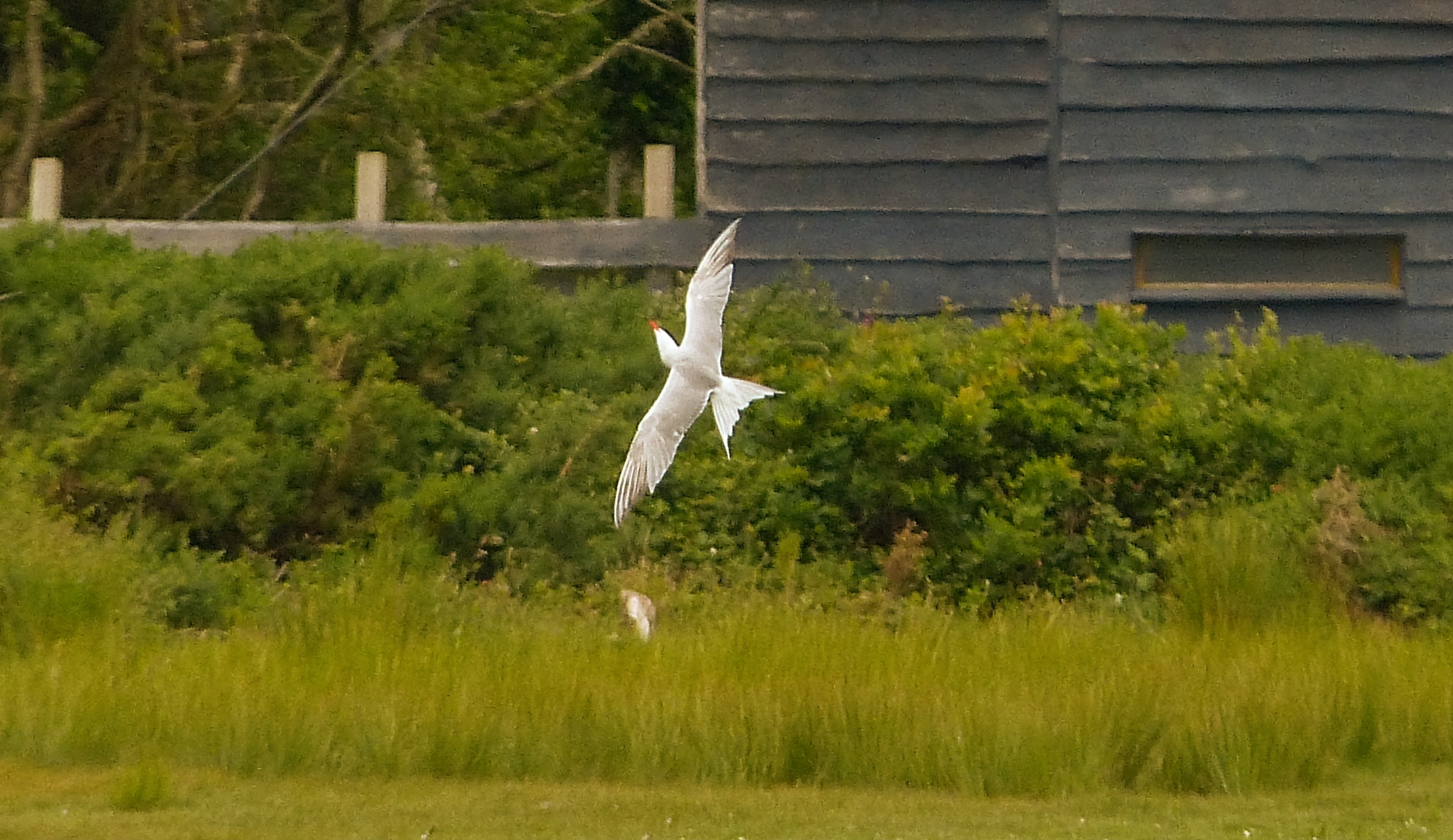
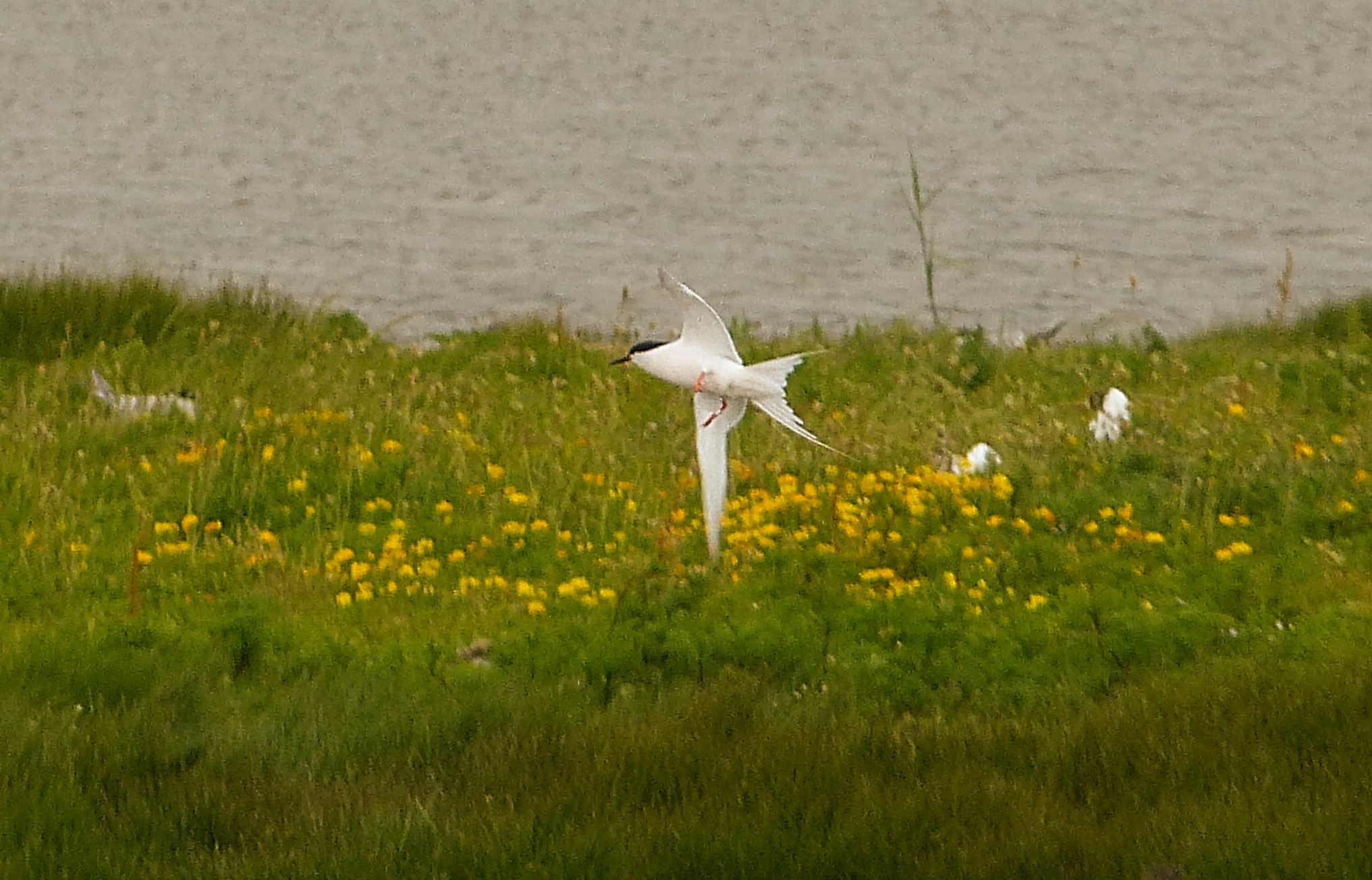
Above, the star bird, the Roseate Tern nesting with Common Terns and Black-headed Gulls.

Normandy Marshes, nr Lymington:

The long drive down to the site was worth it as we eventually got to see one of the Roseate Terns. We even met up with Keith Betton and his friend at the site by the seawall and had a good chat about the birds and also the Peregrines in Southampton and Portsmouth. The Roseate Terns here are actually breeding here and now have a 24hr guard to protect from egg-collectors. Sadly, there is still this type of scum still around, who I would love to meet and have a non-friendly chat with. It seems the justice system in the UK is so pathetically weak regarding these egg-collectors, that some other form of retribution just might be necessary. 


Above, this Redshank was one of two that liked perching on the fence posts in front of us while we watched the Terns by the seawall. Below, you can just about see a Ringed Plover walking by the edge of the island.


Above, an adult Avocet with its youngster and below, a Common Tern which has just caught a fish on the Marshes.


Above and below, a Common Tern, one of many here, was seen fishing around the islands.


Above, the young Avocet on Normandy Marshes.

Normandy Marshes is a superb habitat which has shallow pools in which waders can breed including the many Avocets here with young and a few Redshank. The islands held a large number of both breeding Common and Little Terns and both species showed well all the time. A Great Crested Grebe swam close to the islands while out in the Solent, we found at least 4 drake Eiders resting on the islands and a female was seen further west. Many Terns were seen flying over the Solent including plenty of Sandwich Terns; but it was the Roseate Tern that grabbed our attention. There was an elderly chap who kindly helped us to pinpoint where the Roseate Tern was nesting; but it wasn't quite visible with only brief wing or tail views. Then the shout went up, the bird was showing well and then we had some excellent views of the UK’s rarest Tern. The bird was getting grief from a nearby Black-headed Gull and had a right old fight until the Roseate Tern decided to fly around the island a few times and then return to its nesting area. Very spectacular.


Above, one of many Avocets chicks on the Marshes and below, a Great Crested Grebe swimming past the island with an adult Common Tern and youngsters in the background.


Above, fluffy Black-headed Gull chicks were abundant on the island and below, a Common Tern returning to its nest with food.


Above, the same Common Tern laden with fish for its youngsters.

Other birds present included large numbers of Canada Geese on the site and a few Oystercatchers dotted around too. A Common Whitethroat was singing nearby and eventually flew past us and headed off west. Checking my phone for any bird sightings, it turned out that a Quail had been heard singing on wasteland behind the nearby Fishtail Lagoon. Instead of hiking the long distance to get there, we walked back to the car and drove to the Car Park at the bottom of Lower Pennington Lane. From here, a Lesser Whitethroat was singing deep within a nearby bush (we did see the bird later on) and then we walked west along the Ancient Highway, but it didn't take long for us to catch up with the calling Quail. We had no chance of actually seeing the bird due to the tall vegetation, but the bird was calling roughly every ten minutes or so and we also had a comfy bench to have our lunch on while listening to the bird. Wonderful. 


Above and below, a female Common Darter dragonfly on brambles along the Ancient Highway track.


Above, a good number of both Black-tailed Godwit and Avocet were on the Fishtail Lagoon and also included Ringed Plover, Dunlin and Little Ringed Plover nearby. Below, this gorgeous male Marsh Harrier flew north close to where we sat overlooking Fishtail Lagoon.


Above and below, the male Marsh Harrier drifted off northbound.

There was a good selection of birds present here while we listened to the Quail that included a gorgeous male Marsh Harrier flying north and fairly close too. Out on Fishtail Lagoon, there was a good sized flock of Black–tailed Godwit present (roughly 30+ birds) along with three Ringed Plover and singles of Dunlin and Little Ringed Plover. A male Reed Bunting showed very well nearby and a large flock of around 20+ Swifts flew in and over our heads. A pair of Common Buzzards also flew overhead and a Kestrel was seen a little later. We had seen Andy Friend and Andy Tew earlier walking along the seawall and about 40 minutes later we caught up with them by the bench. Andy Friend had seen some Spoonbills on the western end of Fishtail Lagoon and so we went off to look at them. There were two birds present with two Little Egrets and all the birds showed very well, busy feeding on the shallow pools. A Cuckoo, which was earlier heard calling distantly, flew across Fishtail Lagoon and headed off low west being chased by Starlings! What a great variety of birds here.


Above, we saw both Andy Tew and Andy Friend walking along the seawall by Fishtail Lagoon. Look how close the Isle of Wight looks behind them. Below, a Honey Bee on Cow Parsley. When I saw this, the insect life here really caught my eye.


Above, a male Reed Bunting showed well by the bench and below, one of the Spoonbills taking flight over Fishtail Lagoon.


The pair of Spoonbills showing well over Fishtail Lagoon and below, settling down to feed.


Above, several Mirid Bugs were found along the track and below, I found this large Nursery Spider as well.


Above, a Roe Deer in the grass north of Fishtail Lagoon and below, the guys walking back to the car after another superb day at this fantastic site.

Yet another cracking days’ birding and talking to Andy Friend, he said we could accept both Quail and Bittern (the ‘booming’ bird on Fishlake Meadows earlier this year) on our year lists, as well as Tawny Owl. I had possibly (though I think it probably was) heard a Bee-eater calling from Pembroke Road last month, but because I only heard it once, I will not accept adding this to my Hampshire list this time. Emma and Matt Parkes also turned up at Normandy Marsh and got great views of the Roseate Tern including the sitting birds mate returning with a fish, well after we had left to go home.


Above, the Roseate Tern having a battle with a Black-headed Gull on Normandy Marshes.


Friday, June 7, 2024

More new moths and a trip around the Cemy.

Friday 7th June 2024.


One of two Swifts seen flying over Highland Road Cemetery.

I honestly thought that setting my alarm for 5am this morning would be ample time to get to my Moth Box before the Sparrows attack my moths; but I was very wrong. I could hear a Sparrow calling outside and when I let the dog out in the garden, at least 6 House Sparrows from around the Moth Box area. The white sheet was empty of moths and there weren't many close to the Moth Box either! So now I have to set my alarm even earlier. Sob!


Above, the Single-dotted Wave and below, the micro moth Barred Marble were both new for the year.

The Moth Box:

Another clear blue sky overhead first thing this morning, but most certainly a chill in the air as I went about trying to find the moths that survived outside the Moth Box. Just 31 moths of 17 species were present today and again, two more species were new for the year that included a fine Single-dotted Wave on one of the windows of which I quickly potted and the micro moth, Barred Marble (Celypha striana); a fairly regular species to my garden annually.

The moth present this morning included the following:

  • Brimstone Moth
  • Lime-speck Pug 2
  • Common Pug
  • Pale Mottled Willow 3
  • Garden Carpet
  • White Ermine 4
  • Vine’s Rustic
  • L-album Wainscot 2
  • Riband Wave
  • Bright-line Brown-eye 3
  • Heart & Dart 5
  • Single-dotted Wave (NEW FOR YEAR)
  • Willow Beauty
  • Dark Arches 3
  • Barred Marble (NFY)
  • Ruddy Streak
  • Brown House Moth

Highland Road Cemetery, Southsea:


Above, parts of the Cemetery were still overgrown, but for how long? Below, a Collared Dove posed nicely in the morning sunshine.


Above, this was the only Robin seen this morning in the Cemy.

Before my walk with the dogs around Highland Road Cemetery, my first shift at Pembroke Road, Old Portsmouth, this morning produced just 12 species of birds in all. A lovely start to the morning with bright sunshine with very little wind, but a little chilly in the shadows. A few Swifts flew over and a single Goldfinch also headed west. The Carrion Crow that nested in one of the Holm Oaks by the Bowling Green has two fully fledged juveniles and they showed themselves occasionally. Now that the D-day celebrations are over, the area around Southsea is getting back to normal and all the roads have reopened. 


Above, a Narcissus Bulb Fly nectaring on a Smooth Sow-thistle. Below, a very small species just flew off after nectaring on this Scarlet Pimpernel plant.


Above, Purple Toadflax was growing abundantly around the perimeter of the Cemy.

Just 15 bird species were seen in the Cemetery this morning, which was a little disappointing, but I did see the Green Woodpecker briefly on my walk round. The bird flew up from the grass and flew west over the Cemetery but I failed to find where it actually landed. Unfortunately, I did witness a Carrion Crow take out a juvenile Blackbird, much to the anger of the parent birds that tried to get the Crow to drop the offspring. I know I shouldn't, but I even tried to chase the Crow, but the Crow was having none of it as it flew off with its kill. I later saw it ripping the hapless youngster apart to devour it. Though gruesome, the Carrion Crow probably has young to feed itself and so one has to accept the cruelty of nature now and then.


Above, a Five-spotted Ladybird on Prickly Sow-thistle. Below, an attractive clump of Ox-eye Daisies.


Above, a species of Ichneuman Wasp called Toothed Tiger.

There were plenty of plants on show, but I was very disappointed in the grass being cut again by the Council. However, pockets of long grass, especially by the graves themselves, were left alone (but for how long), which should encourage the insects to be abundant and then plenty of food for the young birds to feed on. Among the plants, Cat’s Ear, Meadow Hawkweed, Purple Toadflax and Scarlet Pimpernel were abundant throughout the Cemetery along with Ox-eye Daisies and Birds-foot Trefoil making it quite a colourful scene despite a lot of the grass being mown (which I find so ugly to look at). Sadly, I expect that some ‘bleeding hearts’ out there like the area to be mown and tidy rather than let nature take its course. Very sad!


Above and below, nature at its most raw. This Carrion Crow had just nabbed a fledgeling Blackbird to quickly devour.


Meadow Hawkweed growing in the Cemetery.

There were some interesting insects found this morning on my walk too with sightings of a Narcissus Bulb Fly, which is a type of Hoverfly which mimics Bees in appearance and also the Ichneumon Wasp called Toothed Tiger (Amblyteles armatorius); a very striking insect indeed. A few Ladybirds were seen and the only butterfly noted was a Speckled Wood, which flew off before I could grab a photo. 

The birds seen in the Cemetery this morning included the following:

  • Green Woodpecker
  • Herring Gull
  • Carrion Crow
  • Magpie
  • House Sparrow
  • Starling
  • Robin
  • Wren
  • Blue Tit
  • Greenfinch
  • Goldfinch
  • Wood Pigeon
  • Collared Dove
  • Feral Pigeon
  • Blackbird

A lovely walk in the Cemetery despite the noise of the Strimmers in the distance, but as always, the ‘grass cutters’ were very polite again. The American Golden Plover was again seen distantly from where we stood yesterday evening, today. Bugger!


Thursday, June 6, 2024

American Golden Plover no show.

Thursday 6th June 2024.


Low tide in Pagham Harbour, but no sign of the American Golden Plover among the few waders present.

Pagham Harbour had a little ‘purple patch’ yesterday with an American Golden Plover in summer plumage and a Golden Oriole reported early this morning, both birds in the north-eastern part of the reserve. The weather remained pleasant throughout the day and I had the opportunity to try my luck in seeing at least the Plover when I was offered a lift to the site with both Emma and Matt Parkes. I dropped my car off at the Farlington Marshes around 7pm and bang on time, we made our way along the A27 eastbound. Sussex is turning up some excellent birds which included their first Cirl Bunting this century in the east of the County. 


Above, evening at the Breach Pool and below, three Mallards fly out into the harbour.

A lot of my birding is virtually in Hampshire, but it was so nice to return to Pagham Harbour again, a site I know so very well and after parking up at the bottom of Church Lane, we made our way to the seawall and took the path leading south to join a small group of birders overlooking the harbour. It was low tide now and earlier this evening, a fellow birder rang me to say that he had great views of the American Golden Plover at high tide earlier in the afternoon, sat on an island and showing well. As we made our way to the guys present, a returning birder told us that the bird had not been seen, but that didn't deter us and so we joined a chap who possessed one of those BTX Swarovski scopes. This guy was convinced that he had the bird some distance away with Golden Plovers, but all I could see was a pristine Grey Plover in summer plumage and possibly a few Grey Plovers in winter plumage on the mudflats. 


Above and below, a male Marsh Harrier drifted over the reedbed by the seawall near the Breach Pool.

These birds were very distant and the light was not that great either (around 8pm now). Both Matt and I have the same scope and on 60x magnification and I was adamant that the American Golden Plover was not present here among the small number of waders on the mudflats. At first, the wind blowing across the harbour was not helping at all, but it soon dropped and studying the distant waders thoroughly, I was happy with the fact the AMG was certainly not showing. Yes, it could be in one of the many creeks or even somewhere else in the harbour.  It was low tide and a few Curlew, Lapwing and Redshank were present and looking south, behind the large number of mixed Gulls, I saw a large flock of smaller waders of which were probably Ringed Plover and Dunlin.


The sun was starting to set in the west over Owl Copse.

So, after a good 30 minutes here, the guys decided to call it a day here and take a look by the Breach Pool as the sun was slowly setting. A Common Whitethroat was seen earlier and in front of us, a few Reed Warblers were flying low over the reeds while a few more were singing deep within the reedbeds. A superb male Marsh Harrier flew low over the reeds and eventually dropped into the reedbed and minutes later, a female Marsh Harrier sailed slowly over the reedbed and then flew off north. Matt and I picked out a Barn Owl flying over the fields near some distant houses, but that was the last we saw of it. Watching a flock of Little Egrets flying out into the harbour with the sunset in the background would adorn many a magazine cover, but my camera is not of the standard for that, but I was happy with it nonetheless. I did miss tonight's Springwatch, but to be here at sunset is something to be treasured and with great company, I really enjoyed tonight.


A flock of Little Egrets flying out into the harbour in the sunset. Gorgeous.

Earlier today, I had a total of 14 species of birds during my both shifts at Pembroke Road, Old Portsmouth that included four species of Gull: Herring, Black-headed, Great Black-backed and Mediterranean Gull seen and a pair of Swifts put in a brief appearance.


Tuesday, June 4, 2024

A very scarce moth graces my Moth Box.

Wednesday 5th June 2024.


The micro moth, Small Fruit Moth, was only my second ever of this scarce species.

Up at the crack of dawn this morning, after seeing those House Sparrows near my moth box the other morning, I dragged myself down to the moth box at 4.45am! There were just two moths this morning that were new for the year, with two Riband Waves and the micro moth, Small Fruit Moth (Grapholita lobarzewskii). The latter is a scarce moth in the UK, especially in Hampshire and I was pleased to get only my second one of this species in my moth box. My second L-album Wainscot of the year was in the moth box this time, after having one in my kitchen last week. There were 40 moths of 18 species present today.

  • Riband Wave 2 (New for Year)
  • Common Marbled Carpet 2
  • Willow Beauty 5
  • Garden Carpet
  • Lime-speck Pug
  • White-point
  • Pale Mottled Willow 6
  • Dark Arches 2
  • L-album Wainscot
  • Vine’s Rustic 5
  • Heart & Dart 4
  • White Ermine 3
  • Shuttle-shaped Dart 2
  • Large Yellow Underwing
  • Buff Ermine 1
  • Light Brown Apple Moth
  • Box-tree Moth
  • Small Fruit Moth (NFY)


Two Riband Wave moths were also new for the year. A very common moth to my garden, but always nice to see.

Last night, while walking the dogs just after 9pm, I noticed at least one Swift returning to one of the Swift nestboxes, in fact, one of the older boxes that had been up for a few years; this one above my neighbours house. I could hear another Swift within the moth box greeting its partner. Hopefully, many more will be doing the same thing in the near future, for they have plenty of boxes to choose from!


The scourge of many gardeners, the Box-tree Moth has returned again and they do come back in huge numbers. Will they be this year?

Yesterday, the big bird news in Hampshire was the discovery of a cracking male Red-backed Shrike at Manor Farm Country Park, Bursledon, Southampton. The bird remained faithful to the site throughout the day after its discovery, allowing many to add this beautiful bird to their year list. Lucky buggers!


Above and below, the male Red-backed Shrike seen yesterday. Photos by Rob Porter.


Monday, June 3, 2024

Two more micro moths added to year list.

Monday 3rd June 2024.


Yellow Oak Tortrix, my first of the year.

It is back to Pembroke Road this morning and though I set my alarm for 6am, I was up at 5am instead. The ‘Body Clock’ will not let me lay in and what with the light shining into the bedroom, I had to get up. I was glad I did as when I stepped into the garden, I flushed around four House Sparrows perched just above my box on the Kitchen roof! It looks as though they have now ‘cottoned on’ about my moth box and an easy food source to feed their young and so I might have to set the alarm clock even earlier now! Sob! On a positive note, there were 41 moths of 23 species and among them was a Silver-ground Carpet perched on the white sheet behind the Moth Box. After finding one at Noar Hill last Saturday, I was surprised to find one in my garden and a good moth too. There were two moths that were new for the year; both micro moths called Yellow Oak Tortrix (Aleimma loeflingiana) and Pale-backed Detritus Moth (Monopis crocicapitella), both being pretty little moths that are regular to my garden.


Above, a Pale-backed Detritus Moth, which was also new for the year. Below, a Least Black Arches moth.

The moths present this morning included the following:

  • Silver-ground Carpet
  • Garden Carpet 4
  • Bright-line Brown-eye
  • Heart & Dart 6
  • Pale Mottled Willow
  • Buff Ermine
  • Shuttle-shaped Dart 2
  • Dark Arches
  • Marbled Minor
  • Least Black Arches
  • Willow Beauty 3
  • Common Pug
  • Lime-speck Pug
  • Green Pug
  • Common Marbled Carpet
  • White Ermine 2
  • White-point
  • Large Pale Masoner 2
  • Yellow Oak Tortrix (New for Year)
  • Ruddy Streak
  • Pale-backed Detritus Moth
  • Blushed Knot-horn 6


My second Silver-ground Carpet in just a few days; but my first one this year in my garden.

My Moth Box also attracts other insects and this morning, there was a Short-tailed Ichneumon Wasp; not a friendly insect to the moths either! There was no sight or sound of yesterday's Reed Warbler in the gardens, but a good flock of 8 Swifts circling low overhead and giving off their single note call. I shall be checking this week on how many of the nest boxes are being occupied in my street. Just 11 species seen this morning on my two shifts at Pembroke Road; nothing unusual, but it was nice to see at least 30+ Starlings feeding on the short grass on Governor’s Green, which included many squawking juveniles among the adults. A couple of Holly Blue butterflies were fluttering about across the road and plenty of Buff-tailed Bumblebees and a few other species making the most of the flowering plants around me. In Hampshire today, a Golden Oriole was heard briefly at Denny Lodge Enclosure and fellow ‘Lazee’ Mark Francis heard a Bee-eater calling along the Canal Path at Titchfield; however, there was no sighting of the bird, sadly.


The Bats were out tonight over my back garden with at least two present. Most likely, they were Pipistrelle Bats.


Sunday, June 2, 2024

Large Yellow Underwing & a Reed Warbler.

Sunday 2nd June 2024.


My first Large Yellow Underwing of the year.

Up early again this morning (my bloody noisy dogs!!!!) as I went downstairs to not only sort the dogs out, but also to check up on my moth box, which I had on again overnight. Now there seems to be more moths coming through, I just had to try my luck again. Among the many moths present, which included 38 moths of 23 species, there were two species that were new for the year: a Large Yellow Underwing and the tiny micro moth Apple Leaf Miner. 

The moths present this morning included the following:

  • Angle Shades
  • Lime-speck Pug 2
  • Bright-line Brown-eye
  • Common Marbled Carpet
  • White Ermine 3
  • Willow Beauty 3
  • Oak -tree Pug
  • Buff Ermine 2
  • Common Pug 2
  • Heart & Dart
  • Large Yellow Underwing (New for Year)
  • Garden Carpet 3
  • Pale Mottled Willow 2
  • Shuttle-shaped Dart
  • Dark Arches
  • White-point
  • White-shouldered House Moth
  • Apple Leaf Miner (NFY)
  • Light Brown Apple Moth 2 
  • Blushed Knot-horn 4
  • Ruddy Streak 2
  • Garden Pebble
  • Garden Mompha

Later in the morning, I heard a Reed Warbler singing deep within cover of my neighbours garden, but I eventually got to see the bird sitting in the Holly Tree in my other neighbours garden, though I couldn't get a photo of the bird. Whether it was a late migrant bird or a bird simply making its way back home, who knows; however, this is the second time I have had a Reed Warbler singing at the back of my garden at this time of the year. The last time was only a few years ago.

This evening, while enjoying a well-earned ice lolly in the back garden after watering the plants, I settled down to watch the Swifts overhead. It just so happened that the Reed Warbler singing earlier was still throwing out a few notes now and then and I even saw it well in our neighbours Holly tree. A little earlier, an L-album Wainscot moth, my first of the year, flew around our kitchen and promptly disappeared. While watering the garden, another first for the year, a female Bee Moth flew up from one of the plant pots and landed on the wall by the Moth Box.  


Great Spotted Woodpecker back at Pembroke Road.

Monday 16 th November 2026. Dawn over Highland Road Cemetery this morning when I walked the dogs. A cold morning as expected for this tim...