Don't let the beautiful day fool you. A strong freezing cold wind blew along the coast here, but the birds were superb.
I met up with both Emma & Matt Parkes very early this morning to take a trip down to Normandy Marshes for a possible Roseate Tern and a Curlew Sandpiper, both of which were present yesterday on this superb site. The weather was looking good for the day though cloud was coming in from the north in the afternoon, but we didn't realise how cold it was going to be this morning. Once we had finished with Normandy Marshes, we would then take a trip to the New Forest for Spotted Flycatchers at an undisclosed site, for we had the chance to see a Nightjar in broad daylight.
Normandy Marshes, nr Lymington:
This Grey Heron greeted us on our arrival from the Car Park first thing.
To say it was cold down here at this site was a major understatement for I was simply unprepared for such a cold wind blowing over the Marshes. Thankfully, the birds here did help to take my mind off it as we made our way to join several other birders present, checking out the island the Roseate Tern was using again this year. Last year, we were very successful in seeing the Roseate Terns nesting on the island, but during the hour or so we were there, the Roseate Tern only put in one appearance as it briefly landed on the island with all the Common Terns, but quickly flew off again and flew out to sea. My photos were very poor, but thankfully, Emma managed to get some great shots of the bird.
The Roseate Tern showed well, but briefly, over on Normandy Marshes. Photos by Emma Parkes.
There was a good variety of birds to look at here this morning with large numbers of Common Terns present and at least a dozen or so Little Terns using the islands too including one pair actually mating on one of the islands. There was just the one Sandwich Tern seen here as it flew over the site and then flew back into the sea. Also on the islands, there were a few Mediterranean Gulls nesting with the Black-headed Gulls, of which the latter species turned out to be real scoundrels.
Above and below, Common Terns over the Reserve.
Above, Little Terns getting amorous and below, mating has begun. Photo by Emma Parkes.
Avocets were well in double figures here and many had young feeding with the adults, which proved to be quite vulnerable to Gull attacks as we witnessed a Black-headed Gull taking an Avocet chick to devour. But it wasn't all one-sided as the Avocets chased any Gull or Crow that got too near their young; but it must surely put so much pressure on the adult birds. There were plenty of waders to look at but there was no sign of the Curlew Sandpiper, though it was seen earlier that morning. Other waders present included at least 20 Dunlin, Oystercatchers, Lapwings, Redshank, Ringed Plover and a few very smart looking Turnstone. A lone Sanderling going into summer plumage was on its own on a strip of mud in front of us and I believe that this bird was mistaken for a Little Stint.
Above, a Common Tern resting with Dunlin. Lovely to see so many of the Dunlin in their summer plumage. Below, a couple of Ringed Plovers were present.
Above, a Sanderling on one of the nearer islands and below, at least two Turnstone, both in their gorgeous summer plumage, were seen.
Other birds noted on our trip here included several singing Reed Warbler's and Common Whitethroat's within the ditches and a pair of Gadwall on the pools. The Terns were most impressive with some hovering over the water, but I thought the water was too shallow to hold fish? The freezing northerly wind was getting too much as I suggested we should all make our way back to the car before my fingers froze off!
Undisclosed site, New Forest:
This was only my second ever sighting of a Nightjar during daytime. What a beautiful looking bird.
For obvious reasons, we saw a Nightjar (there were in fact two birds in the same tree) on the edge of some woodland and among a few birders, it was a tree that the birds were seen in last year. We met up with fellow birder Andy Tew, who kindly told us exactly where to look and we had no problem in finding the bird perched nicely on one of the thicker branches. This was only my second ever sighting of a Nightjar during the daytime and I managed to get some lovely photos of this beautiful bird. Looking through the scope, I could see every intricate detail of the plumage that included all the different shades of grey and brown on the feathers. The bird actually ‘churred’ briefly but quietly; so we knew it was definitely in the tree.
Above and below, totally unexpected, this adult White-tailed Eagle flew over the heath heading east.
Above, just seconds after the Eagle, this Red Kite flew over and below, a Double-striped Pug moth on the heather.
Above and below, a Grey Heron flew over close to us.
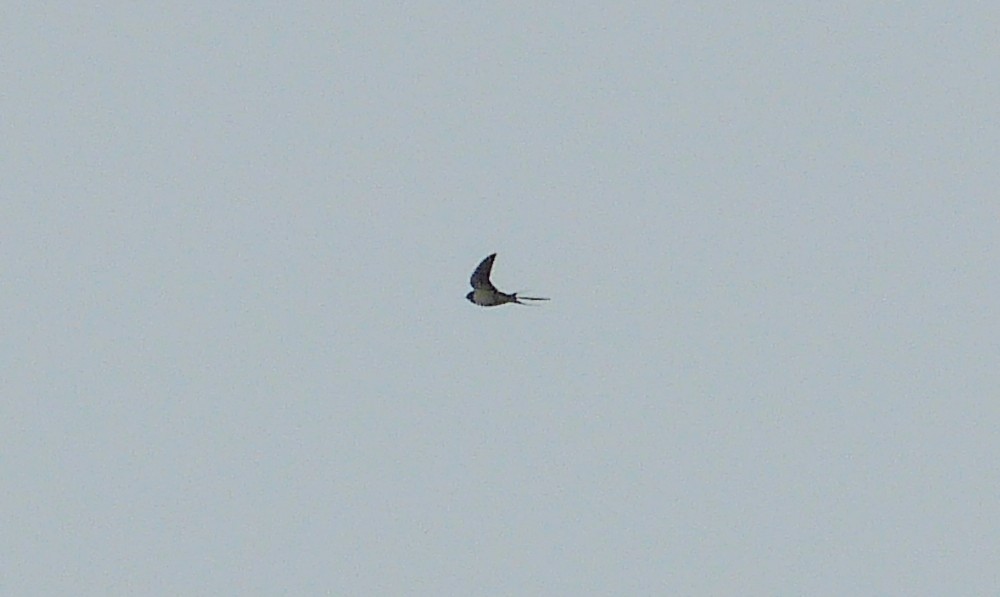
Emma had earlier seen a Spotted Flycatcher in a small stretch of woodland and before checking out the Nightjar, I took a walk deeper into the wood and found a Spotted Flycatcher perched on a dead tree briefly until it flew off back into deeper cover. Redstarts were calling in the woodland, but we only got a brief view of a bird flying out of a tree and into the woodland. Several Stonechats and Meadow Pipits were seen on the heath and a group of three Swallows were also seen hunting for insects by the woodland edge and a pair of House Martins headed south high over the heath.
Above a 'teneral' Large Red Damselfly and below, a Meadow Pipit.
Above, a Woodland Dor Beetle crossing the main footpath through a wood. Below, Swallows were landing briefly on a tree beside a wood.
Above, this Willow Warbler was in song by the heath. Below, the Nightjar roosting in a tree.
Raptors put on a good performance over the heath and on our arrival we were walking around the edge of the woodland when Emma found a large raptor some distance away making its way towards us. I quickly got onto the bird and then realised it was an adult White-tailed Eagle! The bird sped over the heath on those huge wings and headed eastbound probably heading towards Beaulieu River, but I did manage a few photos of the bird, despite being some distance away. A Red Kite, a couple of Buzzards and a Kestrel were also seen on our trip here.
Normandy Marshes, Lymington:
I was so pleased in making another journey to Normandy Marshes to see this superb Curlew Sandpiper. I never got to see one last year, but this bird made up for that.
When we got back to the car park, a quick check on Birdguides revealed that the Curlew Sandpiper had returned to Normandy Marshes and also a report of a Little Stint. It was a 'no-brainer' and so we made our way back to this site again. It didn't take long to find the Curlew Sandpiper searching for food along the water edge with a Redshank on our arrival. The bird showed superbly well and I even managed to film the bird too. We then made our way to the area we stood at this morning and searched in vain for the supposed Little Stint. I picked up theSanderling on the Tern Island and I could see why someone could potentially make the mistake of misidentifying the Sanderling for a Little Stint. But the latter bird is much smaller than a Sanderling and the upperparts did not match a Little Stint either. Shame; for I would have liked to have 5 ‘year- ticks’ in one day.
Above and below, the near summer plumage Curlew Sandpiper.
Above, a parent Avocet protecting her young from Gulls and below, one of the adults feeding in the shallow water.
Above, these Mallard ducklings swam close to where we stood and below, anxious parent Avocets with one of the young.
Above, the parent Avocet protects her young.
Above, the Curlew Sandpiper on Normandy Marshes.
A Common Sandpiper joined the long list of waders seen here today and showed distantly on the opposite side of the reserve. A Little Grebe in full summer plumage was fishing by the Tern island and within the creek in front of us, a Mallard and her broods passed by in front of us, totally unaware of our presence. Gorgeous. There were a few species of wildfowl present, which included Gadwall and Tufted Duck to make up a good list of birds present on the reserve today. I had to be back home by 2pm as I promised my wife I would not be out all day and though I managed to get back at exactly 2.03pm, she still moaned at me!
I took my dogs for their morning walk a little later than expected and I must say, it was certainly a lot cooler than yesterday and a bit more breezier. However, it was pleasant enough for a nice slow walk around the Cemetery and though only the usual birds were encountered, there were a few insects on the wing and a lot of plants in bloom too. On the way to the Cemy, I could hear the cries of Swifts and the sounds from which they were coming from were two Swift Boxes that had been installed on a house in Highland Road. I had never noticed them before here and so must have only been recently installed. Excellent stuff. These boxes had Swift calls coming out of them to entice the Swifts to nest there.
Above, this female Blackbird was busy searching for worms within the tall grass and below, one of the Swifts heading north over the Cemetery.
Above and below, more photos of the Swifts going over.
Above, a Robin perched on a gravestone close to the footpath.
The Cemetery had all the usual birds showing fairly well and included a Dunnock that actually showed very well for a change by the Holm Oak clump. There were no migrants seen here this morning, except for the Swifts overhead, where two birds followed one another low over the Cemetery. The birds are now busy caring and looking after their youngsters and that included the Starlings nesting in the guttering of the surrounding houses where you could hear the youngsters calling within. Blackbirds were collecting worms etc, for their broods as well and it will not be long for the youngsters to venture out into the world, if they can avoid all the Corvids and Cats in the area.
Above, Birds-foot Trefoil growing along the footpath and below, a Wood Pigeon inone of the old and smallest Horse Chestnut trees.
Above, this Horse Chestnut, laden with 'spikes' looked amazing in the sunshine. Below, a Buff-tailed Bumblebee nectaring on a Green Alkanet.
More flowering plants were on show this morning including Herb Bennet, both Smooth and Prickly Sow-thistles, Wintercress, Common Vetch and Green Alkanet (the latter attracting a Buff-tailed Bumblebee). Though fairly quiet with the birds (around 14 species seen or heard), it was a pleasant walk with the dogs and relatively few dog-walkers too.
Despite being totally butchered, this tree within the southern perimeter of the Cemetery, still finds a way to produce leaves. Below, a Wren in full song proclaims its territory to a rival nearby Wren.
The Moth Box was on again overnight and again, there were a few more moths added to my year list. Getting up at 5.30am is getting a bit easier, but as Summer approaches, I have to get up even earlier to make sure I get all the Moths my light trap will entice before it gets too light. While checking the Box, there was a squadron of Swifts ‘screaming’ overhead in the clear blue sky; but I have to say, it was quite cold at first thing this morning.
The Moth Box:
There were a total of 34 moths of 18 species and among them, new for the year, was a Buff Ermine, Treble-line and the micro moth, Brown House Moth (Hofmannophila pseudospretella).The Toadflax Brocade moth was still present and up to 3 Cabbage Moths were found. It looks as though the Puss Moth had finally gone, which I am pleased about. I did find a pair of Least Black Arches actually in a mating position, which is a first for me and my first Heart & Dart for my garden this year was most welcome.
Above, a Buff Ermine and below Treble-lines.
The Moths present this morning included the following:
Macro moths:
Buff Ermine x1
Cabbage Moth x3
Double-striped Pug x2
Common Pug x1
Vine’s Rustic x3
Shuttle-shaped Dart x3
Least Black Arches x3
Toadflax Brocade x1
Pale Mottled Willow x1
Bright-line Brown-eye x1
Heart & Dart x1
Brimstone Moth x1
Garden Carpet x2
Treble-lines x1
Micro moths:
Rusty-dot Pearl x1
Brown House Moth x1
Black Cloak x1
Light Brown Apple Moth x4
Diamond-back Moth x4
I was busy tidying the back garden up throughout the morning and a couple of butterflies joined me. A Speckled Wood dropped in and landed on the outside table and a couple of Holly Blues fluttered around the plants and trees nearby. Overhead, at least 8 Swifts were chasing one another in the clear blue sky, but as the morning wore on, the clouds came in, but the Swifts were always visible.
Some of the Swifts over my house this morning.
In Hampshire today, a near summer plumage Curlew Sandpiper was on Normandy Marshes and there was a welcome return for the Roseate Terns too. A Black Stork was soaring over Acres Down and seen to land in the trees.
Like I said to the guys, yesterday, there was supposed to be a weatherfront coming into the south coast with heavy thundery showers predicted; hence I suggested going to Gilkicker for a potentially good sea-watch and hopes were high for a Pomarine Skua passing through the Solent. Well, in fact, there was absolutely no sign of any weather front coming in as the sea state was calm and a mixture of cloud and sunshine dominated the day instead. I, for one, will never ever trust the BBC Weather forecast again.
Yesterday, a Woodchat Shrike was found off the Canal Path at Titchfield, but there was no sign today despite a lengthy search by us after our disappointing sea-watch at Gilkicker. No new ‘year-ticks’ were obtained today either, however, if it wasn't for the superb Moths we saw this morning, the day could have been a complete quiet affair. True, there were some nice birds seen today, but after all these ‘Pom’ Skua’s being seen throughout the week through the Solent, not one of the buggers was seen today and to rub salt in the wound, a flock of 5 Black Terns were seen off Hill Head, but they never passed us during our four hour stint at Gilkicker. Fume!
The Moth Boxes:
The Puss Moth was again still present by my Moth Box this morning and I could tell it was getting itchy feet and thankfully, when I got back late this afternoon, the moth had flown. There were, however, some excellent moths present this morning that included my second ever Toadflax Brocade and ‘year-ticks’ of Knot Grass, Cream-bordered Sweet Pea and the migrant micro moth, Diamond-back Moth. A total of 38 moths of 23 species that included the following recorded this morning:
Above, my second ever Toadflax Brocade and below, a Cream-bordered Green Pea.
Above, my first Knot Grass of the year.
Macro Moths:
Puss Moth x1
Toadflax Brocade x1
Knot Grass x1
Cream-bordered Sweet Pea x1
Blair’s Mocha x1
Early Grey x1
Brimstone Moth x2
Common Carpet x1
Double-striped Pug x3
Least Black Arches x2
Vine’s Rustic x2
Shuttle-shaped Dart x2
Garden Carpet x1
Bright-line Brown-eye
Pale Mottled Willow x3
Swallow Prominent x1
Macro Moths:
Diamond-back Moth x2
Sulphur Tubic x1
Rusty-dot Pearl x2
Light Brown Apple Moth 5
Black Cloak x1
Hourglass Mompha 2
Ruddy Streak
The migrant Diamond-back Moth.
Over at Andy’s Moth Trap, four more moths that were new for the year were discovered that included a Red-green Carpet, Currant Pug, Maiden’s Blush and Heart & Dart. A total of 20 moths were present around Andy’s Moth Box of 13 species.
Above, a Heart & Dart and below, a Red-green Carpet.
Above, a Maiden's Blush and below, a Currant Pug.
The following moths were recorded this morning here in Andy’s Garden:
Macro Moths:
Garden Carpet x1
Red-green Carpet x1
Oak-tree Pug x1
Currant Pug x1
Common Pug x1
Knot Grass x1
Maiden’s Blush x1
Brimstone Moth x3
Heart & Dart x3
Bright-line Brown-eye x1
Micro Moths:
Common Plume x2
Diamond-back Moth x2
Ruddy Streak x2
Andy's Moth Box also attracted two Cockchafer Beetles.
The Solent from Gilkicker:
It was the 'bread & butter' birds that kept us entertained this morning. This adult Med Gull flew low over the beach.
Well, despite a nice early start, a quick bit of extra breakfast from Greggs and we were on our way for a busy sea-watch from the shelter at Gilkicker. But I am afraid to say, it was arguably one of the worst or should I say, the quietest sea-watch this year. Thank God I was in such a great company and there were even some interesting plants to look at during the long quiet spells here.
Several Sandwich Terns patrolled the shoreline.
Geoff and I took a look at the various plants growing on the beach that included flowering Sea Kale, Sea Campion, Beaked Hawksbeard, Buckshorn Plantain, Dovesfoot Cranesbill and Birds-foot Trefoil. Many of the plants were occupied by Soft-winged flower Beetles that seemed to be everywhere. If I got a £1 for every time someone asked us what we were looking at, it would have paid for a slap-up nosh for three; but we were very hospitable giving the same answer time and again. Pays to be friendly to the public.
Above,Sea Campion and below, Sea Kale.
Above, Buckshorn Plantain and below, Beaked Hawksbeard covered in Soft-winged flower Beetles.
Above, Birds-foot Trefoil.
The birds seen here this morning included the following:
Sandwich Tern: Several birds flew up and down the shoreline and more were seen flying mid-channel, but I could not tell for sure if these were migrant birds or local birds.
Common Tern: Just the one bird was seen flying west over the Solent.
Mediterranean Gull: About a dozen or so birds were seen throughout the morning; some coming in quite close while others were seen mid-channel on the sea.
Above, a pair of Linnets searched for seeds amongst the vegetation on the beach. Below, a few Swallows came off the sea.
Above, an adult Med Gull patrolling the beach and below, even a Jackdaw kept us briefly entertained.
Andy checked out the scopes while Geoff and I checked out the beach vegetation. Yes, it was that quiet! Below, one of several Cormorants fishing offshore, This individual caught a flatfish as we watched him devour it.
Grey Heron: Two adult birds were seen coming in off the sea from the Isle of Wight, while another bird was making the opposite crossing.
Swallow: Four birds were seen twittering above our heads and eventually flew off north while a single bird was actually seen coming in off the sea and headed off over the fields behind us.
Oystercatcher: A single bird was seen heading east and another west.
Great Crested Grebe: A single bird was seen flying low over the sea heading west.
Titchfield Canal Path:
A male Marsh Harrier over the reserve.
Though we did not get to see yesterday’s Woodchat Shrike, despite putting some severe effort in, there were a few notable birds seen as well as a variety of insects to keep us entertained. There was the amazing sight of the Willow Trees discharging their woolly-like seeds along the Canal Path, which covered the edges of the footpath and also a lot of the shallower stretches of the Canal.
Above, Speckled Wood butterflies were abundant along the footpath. Below, Red-headed Cardinal Beetle.
Above, we found many Nursery Web Spiders on the brambles enjoying the warm sunshine.
Our walk north, after parking at the seafront, kicked off with a Hairy Dragonfly patrolling a part of the Canal; our first of the year. A little later, the first sighting this year of a Beautiful Demoiselle damselfly was seen flying over the brambles by the edge of the Canal, but would not settle for a photo. However, an Azure Damselfly was far more obliging. Singing Cetti’s, Chiffchaff, Reed and Sedge Warblers were heard and a few Blackcaps joined in too as we walked north up the footpath and our first notable birds were up to three Marsh Harriers over the reedbeds and fields. These were joined by two Kestrels and I was sure I had a Peregrine flying over heading south, but was lost behind the trees.
Above, the male Marsh Harrier displaying a nice pair of legs and below, a female Stonechat just east of the footpath.
On reaching Hammonds Bridge, we searched thoroughly the fields adjacent to the main footpath but the best we could muster was four House Martins, 2 Swifts, a Common Buzzard and a male Sparrowhawk. A Common Whitethroat was seen displaying in a nearby hedge and a pair of Stonechats were on the barbed wire fence on the opposite side of the main footpath. The long hot walk back was pretty quiet, but there were a lot of Speckled Wood butterflies on the wing here. We gave the Posbrook Floods a good scan and notched up the following wildfowl: Mallard, Teal, Gadwall, Shoveler and a single drake Wigeon. A Little Egret and three Grey Herons patrolled the shallows in search of prey while a couple of Swallows dropped in and took a drink.
My first Azure Damselfly of the year along the footpath.
When we finally reached the Car by the beach, up to 6 Common Terns were seen over the Reserve and another two more were seen chasing each other very high up. OK, today didn't really go to the script, but it was still a good day with these guys.