Another week has begun and finally, the sun has broken through this long staying blanket of cloud. Though a tad colder this morning, I was hoping for a bit of visible migration, which started off well first thing when I took the dogs for their early morning walk and a small flock of thrushes contained 4 Fieldfare (calling) with a Redwing among them, flying north high over the rooftops. Also on my walk, I found a Rusty-dot Pearl moth sitting on a lit-up advertising board at a Bus stop!
Pembroke Road, Old Portsmouth:
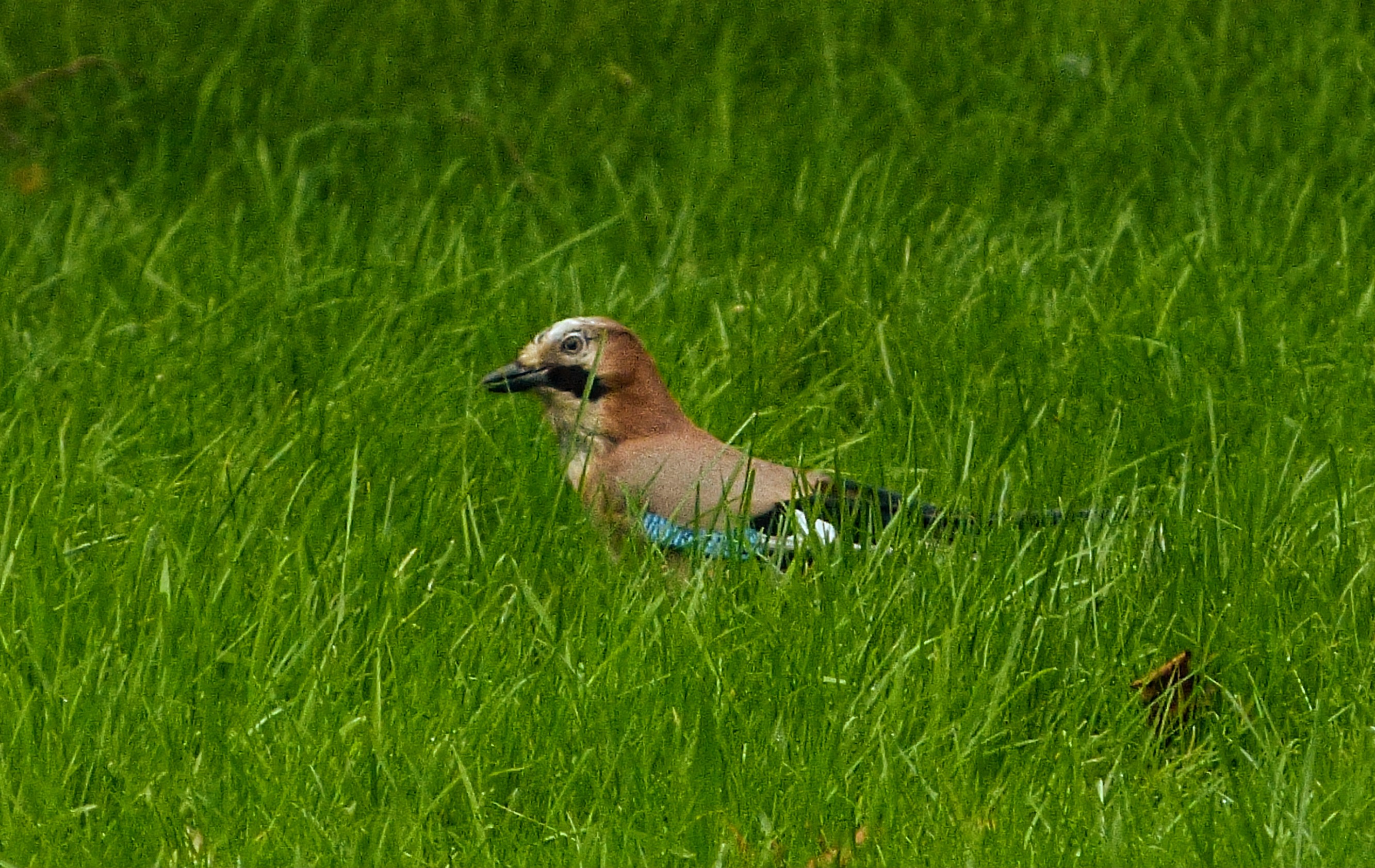
Sadly, not a great deal of excitement during my hour here in Pembroke Road, with just 13 species seen this morning. The usual Jays were flying up and down, collecting their acorns from the Holm Oaks adjacent to the main road. The Great Black-backed Gulls were among the thirteen species when an adult and youngster were seen flying over the Garrison Church heading eastbound. Just the one Garden Spider still sitting in its web behind me, though it is supposed to be getting colder as the week progresses; so it is a matter of time these hardy creatures will be here for much longer. On the second shift, a Wren was heard singing somewhere by the Bowling Green to make it 14 species for the day.
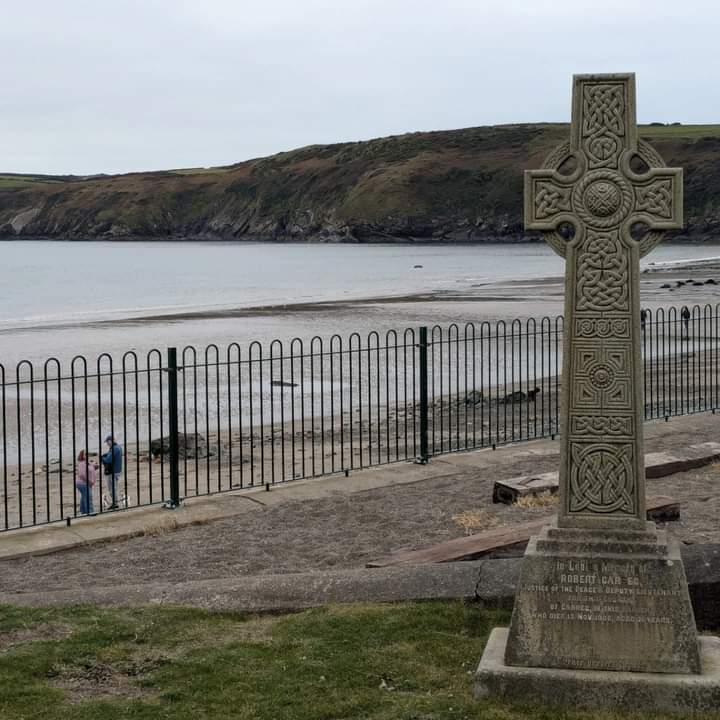
Becky and myself on Aberdaron beach last month. This photo was taken from St, Hywyns's Church by Russ Smith.
Birding pal, Geoff Farwell, took a walk around Farlington Marshes yesterday and recorded the following sightings: Kingfisher, 5 Stonechats, Greenshank, 2 Peregrines, Common Buzzard and a Water Rail.
The Common Stonechat at Titchfield Haven.
The birds seen over the weekend in Hampshire and beyond have been noteworthy. Firstly, a possible Amur Stonechat (Stejnegeri Stonechat as previously known), a species from Eastern Asia, was found around the southern entrance of Titchfield Haven last Saturday. It has been under an enormous amount of scrutiny from fellow local birders, with some excellent photos thrown in and the conclusion is that it is a Common Stonechat.
The female Pied Wheatear at Seaford last weekend. Photo by Andy Friend.
Another superb bird found over the weekend, was a female Pied Wheatear. Sadly, I have been too busy to go for one of my ‘bogey’ birds, a species I have always wanted to see along with Isabelline Wheatear. The bird was in the Seaford area at first, but moved further west today and relocated by Splash Point. Much further away, in West Yorkshire near Bradford, a Scarlet Tanager, a very rare North American passerine to the UK, was found at a place called Northowram within someone's back garden! This will no doubt bring on a huge ‘twitch’. Finally, good news regarding Farlington Marshes and the broken Sluice. The heavy machinery has arrived at last, due to huge public outcry, on the reserve to finally sort out this outrageous ‘cock-up’ by those supposed to be looking after the reserve. The huge reedbed around the Lagoon area is mostly destroyed by the seawater and will probably take years to get back to normal.
Today was a chance to get my 200th Hampshire bird species for the year and although I had a lovely offer to go to Staines Reservoir for the showy Lapland Bunting with both Matt & Emma Parkes, I decided to keep it fairly local for personal reasons. Again, this anticyclonic weather we are having at the moment (and I have read and heard the explanation for it by a number of experts), which is causing the continuous low cloud and still weather conditions, carried on into Saturday. So, today, Geoff, Andy and myself travelled west to the Hampshire border to Blashford Lakes to hopefully catch up with the long staying female Red-crested Pochard. Afterwards, a visit to Black Gutter Bottom for raptors and then home.
The Moth Boxes:
A poor moth showing this morning, but a Black Rustic is always welcome.
To put it mildly, it was a very poor day for moths with just two in my Moth Box; one Black Rustic and the micro moth, Lead-coloured Tortrix. It was even worse in Andy’s Moth Box where there was nothing at all! Despite all the egg trays scattered all around his Box, there was complete zilch! A Goldcrest was calling nearby as Geoff and I got out of the car by Andy’s house, but nothing more exciting in or around his garden this morning.
My second Lead-coloured Tortrix of the year.
Blashford Lakes, nr Ringwood:
A grey, but calm view from the windows of the Tern Hide overlooking Ibsley Water.
Obviously, the first stop was to be the Tern Hide at Blashford Lakes and on a very still Ibsley Water, it took just a few minutes to see my 200th bird species in Hampshire, just seconds before Andy and therefore the race to 200 was won! Actually, Geoff found the female Red-crested Pochard at first, swimming quietly not too far away, surrounded by a few Wigeon, Coots and a Great Crested Grebe. OK, not the most exciting bird out there, but always nice to get it on your year list anyway.
Above, a drake Pochard swam past in front of the Hide. Below, one of the Meadow Pipits just below the Hide windows.
We spent a good hour here searching through the many wildfowl, gulls and waders present and even a few notable passerines too. At least one Great White Egret was seen by the waters edge, albeit distantly, with at least four Grey Herons in the area. The usual wildfowl were present that included Mallard, Shoveler, Gadwall, Wigeon, Tufted Duck, Pochard and Pintail; though numbers of each have nowhere near reached the maximum yet. There was just the one Goldeneye present which was in the female type plumage fishing some distance from the Hide. The usual Egyptian Geese were on the islands and banks of Ibsley Water in good numbers and a single Grey Lag Goose grazing the western side of the grassy bank. Great Crested Grebes were in double figures here, with some still in summer plumage too.
Above, a sleeping Great Crested Grebe, still in summer plumage, in front of the Hide and below, Geoff found this resting Peacock butterfly, which was also in front of the Hide.
Above, the female Red-crested Pochard on Ibsley Water.
A small number of both Lapwing (15) and Black-tailed Godwit (20) were resting on the islands with the Black-headed, Herring and Lesser Black-backed Gulls; but I couldn't find a Yellow-legged Gull to add to Andy’s Hampshire year list. On the shoreline directly in front of the Tern Hide, we had amazing views of several Meadow Pipits going about their business looking for insects among the pebbles and plants. A pair of Grey Wagtails popped in briefly with the Pipits, as did a single Pied Wagtail and a few Chaffinches. Outside the Hide, a small flock of Redwing flew over and a Bullfinch was heard but not seen. I was sure that a Ringed Plover was flying over the lake somewhere, for I could hear one calling, but I did not locate the bird.
Some of the birds on show in front of the Ivy North Hide included this Robin (above) and (below) a Grey Heron.
After a brief look in the Park Centre, we made our way to the Ivy North Hide where there was an outside chance of a Bittern. Once in there, for we had the place to ourselves most of the time, Andy and myself were conveniently sitting at the ‘right place right time’ to watch at least two Water Rails crossing between two reedbeds. The birds were calling a lot of the time deep within the reeds, but at least we got to see them this time! Sadly, no photos of the birds because they were too quick to get from one reedbed to the other! A skulking Cetti’s Warbler showed itself briefly in the reedbed in front of us, but again, too quick to grab a photo. A Great Spotted Woodpecker flew off southbound over the trees, but apart from a few ducks and a Grey Heron flying over, all was relatively quiet here.
Above, Trooping Funnel toadstools and below, the macabre named Dead Mans Fingers toadstools. Both species were seen on the path from the Woodland Hide to Ivy South Hide.
Our next stop was to be Ivy South Hide and on the way there, we had sightings of a large flock of Siskins flying over the treetops. A brief look at the feeders by the Woodland Hide produced sightings of a Jay, Coal Tits and a Nuthatch and some interesting Toadstools were seen along the way, that included Turkeytail fungus, Trooping Funnel and what we think was Sordid Blewit; a very pale purple coloured toadstool.
Above, a Jay on the feeders and below, a Nuthatch also on the feeders.
Above, a Sordid Blewit toadstool along the main footpath and below, a pair of Gadwalls sail passed a Cormorant in front of the Ivy South Hide.
Above, Wigeon in front of the Hide.
Above, a Great Crested Grebe taking flight from Ivy Lake and below, one of many Long-tailed Tits by the Woodland Hide.
Above, a Nuthatch joined a few other species in front of the Woodland Hide.
From Ivy South Hide, Ivy Lake produced a few ducks that included Wigeon, Gadwall, Tufted Duck and Mallard. Several Great Crested Grebes swam on the water some distance from the Hide and several Cormorants were present also. Two Kingfishers flew past together at pace in front of the Hide, but little else to be seen here during our 30 minute stay here. Walking back to the car, the lake opposite Ivy Lake held a Little Grebe by the edge of the reeds and a drake Mallard swam on the same lake. Overhead, a Goldcrest was calling and eventually seen in the trees while near the Woodland Hide, a large flock of Long-tailed Tits had a Chiffchaff, Nuthatch and a Treecreeper among them to round off our trip here to the superb Blashford Lakes.
Black Gutter Bottom, New Forest:
It certainly looked bleak looking over the expanse of heathland from Black Gutter Bottom; with the low cloud cover not helping. On the positive side, there was no wind and it was dry as we made our way to the Gorse Bushes that were just west of the small car park. From here, we spent the next cold hour searching the heath and sky for raptors of which just a Common Buzzard and a male Kestrel were seen. Sadly, no Hen-harriers or Merlins to liven things up and remarkably, not a single Redwing or Fieldfare seen either! I scanned the distant trees and bushes consistently, but all we noted were a few Song Thrushes and Blackbirds during our time here.
A few small flocks of Meadow Pipits flew over the heath and a distant Raven was seen also flying over the heath, but no Stonechats either! A Dartford Warbler was heard calling twice, but no sightings of the bird as we entertained ourselves by talking about 70’s and 80’s comedy programmes and where the actors/actresses are now. A couple of birders also arrived and started looking out for the Harriers as we eventually got back into the car and made our way home. Another great day’s birding with Geoff and Andy as always.
The Lapland Bunting at Staines Reservoir. Photo by Emma Parkes.
In Hampshire today, fellow ‘Lazee’ Mark Francis found a very late Whinchat north of Posbrook Floods and a possible Amur Stonechat was found at the southern end of Titchfield Haven. Two Black-necked Grebes were in the harbour entrance off Sandy Point, Hayling Island and a Short-eared Owl was seen in the north of the County. Emma and Matt Parkes successfully saw the Lapland Bunting at Staines Reservoir (a ‘lifer’ for them) and were going on afterwards to Seaford, in East Sussex, for the female Pied Wheatear that had been reported there for its second day! However, the bird disappeared in the afternoon.
The weather has been the same all week, with low clouds and hardly any wind and the temperatures hovering around 12 to 14 degrees. A quick check of the Moth Box revealed just 4 moths this morning of which one turned out to be a real surprise. It was back to Pembroke Road again this morning as I kept an eye out for anything interesting during my hour there. When I got home from my first shift, I took the dogs for a nice walk around Highland Road Cemetery. Though fairly quiet, both a Green Woodpecker and Chiffchaff showed well.
The Moth Box:
Only my second ever Oak Rustic moth.
Yet, another Golden Twin-spot moth was present again within my Moth Box, which begs the question, how many of this rare Mediterranean species are out there in Portsmouth or are there more making their way to our shores (sounds familiar doesn’t it?). However, another dark looking macro moth was in the Moth Box and at first, because of the poor light this morning, I thought it was a Black Rustic and took a few photos. Other moths present included a couple of Double-striped Pugs.
Another Twin-spot Rustic this morning.
I checked my photos a little later and I was sure now that the Black Rustic was in fact something completely different and when I got home from my first shift, I confirmed it was my first Oak Rustic for my Moth Trap in my garden. This is only the second individual I have ever seen and a smart looking moth too. As the temperatures in Portsmouth have been very mild of late, I shall keep the Moth Box going till it gets too cold over the coming month. All the time I was checking the moths, a Song Thrush was calling deep within the cover of the trees at the back of my garden.
Pembroke Road, Old Portsmouth:
A couple of the Sycamore trees in Pembroke Road of which the Jays favoured.
I shall kick off with yesterday's birds here at this site, which totalled 14 species that included a Cormorant heading east and three Mute Swans (two adults and a juvenile) heading west towards Gosport. This morning, up to 13 species were seen or heard and included the usual Jays, a Grey Wagtail flying over heading east and a Chiffchaff heard calling along the footpath towards Curtain Moat.
Highland Road Cemetery, Southsea:
The leaves are falling in the Cemy.
It was still overcast yet still around the Cemetery this morning, but there were still a few notable birds seen. This included the Green Woodpecker that showed well briefly high up in the bare branches of a tree, but flew off only to land on a gravestone. A single Chiffchaff was first heard and then seen well in a bush close to the Mausoleum, along the main footpath but did not linger long. At least one Jay was present (see photos and film footage below) and showed very well burying acorns in the uncut grass near the Holm Oak clump. Both Song Thrush and Goldcrest were heard only, but no Titmice or Robins seen or heard which was unusual.
Above, this Carrion Crow was calling high up in one of the tallest trees and below, the large clump of Honey Fungus we saw here on Sunday was still present.
Above, the Green Woodpecker showed well briefly, but was quite vocal. Below, the Chiffchaff scurrying around by the footpaths.
Above, the beautiful colours of Autumn leaves and below, the Jay about to swallow an acorn!
Above, the same Jay perched on a gravestone and below, I believe, because of the size, this is a Parasol Toadstool.
Above, I think this is Fenugreek Milkcap and is poisonous.
The only insects seen in the Cemy this morning were a couple of Buff-tailed Bumblebees and the only notable flowers still in bloom included Yarrow, Smooth Sow-thistle and Mallow.
The birds seen or heard this morning included the following:
Another grey and slightly colder day today and again, I kept an eye out for anything interesting in Pembroke Road, Old Portsmouth this morning. Looks like I shall have to wear a woolly hat sooner rather than later. I also had the Moth Box switched on last night and although there were very few moths, I was in for a nice surprise.
Pembroke Road, Old Portsmouth:
Only 13 species were seen this morning during my first shift of which, the most notable birds seen or heard were at least two Jays, showing very well as per normal and a Cormorant flying east high over the houses. Great Black-backed, Herring and Black-headed Gulls were seen and Robins, House Sparrows and a Wren were calling. What will this afternoon bring? Not a great deal to be honest, but the day total increased by one species: a Greenfinch and the Jays were seen again throughout my second shift. The day remained grey, overcast and hardly any wind whatsoever; which has been the weather all week so far.
In Hampshire today, fellow 'Lazee Birder' Pete Gammage found a male Ring Ouzel off Pigeon House Lane, Portsdown Hill. A Great Northern Diver was just offshore from Southsea seafront and a female Black Redstart was by Southsea Castle. The three Glossy Ibis were still near Titchfield Village.
The male Ring Ouzel by Pigeon House Lane this morning. Photo by Andy Friend.
The Moth Box:
My first Lead-coloured Totrtix of the year.
There were just three moths present this morning, but all three were stunning moths. Two more Golden Twin-spots that were perched on one of the egg boxes inside the Moth Box and the other was a micro moth; my first Lead-coloured Tortrix for the year. OK, not the most colourful of moths, but a good Autumn moth to pick up for this
It was back to work this morning at good old Pembroke Road and thankfully, it was dry again. Though not a great deal was seen during the day, I still had an interesting bug to look at. Hampshire is hosting quite a few Black Redstarts, with another one found in Southsea and a report of a Richard’s Pipit in the Basingstoke area.
Pembroke Road, Old Portsmouth:
The male Black Redstart on Southsea seafront today. Photo by Andy Friend.
There were just 12 species noted today here in Old Portsmouth, which included a couple of small flocks of Brent Geese entering distantly either into Portsmouth Harbour or Gosport. Two Jays showed well all morning and even one rested on the railings by Governor’s Green. Earlier today, while walking the dogs before work, a small flock of 3 Redwing flew east, calling as they passed. ‘Lazee birder’ Andy Friend found a gorgeous male Black Redstart within the gardens of the Blue Reef on Southsea seafront this morning and was still there this afternoon, apparently. A Ring Ouzel flew over Tweseldown in North Hampshire and a Red-throated Diver was off Chilling cliffs.
The Western Conifer Seed Bug. It was a big bugger too!
When I got back, I had the chance to check out the Beetle that was crawling down our wall in our back room. It transpired to be a Western Conifer Seed Bug; my first ever. This species is actually a native of North America, but has recently been accidentally introduced into the UK. Around this time of year, it looks for places, like peoples homes, to hibernate for the Winter; hence finding one inside my house!
This Golden Twin-spot moth was my fifth of the year.
I had my Moth Box on overnight and though it was a bit windy, there was always a chance of a migrant moth or two. Thankfully, I was rewarded with yet another superb moth, a Golden Twin-spot. This was my 5th individual of this species and there seems to be an influx of them here on the south coast. A fellow ‘Moth-er’ also had one during the week, so proving I wasn't the only one here in Portsmouth getting them.
Rusty-dot Pearl.
However, that was the only moth in my Moth Box though outside the Box, there was one Rusty-dot Pearl, one Common Plume and two Light Brown Apple Moths. Again, it was overcast with a light easterly wind though a mild 14 degrees.
My HOS (Hampshire Ornithological Society) Bird Report arrived yesterday and proved, yet again, a very interesting read. Some alarming statistics were noted, including the demise of both Willow Tit and Wood Warbler in Hampshire and the two Hampshire ‘firsts’ that included a Forster’s Tern and a Kumlien’s Gull. The latter bird I actually saw along with a dozen or so birders present at Gilkicker on a seawatch on the 14th April. This is a sub-species of Iceland Gull that breeds in Canada and was only considered when the photos taken of the bird were studied well by the Hampshire authorities and agreed upon that it was indeed a Kumlien’s Gull.
However, the Report also is now stating that most if not all sightings of Willow Tit in Hampshire, especially in the last few areas where they were seen last in North Hampshire are in fact most likely Marsh Tits. I would like to dispute that theory. I have very good experience on the call and in particular, the ‘jizz’ of this species and the bird I saw with Andy Fisher was indeed a Willow Tit after noting its call and seeing it well. Though I feel that this species is near lost to Hampshire, while its close cousin, the Marsh Tit is thriving. Swings & roundabouts, as they say.
Highland Road Cemetery, Southsea:
I had the pleasure of walking the dogs with our Isabelle late this afternoon over Highland Road Cemetery and boy, this girl can chat. That I wouldn't knock it one little bit, for too many youngsters are simply glued to their mobile phones or telly and now she is 10yrs old, I was amazed at how she remembered things from previous visits from a long time ago. She walked Buddy and I walked Ted as we made our way around my usual walk around the Cemetery.
Honey Fungusgrowing in the Cemetery.
This time, I didn't take my binoculars or camera and I was starting to regret it as a pair of Jays showed very well reasonably close to the footpath. But it was when we got to the south-east corner that I saw a young lady looking at something by a grave. I was not sure if she was looking at an insect or plant, but she moved on and carried on walking behind us. That was when something caught my eye and I couldn't believe that a Woodcock flew past us and close too! That young lady must have flushed it from the grass as the bird flew off heading east and quickly out of view. However, I saw the bird again, further north this time, but the sighting was brief as it disappeared from view behind the trees. This was a ‘patch tick’ for me and put a big smile on my face.
Agaricus species of Toadstool were abundant here this afternoon.
A little while later, a Sparrowhawk belted low past us and westbound low over the footpath. The Jays were seen again and noisy birds they were too, squawking noisily within the trees. A lot of the leaves on the trees have now fallen and the footpaths were carpeted in the fallen leaves. So very Autumnal. I did take some photos from my mobile phone as we came across some large Toadstools that included Honey Fungus and some Agaricus species on the grass.