Sunday, January 2, 2022

From Dawn till Dusk birding!

Saturday 1st January 2021.


Dawn over the Solent this morning.

And so a new year begins and today, both Andy and I done our ‘From Dawn till Dusk’ birding and for a change, we only kept to Hampshire. Yes, it was going to be a tall order to beat our record of 92 species in a day, but we gave it our best shot and at one stage, it looked promising, but time got the better of us and we ended up with a reasonable 73 species for the day. Not only was the weather dry (so much for the weather forecast saying it would be raining all day!), but we also came across a good many familiar faces along the way.


The Purple Sandpipers at Southsea Castle roosting in their usual site at Southsea Castle. 


Including this lone individual!

Andy picked me up in his car at 7.45am and while waiting for him to arrive, my first birds of the New Year passed overhead: firstly several Herring Gulls and then a Carrion Crow, though I did hear both a Robin and Blackbird sing nearby, but to add to our year list, they must be sightings. Our first stop was to be Southsea Castle for the Purple Sandpipers and possibly some other goodies we might come across. It took just a few minutes for me to find our first Purple Sandpiper, a single bird all by itself perched high up on the wall as the sea level was quite high. A further 14 more were found on our walk back along the promenade, though all were roosting while the tide was high. Other bird sightings added to our year list included Black-headed Gull, Blackbird, House Sparrow, Great Black-backed Gull, Brent Goose, Oystercatcher, Common Gull, Feral Pigeon and a good sized flock of Mute Swan as we passed Canoe Lake.

Oystercatchers in the southern car park at Eastney.

Our next stop was Eastney and by parking by the harbour entrance, we made our way down to the Ferry Terminal to view Langstone Harbour, which was now at high tide. We quickly picked up a flock of Turnstone on the boats plus Starling, Wood Pigeon, Cormorant, Red-breasted Merganser, Great Crested Grebe and a Guillemot. A pair of Pied Wagtails flew over our heads and landed near our feet! From the southern car park; Robin, Stock Dove, Greenfinch, Goldfinch, Meadow Pipit and by the shoreline, a large flock of Sanderling.


Great Crested Grebes swimming in the harbour near the main entrance to Farlington Marshes.  

Farlington Marshes was our next destination and a site where we had the most species seen - 26 species. A pair of Stonechats were by the car park and a pair of Collared Doves and a Dunnock were seen by the entrance to the reserve. Walking through the Bushes area up to the Lake, we notched up the following: Lapwing, Black-tailed Godwit, Moorhen, Canada Geese, Pintail, Shelduck, Coot, Redshank, Little Grebe, Mallard, Wigeon, Gadwall, Teal, Avocet, Grey Heron, Pheasant, Ringed Plover, Curlew, Skylark, Rock Pipit, Wren, Grey Plover, Common Snipe,Kestrel, Little Egret, Dunlin, Mediterranean Gull and Blue Tit. Though we never walked all the way around the reserve, I felt that time was against us and so from the Info Centre, we made our way back to the car park. We did hear Bearded Tit, Grey Wagtail and Cetti’s Warbler, but we could not count them in our year list. Frustrating!


A pair of Teal by the viewing platform.


Lapwing, Shelduck and a Little Egret among the Avocets on Farlington Marshes.


Our first Med Gull of the year being carefully watched by a young Common Gull.


Next stop was Budd’s Farm and the Mound. The weather wasn't that clever, with a southerly wind blowing in off the harbour that didn't help us locate anything of note from the Mound. However, two more ‘year ticks’ were added from the pools by the Water Works area: Tufted Duck and Shoveler. Sadly, no sign of any Pochard, which was surprising. There was a friendly chap there doing a WeBS count, but he could not find anything more for us. 


A female Stonechat on Budd's Mound. 


Gadwall on the pools at Budds's Farm.

We picked up some grub from 'Greggs' on Hayling Island and after we consumed our well deserved nosh, we made our way down to Sandy Point. Parking up in Seafarers Walk, we took the footpath to the beach and harbour entrance. On our way there, we picked up both Great Tit and Chaffinch to our list (phew; sometimes the really common birds are the hardest to get!). On reaching the beach, we set up a scope and was soon joined by both John Cronin and Andy Friend! We picked up our first Razorbill of the year drifting on the outgoing tide into the Solent. Apart from a few Great Crested Grebes flying by and a large flock of Teal giving us a headache on ID, it was pretty quiet here and so Andy and myself took a stroll to the Hayling Sailing Club.


A Grey Heron at Langstone Mill Pond. We were hoping for both Mandarin and Cattle Egret at this site but drew a big blank!

From here, we came across birding pal, Geoff Farwell, who was checking out the harbour. Thoroughly enjoying our chat, we picked up 2 Great Northern Divers, 2 Slavonian Grebes, more Razorbills and Guillemots and finally a large flock of Bar-tailed Godwits. When we walked back to our respective cars, we came across Andy Johnson who kindly showed us where a flock of Sandwich Terns were fishing! Many thanks Andy. We said cheerio to Geoff and hurried off to Warblington for the Cattle Egrets and while driving back through Hayling, we notched up both Rook and Jackdaw to our total.


Around 20 years ago, us three (Andy, myself and Geoff Farwell) used to 'twitch' all over the place and here we are on Sandy Point today.


Wartblington was somewhat disappointing as we hoped to pick up a Woodpecker or some Thrush species, but at least we picked up the Cattle Egrets, with at least 14 present and a further four more flying overhead. The light now at 3.30pm was getting poor and so we hastily finished off our day at Southmoor again. It was low tide in Langstone Harbour and so getting anything interesting out on the water was a non-starter. Instead, we checked out the pools again and though no Pochard was to be seen, I did find our first Buzzard of the year! We eventually called it a day, but as we were packing our stuff away back in the car, I found both Goldcrest and Long-tailed Tit to draw a close to the day's birding! OK, 73 species was much lower than our highest ever total, but I was fairly pleased with this, seeing we kept to Hampshire only. I think we will hit the magic 100 species for the year by close of play next Saturday.


Arguably, the worst photo of three Cattle Egrets coming into land over Warblington. The light was bloody awful in my defence! 

If you are reading this, I hope you have a fantastic New Year and thank you again for reading. Joining the ‘Lazee Birders’ Whatsapp site has made me more friends and readers, so I hope to entertain you guys as the year progresses. 

Wednesday, December 29, 2021

My first moth in a while!

Wednesday 29th December 2021.


The Pond at the southern end of The Oaks Crematorium this morning. 

I was back to work today for just one day this week, which took me to The Oaks and Portchester Crematorium and also a jaunt across the top of Portsdown Hill and therefore, I was hoping to see a few notable sightings throughout my day. The weather first thing morning was simply grim, with heavy low cloud and drizzle and a blustery wind, which eventually gave way to bright sunshine and a bit of cloud. Again, temperatures remained very mild for this time of year, into double figures to be exact and the Met Office are predicting the warmest New Years Day ever recorded!


The Double-striped Pug at Porchester Crematorium. I had to use my mobile phone camera to take a poor image of the moth which was some 12 feet up at the exit of the South Chapel.

OK, I did not see all that much today, with just a Kestrel hovering over Portsdown Hill was the only noteworthy bird along there. The Oaks offered just a Jay and a thrush species sighting, though the weather was awful around midday and hardly anything else was seen, but I noticed the water level in the Pond was at an all time high here. Portchester Crematorium didn’t really offer any bird sightings, but I saw my first moth here in ages, a Double-striped Pug, that was perched high up in the exit of the South Chapel. 


Some of the Glossy Ibis at Brading Marshes today. Photo by Isle of Wight birder, Linda Hammant.

In Hampshire today, an adult Little Gull and a Great Northern Diver were by the harbour entrance at Sandy Point, Hayling Island and a Black-throated Diver was seen in the area later in the day. Blashford Lakes hosted both the long staying female Red-crested Pochard on Ibsley North Lake and the drake Ferruginous Duck was still on the Kingfisher Lake. On Ibsley Water, a Caspian Gull and 8 Yellow-legged Gulls were counted. On the Isle of Wight, a flock of up to 11 Glossy Ibis are still present on Brading Marshes; an incredible number. Another incredible record is the long-staying Swallows at Porthole Farm, at Medmerry RSPB Reserve. Whatever next?  


Monday, December 27, 2021

A large Fairy Ring in the Cemy this afternoon.

Monday 27th December 2021.

Highland Road Cemetery in the sunshine.

Yet another damp day, but in between the heavy showers, there was a bit of respite and the sun actually came out now and then, revealing a bit of blue sky too! Along with this wet weather came very mild conditions with temperatures up to 11 degrees and a breezy southerly wind. I took Scruff for a nice walk around Highland Road Cemetery early afternoon hoping for a nice surprise for me there. 


A male Greenfinch high up in the Chestnut trees. This species has nationally decreased by 92% over the past 25 years, so how long are we to have this species breeding in the UK? There was a small flock here this afternoon. 


Just the one Jay seen this afternoon. 

I notched up a total of 16 species of birds on my walk round, which is about average here for this time of year, which included a single Jay and at least 4 flyover Pied Wagtails. There were no Green or Great Spotted Woodpeckers today and I have noticed a lack of Goldcrests within the Cemy of late too. This week is a continuation of mild and wet weather, but I think we really need to have a good long cold snap to bring the more unusual winter birds down south. With ‘Global Warming’ and our winters getting milder and wetter, these ‘cold winters’ will probably be a thing of the past?


Good numbers of Carrion Crows in the Cemetery as usual.


A female/first winter type Blackbird over on the north side of the Cemy.

Species present on my local patch this afternoon included the following:

  • Carrion Crow
  • Jay
  • Magpie
  • House Sparrow
  • Starling
  • Feral Pigeon
  • Wood Pigeon
  • Collared Dove
  • Herring Gull
  • Robin
  • Blue Tit
  • Great Tit
  • Pied Wagtail
  • Greenfinch
  • Goldfinch
  • Blackbird

Probably the most commonest plant in the Cemy, the Smooth Sow-thistle, which occupies many a grave! 

There were quite a few flowering plants on show including the obligatory Smooth Sow-thistle along with Yarrow, Daisies, Nipplewort, Groundsel and even a few sprigs of Common Germander, with its tiny blue flowers. I was keeping an eye out for hoverflies around the flowering Ivy, but all I could find was House Flies enjoying nectaring on the plants. It was on my second lap through the Cemy, under the Holm Oak clump, that I came across a ‘Fairy Ring’ of Toadstools! I am pretty well convinced that they are Honey Fungus, for this species is a common variety of Fungi in this location.


The Fairy Ring beneath the Holm Oak Clump. Below, a close up of the Honey Fungus.


On Saturday, New Years Day, Andy and I will be trying to beat our day record of 92 species  and this year, we shall be only concentrating on Hampshire only. Currently, there are some nice birds to be had in Hampshire and so weather permitting, it should be a challenging but interesting day. 


Goldfinches flying south over the houses.

Andy is going to be picking me up (yay!) at dawn and will probably kick off with Southsea Castle to get the Purple Sandpipers of which there were 14 there this morning. The 6 Velvet Scoters were still off Hill Head this morning along with a Slavonian Grebe and a few Hawfinches were seen in some lucky persons' gardens in the New Forest. Yesterday, one of the ‘Lazee Birders’ had a good day around Blashford Lakes with Siskin, Brambling, Goldeneye, Goosander, Green and Common Sandpiper and Water Pipit seen.   

Sunday, December 26, 2021

Plenty of Auks around Eastney.

Sunday 26th December 2021.


Razorbills in the harbour entrance.

I hope everyone had a great Christmas, for I know I did, despite the horrid weather. I only had one bottle of beer and a late drop of Bailey’s yesterday as I offered to drive and so this morning, no hangover for me! Yay! Still, we had a good lay in this morning and I promised to take our Scruff out for a walk and so, took him over for a walk around Eastney and the harbour entrance.

View overlooking the west side of the harbour.


One of the Harbour Seals swimming into the harbour.

High tide was to be much later in the afternoon and so, checking the harbour after parking the car, I took a slow walk to view by the Hayling Ferry Terminal. It was overcast and so getting any sharp photos of the birds with my Bridge Camera was going to be ‘iffy’, but with help of Photoshop, some came out reasonably well. The usual House Sparrows and Starlings were present within the car park, but I didn't expect an adult Mute Swan to stand up in one of the large puddles there!


This Mute Swan was a surprise find in the car park by the Harbour entrance. 


Another large number of Brent Geese were in the harbour.

Scruff and I passed the Lifeboat station and took a walk to the spit overlooking the west and northern half of the harbour. A small group of 7 Red-breasted Mergansers were swimming over the west side of the harbour until four of them took flight and landed a little closer. A pair of Guillemots were fishing together near the boats and showed really well at times and were joined by a Razorbill that ended up fishing close to the Ferry Terminal. Auks have been abundant of late within our local harbours and today was no exception as I found three more Razorbills near the Eastney Outfall.


Above and below, Red-breasted Mergansers in the harbour this morning.

One of the Harbour Seals swam into the harbour, but I only watched the animal briefly as it soon dived and simply disappeared. I do know from experience that Seals can swim underwater for a very long way and hold their breath for up to 30 minutes! I did scan the harbour thoroughly for anything else interesting, but drew a blank. A few wader species were on show including Dunlin, Grey Plover, Redshank and a few Turnstone plus a distant Curlew.


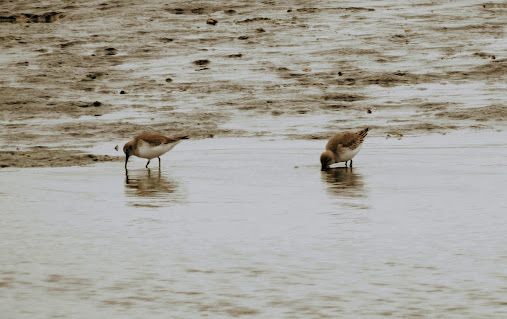
Dunlin feeding along the shoreline near the Ferry Terminal.


Close up of one of the Razorbills that swam by the Ferry Terminal.

Getting back into the car, we took a ride to the big car park to the south where I came across a large flock of Gulls feeding on grain someone had put down. Both Black-headed Gulls and Herring Gulls were present and a couple of juvenile Great Black-backed Gulls joined the birds also. Behind them, a small flock of finches perched on the perimeter fence including both Goldfinch and Greenfinch. I was pleased to see that there was hardly any rubbish around, for this place is a favourite area for fly-tipping. Large bins have been put out to discourage people from just dumping their rubbish. Let's hope it works.


One of the juvenile Great Black-backed Gulls flanked by Herring Gulls.


A male Pied Wagtail walking about the many puddles in the car park. 


Oystercatchers passing the Outfall.

Scruff and I took a walk along the Outfall and I managed to grab some more photos of the Razorbills before they disappeared, but I found at least two of them swimming / fishing close to a resting flock of Oystercatchers on the concrete spit. There were no signs of any Divers out on the sea and so I made my way back to the car and back home as the rain began to fall again. Earlier today, both a Black-throated and Great Northern Diver were seen in Chichester Harbour and an unusually large number of Gannets were fishing offshore in the Solent, roughly 62 in number.  


 The harbour entrance looking north from the Eastney Outfall.

Wednesday, December 22, 2021

A brief update and some sad news.

Wednesday 23rd December 2021.


This superb Red-necked Grebe was swimming off Pennington Marshes on the 19th December. Photo by Pete Appleton. 

This week so far leading up to Christmas has been a busy one which has taken me all over the place including Brighton and Peacehaven, in East Sussex today. There seems to be no let up with our work and with it, the temperatures are starting to get a lot colder. Today was no exception where it was only just above freezing with that horrible north-westerly wind blowing right through you.

Sightings this week have been few and far between with the only birds of note being several Common Buzzards along the A27 and the M275. A pair of Yellowhammers were seen in Woodingdean,  just outside Brighton and on such a cold day, they were most welcome. Yesterday, at The Oaks, a small flock of Redwing flew overhead and a female Sparrowhawk nearly took out a Magpie, but only just missed it as she flew off somewhat bemused, no doubt!

I received my quarterly magazine from the RSPB yesterday and I am somewhat not very pleased with it. With the power of free speech, I shall have my say on the issue:

  • It is virtually full of adverts trying to make us buy something from it with every other page of expensive clothing, optical equipment and holidays 
  • The topical subjects they like to discuss is, in my opinion, focuses on absolute novices in the birding world who know either nothing or very little of birding or birds themselves
  • One could flick through this magazine in roughly ten minutes, even the stories the public send in are so uninteresting, I wonder sometimes what the editorial team actually do.

I am a big fan of protecting our birds and wildlife, but something that is doomed on the other side of the world because of the disinterested  locals on the particular island trying to survive, really does not rock my boat. Yes, what goes on in the UK gets my attention, but to bleed their subscribers dry with very expensive goods, really gets my back up. I understand that the manufacturers pay the RSPB a huge amount of money to advertise in their magazines, but really, it is getting so utterly boring. Rant over.


This amazing photo of a Ringed Plover landing among the Sanderling at Hill Head would get my vote for one of the best photos of the year. It was taken at Hill Head by birding friend, Christine Whiffin. 

On a sad note, a birding friend of mine, John Goodall, sent me a text to say that Dave Compton had passed away earlier this year in January. Over the years, I met Dave many a time over Old Winchester Hill, when I was walking Scruff or birding in the area and never short of a word or two, we talked about our sightings of late on the reserve or in the local area. He told me that he suffered a Heart Attack some time ago and was told to keep fit by regular walking of which he would do at least two circuits of his beloved Old Winchester Hill. 

I can remember one such conversation with him when he told me about when the White-throated Sparrow turned up some years ago and the blatant disregard of a few ‘irresponsible birders’ Dave tackled. In fact, he was very shocked at the verbal abuse he took after asking them to keep to the footpaths and not tread on the plants that the butterflies laid their eggs on. After that nasty episode, he vowed to keep his rare sightings to himself or to a very select few and that included a Red-backed Shrike that spent some time there at the same location. I cannot blame him in doing this and would probably do the same if I was in his shoes. 

There is also a nice written piece about him by Lucy Hutchinson, writing for the Warnford press, which is a good read. Dave worked very closely with the local Police and reduced car crime within the car parks of Old Winchester Hill,  West Meon, Beacon Hill and Exton and was rewarded with the British Empire Medal, which was so thoroughly deserved. Dave will be missed and somewhat explains why I have not seen him this year. I have provided a link below should you wish to read a little more about him. 

    https://www.hugofox.com/community/warnford-village-7802/news/dave-compton-rip-44334#     


10 years ago to the very day, I was birding down Southsea Castle, enjoying the Purple Sandpipers again.

Saturday, December 18, 2021

A good Geese day at both Hill Head and Farlington Marshes.

Saturday 18th December 2021.


Looking over the Solent from the Chalets at Hill Head, where we found a nice variety of birds.  

Our destination this morning was to be Hill Head to view the sea duck on the Solent from the Chalets. There has been a nice variety of birds noted this week off here and though it was a grey overcast start to the day, I felt that something good could be lurking out there on the water. After paying the small car parking fee (yes, I have come to accept that sometimes you have to pay for your pleasure!).


Above, the two Slavonian Grebes in the Solent which were west of the Chalets  and below, some of the many Great Crested Grebes on the sea here. Both species remained quite distant.

A quick scan on a reasonably calm Solent revealed good numbers of Great Crested Grebes out on the water, though some distance out I might add. In fact, I had a final tally of this species of at least 52+ birds, though another birder counted at least 94 plus birds! Walking west to the far end of the Chalets, I got the scope out and began checking the sea. A flock of four Eiders flew west low over the sea, 2 drakes among them as they headed off west. I was pretty sure I picked them up again on the water a bit later on and was joined by at least two more.


A Common Buzzard drifted overhead while we were watching the wildfowl out on the Solent.  

I found yesterday's Velvet Scoters, though I could only find 5 of the 6 birds that were reported yesterday. Still, a good find nonetheless and better still, a drake Scaup was swimming among them! Having found one last weekend on Budds Farm, to find a drake here on the sea was most pleasing and totally unexpected. Slavonian Grebe was on the menu and with one here yesterday, I soon found the bird which was quickly joined by a second individual. They both joined up and eventually went their separate ways and fished among the many Great Crested Grebes present.


The Sanderling roosting on the beach at Hill Head.


These Ringed Plover joined the Sanderling near the roost on the beach.

A flock of Canada Geese swam on the water some distance out and a much larger flock of Brent Geese were also swimming on the sea, close to the shoreline. To round off the Geese here, I spotted a flock of four Egyptian Geese flying high over a red cliff along the shoreline, only to disappear inland and out of sight. It was going to be a very good day for Geese as the day wore on. A Common Buzzard flew low overhead and circled a few times before flying off inland. 


Oystercatcher and Lapwing on the small island on the River Meon.

A mixed flock of Lapwing, Oystercatcher, Lapwing, Black-tailed Godwit and Black-headed Gulls flying over the Reserve.

Walking back to the car, we decided to walk to the small seating area overlooking the River Meon and from here, we had good views of the wader and wildfowl by the small island. Lapwing, Oystercatchers and Turnstone showed well, as did a few pairs of Gadwall. A pair of Little Grebes were swimming on the River and a Water Rail, a species that has yet to climb onboard Andy’s yearlist, was calling in the reedbed in front of us, though no sightings today! Back on the beach, a special sign has been erected on the fence to keep people away from the roosting Sanderling on the beach and seeing it was high tide, the Sanderling were duly roosting on the beach some 100 yards away with a few Ringed Plover joining them.


Lapwings and Black-headed Gulls by the small island on the River Meon.


A flock of ten Long-tailed Tits were searching for food in the brambles by the viewing platform including this individual.   

Checking the Hampshire Birding website, a flock of 34 Russian White-fronted Geese was discovered in the North Fields of Farlington Marshes and as Andy had not seen this species yet this year, this was to be the next destination. Personally, I was hoping for yesterday's Barnacle Geese to tbe there and thankfully for both of us, both species were present and correct! After parking, we made our way along the back of the reserve to the Info Centre and then up to the Hay field to see if the White-fronts were there. They weren't, but I did find a lone Barnacle Goose feeding among the many Canada and Brent Geese present. My 203rd species of the year! Also among the Geese, were at least forty plus Curlew and now with the overhead cloud totally gone to reveal a clear blue sky and bright sunshine, the birds showed very well indeed. 


One of the Barnacle Geese in the Hay Field among many Canada and Brent Geese.


Though distant, the Russian White-fronted Geese (centre) were seen.  

We decided to walk up to the Blockhouse to view the Geese in the fields from there and we came up trumps when I spotted some ‘grey’ Geese near one of the pools out in the fields. Sure enough, I zoomed up on them with my camera and found at least a dozen of the Russian White-fronted Geese among the many Brent Geese. Our 5th species of Goose of the day and I have to say, I am not sure about seeing so many Geese on this reserve.


A lot of Curlew were feeding among the Geese.


A male Kestrel hunting over the fields.

I found at least 7 Great Crested Grebes out in the harbour looking east towards the islands as we had a pleasant walk around the perimeter of the reserve. The usual wildfowl were in the Deeps and out in the fields and a pair of Stonechats showed well with a Meadow Pipit by the small reedbed there. Another female Stonechat was found perched on brambles as we neared the Lake. On nearing the Lake, a flock of Avocet flew off and headed off towards the harbour to join the 11 birds I counted earlier out near the Eastern Road. 


This male Stonechat was by the Deeps.


A Meadow Pipit by the Deeps also, sharing the same bush as the Stonechats.

We parked ourselves up by the viewing platform and enjoyed the many waders and wildfowl present. At least 3 Common Snipe were found as well as a lone Dunlin flying in from the harbour. I gave the edge of the reedbeds a good search for Water Rail, but no diamonds there, unfortunately. A large flock of Black-tailed Godwit were joined by a similar number of Redshank on the north side of the Lake, all ready to take advantage of the ebbing tide. As we were leaving the reserve, it was sad to see several people letting their dogs off their leads, but it is not my place to reprimand them even if they do deserve it. There seems to be no Wardens on the reserve anymore, for when I was young, there was good old Dave Billet who would never tolerate any dogs off leads and also an army of Voluntary wardens as well! Times have most certainly changed.


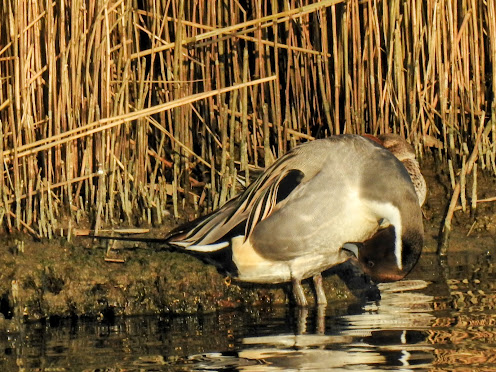
A drake Pintail preening itself by the Lake.


More Barnacle Geese out in the fields.


Great Spotted Woodpecker back at Pembroke Road.

Monday 16 th November 2026. Dawn over Highland Road Cemetery this morning when I walked the dogs. A cold morning as expected for this tim...